Last one

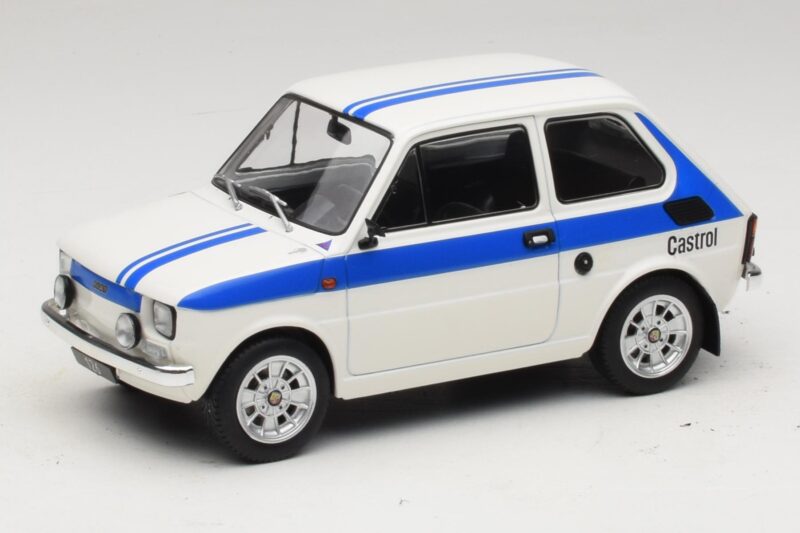
TL;DR: MCG's 1:18 diecast Fiat 126 reproduces a period Castrol competition livery in white and blue. The 1972 rear-engine microcar carries a sealed one-piece body with no opening panels, its compact proportions cast for small-class motorsport display, at a mid-tier diecast price point.
Small-class rallying and club racing gave plenty of budget-minded drivers their start, and the Fiat 126's light weight and simple mechanicals made it a natural fit for that world. MCG's 1:18 diecast wears a period-style Castrol livery in white and blue, reproducing that grassroots competition spirit as a sealed, compact casting.
The Fiat 126 carried over the rear-engine layout and minimal mass of its 500-series predecessor, a combination that made it inexpensive to run and, in period, a common sight in the lower classes of club rallying and circuit racing across Italy and beyond. Its simplicity, the same trait that made it an affordable daily car, also made it easy to maintain and modify on a limited budget, which is exactly what a grassroots competition entry needed.
Sponsor liveries like a Castrol scheme were common even at the small-class level, where a modest sponsorship deal might cover fuel and tires rather than a full works budget. That livery culture gave even a humble microcar the visual language of top-flight motorsport, sponsor decals and number panels included, scaled down to a car that cost a fraction of what a factory rally entry did.
This casting is a one-piece diecast shell, with no door, hood, or rear hatch built to open, a construction choice well suited to the 126's compact, simple shape, where the entire visual interest sits in the livery graphics rather than in styling flourishes. Getting the car's short wheelbase and boxy greenhouse proportions right matters more on a small subject like this, since there is less body surface to distract from an error in scale or stance.
A livery this dense, with number panels, sponsor logos, and racing stripes all competing for space on a genuinely small body, demands tighter tampo registration than a larger car's livery would, since there is simply less surface area to work with before graphics start to look cramped or misaligned. MCG's execution keeps the Castrol branding legible at this scale, a harder trick to pull off than it looks.
The white base and blue graphics follow a period-recognizable sponsor color scheme, one that would have marked this Fiat 126 out as a sponsored entry rather than a privately run car on any small-class grid it contested. On the diecast body, the white shows off crisp panel definition under a directed shelf light, while the blue graphics provide the visual anchor points, the roof, doors, and number panels, that carry the eye around the compact shape. Because the body is sealed, with no opening door or hood, the livery has to do all the visual work on its own, and a plain single-color 126 would look far less compelling on a shelf than this two-tone sponsor scheme does. The zinc alloy build gives the small casting real heft for its size, denser in the hand than its modest dimensions might suggest. For a subject this compact, that weight is a pleasant surprise rather than an expectation.
At 1:18, the Fiat 126 measures a modest length compared to nearly every other subject in this scale, closer to 17 or 18 centimeters than the 24 to 26 centimeters a typical sedan or sports car occupies. That smaller footprint means a shelf can hold several microcars in the space a single full-size model would need, making the 126 an efficient way to add motorsport variety to a display without sacrificing much room. The sealed body needs no special handling, and its light overall size makes it easy to reposition often, useful for a collector who likes to rotate liveries in and out of a front display row. For anyone drawn to grassroots motorsport history rather than factory works teams, a modest Castrol-liveried 126 like this one is a genuinely charming, easy piece to shop for.



You save 3.00 €
Lowest price in the 30 days before the reduction: 60.00 €
You save 3.00 €
Lowest price in the 30 days before the reduction: 60.00 €