Last one

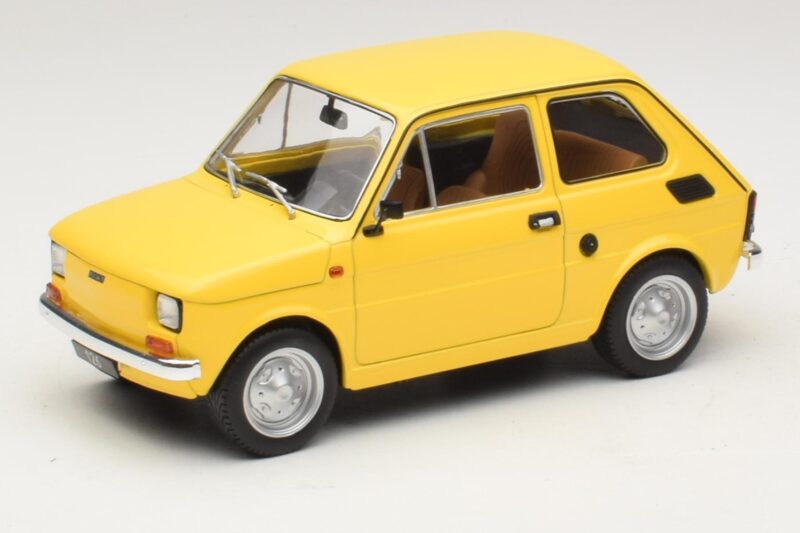
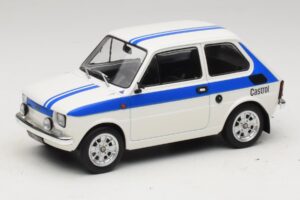
TL;DR: MCG's 1:18 diecast Fiat 126 reproduces the rear-engine Italian city car in yellow. This 1972 casting is built as a sealed one-piece body with no opening panels, its compact proportions capturing an economy car that put ownership within reach across two countries, at a mid-tier diecast price point.
Not every collectible subject needs a racing pedigree to earn a place on a shelf. The Fiat 126 spent nearly three decades putting car ownership within reach of ordinary families in Italy and Poland, and MCG's 1:18 diecast in yellow reproduces that unpretentious city car as a sealed, honestly proportioned little casting.
Fiat introduced the 126 in 1972 as a successor to the 500, built to carry forward the same mission of putting basic, affordable transportation within reach of buyers who could never justify a larger car. Production soon expanded to Poland, where the car, built and sold as the 126p, became one of the most common sights on Polish roads for decades and a genuine touchstone of everyday life under difficult economic conditions.
The rear-engine, rear-drive layout carried over from the 500 kept the mechanical package cheap to produce and simple to repair, priorities that mattered more to the 126's target buyer than performance or comfort ever did. That simplicity gave the car remarkable longevity in production, with the basic formula changing little across nearly thirty years on sale.
MCG casts the 126 as a one-piece diecast shell, with no door, hood, or hatch built to open, a construction well matched to a car whose entire appeal rests on its compact, uncomplicated shape rather than on any interior detail. The rear-engine layout gives the 126 a distinctive short front overhang and a slightly bulged rear deck, proportions that a lazier casting could easily round off into a generic small-car silhouette.
Getting the greenhouse-to-body ratio right is the detail that separates a convincing 126 from a vaguely similar microcar shape, since the car's boxy cabin sits proportionally large against its short overall length. MCG holds that ratio, and the diecast's zinc alloy weight gives even this small subject a satisfying heft that belies its modest dimensions.
Yellow sat among the cheerful, practical color options Fiat offered on the 126, a shade that suited a car meant to be seen as approachable rather than aspirational. On the diecast body, the color shows the metal's even gloss clearly under a directed light, and against a small canvas like this one, a bright, saturated finish does more visual work than it would on a larger, more detailed sports car. Chrome bumper and window trim provide the only real contrast against the yellow body, kept crisp enough by MCG to read clearly even at this compact scale. Because the body is sealed, with no opening door or hood, the exterior finish alone carries the model's entire presentation, and a plain, honest color like this one suits a plain, honest subject far better than an invented racing scheme would. Sometimes the simplest option is also the most appropriate one.
The Fiat 126 will never headline a collection built around performance or racing pedigree, and it was never meant to. Its value lies in honest representation of a genuinely important chapter in European motoring, the democratization of car ownership across two very different economies. At roughly 17 to 18 centimeters in 1:18, the 126 takes up a fraction of the shelf space a full-size sedan needs, making it an easy, low-commitment way to add variety to a display or to start a themed collection of small European economy cars. The sealed body requires no special care beyond what any diecast model needs, and its modest price point makes it a sensible piece to shop for when building breadth rather than chasing a single hero subject.




You save 3.00 €
Lowest price in the 30 days before the reduction: 60.00 €

You save 3.00 €
Lowest price in the 30 days before the reduction: 60.00 €