Last one

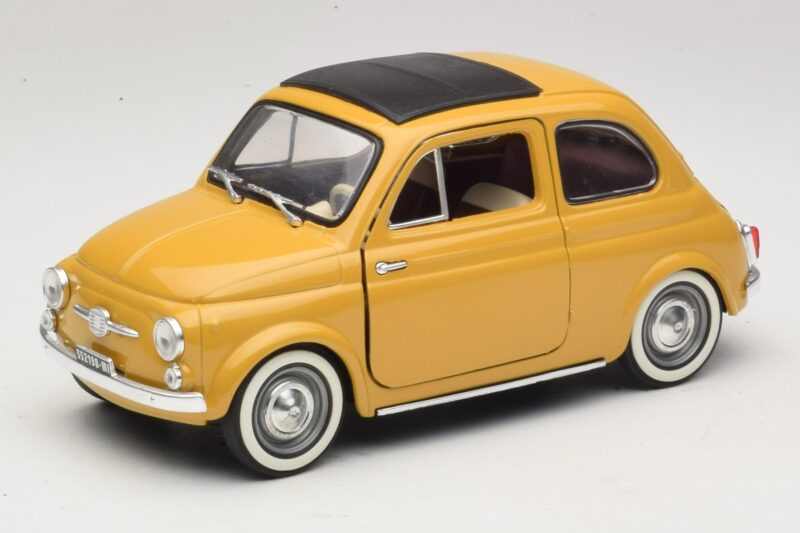
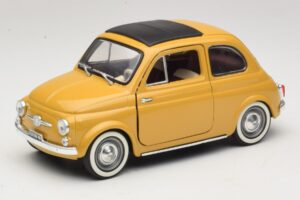
TL;DR: The Solido Fiat 500 1:18 is a diecast replica of the 1960 Fiat 500 city car in yellow. Metal construction gives it real weight, the body has opening parts, and the roughly 16.5 centimeter length keeps it compact on a shelf. It suits retro city car and Italian classic collections at an accessible price tier.
Few cars are as easy to love as the Fiat 500. Dante Giacosa's tiny Nuova arrived in 1957 as affordable transport for Italian families, and this Solido Fiat 500 1:18 in yellow brings the 1960 version to a display shelf. It is a cheerful, small subject at a generous scale, and that contrast is exactly its charm.
The Nuova 500 replaced the Topolino with something even smaller and cheaper. Giacosa packed seating for a small family into a body under three meters long, hung a compact air-cooled twin-cylinder engine at the rear, and kept mechanicals simple enough for ordinary owners to understand. That rear-engine layout explains the car's short, rounded nose and its upright, bubble-like cabin, two proportions a replica must get right before anything else counts. By 1960 the car was a fixture of Italian streets, and it has since become a shorthand for postwar Italian city life, which is why it sits so comfortably in a retro city car collection.
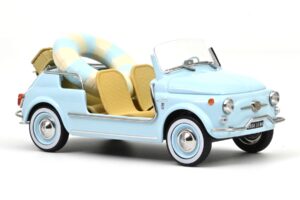
Start with the silhouette, because the 500 gives a model nowhere to hide. The roofline should curve in one soft arc, the windows should look tall and generous, and the body should sit on small wheels with a visible gap above the tires. Hold the model next to a reference photo and check the face: round headlights, a slim bumper, and a modest badge at the nose. Yellow is a bright shade that exposes every flaw in surface finish, so it works as a fair test of casting and paint quality at a glance. Under a lamp, the gloss should look even rather than patchy.
Lifting the Solido from its packaging, the first thing you register is density. Diecast means a pressure-cast metal body, and even at this compact size it carries a satisfying heft that lighter resin pieces do not. That heft also keeps a small car planted on a shelf that gets bumped. Metal also tolerates handling well, and a hard shell gives paint a stable base, so the gloss tends to look deep and even. The trade-off is tolerance: cast metal and assembled parts usually leave slightly wider seams than a one-piece resin casting can hold, so expect visible but orderly panel lines rather than razor-thin ones.
This model has opening parts, which changes how you can display and inspect it. Collectors who like to show a model in more than one state get a genuine second pose from a piece that articulates, and the movement is worth testing gently when the box first opens. Open panels should swing freely without binding, and they should close back flush with the surrounding body. Treat them with a light touch, since repeated forcing wears any hinged part on any scale. Between displays, leave them closed so the shut lines stay clean and the finish stays protected.
At 1:18, the Fiat 500's real length of just under three meters scales to about 16.5 centimeters. That is a small body even by 1:18 standards, and the size difference is the point. Next to a 1:18 sports car or sedan, it looks like what it was, a tiny car among larger ones. A 1:43 version would save space, but it could not carry the same visible detail in the grille, lights and trim, nor the same weight in the hand.
Placement matters. Keep the model out of direct sunlight, which fades paint and dulls clear coat over the years. A glass cabinet or acrylic case keeps dust off, and soft directional lighting from above brings out the gloss without glare. Dust with a soft brush, never a dry cloth rubbed across the paint, which leaves fine swirl marks. Keep it away from heat sources, since warm shelves above lamps or radiators can soften adhesives over time.
Pairing is where the small size pays off. A yellow 500 gives a themed shelf a bright color anchor, and it pairs naturally with other Italian classics or a row of retro city cars from the 1950s and 1960s. Because the subject was an everyday car rather than an exotic, it also reads well beside period-correct accessories and dioramas.
Solido sits in the accessible part of the 1:18 market, so expectations should match: a solid metal body with opening parts and sensible detail, rather than the finest trim found at premium tiers. For many buyers that is the right trade. A first 1:18 purchase, a gift for someone who remembers riding in a 500, or an inexpensive way to start an Italian city car theme all make sense here.
Anyone ready to buy should check three things before ordering: the stance, the paint finish and the way the opening parts move. If those three look right, the rest is a matter of taste. Shoppers weighing a 1:43 alternative should remember that the larger scale shows more of the grille, lights and trim, which is what makes a tiny car feel substantial. It is a charming piece of automotive history at a price that rewards enthusiasm over deep pockets, and it should look right on a shelf for years.


You save 3.00 €
Lowest price in the 30 days before the reduction: 60.00 €
You save 3.00 €
Lowest price in the 30 days before the reduction: 60.00 €