Used
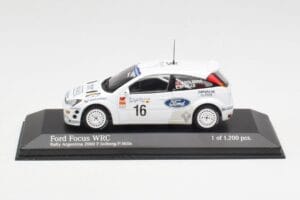
Ford Focus RS WRC #4 R. Kresta / J. Tomanek Rally Monte Carlo 2005 Minichamps 1:43
Only 2 left
Price:
103.00 €
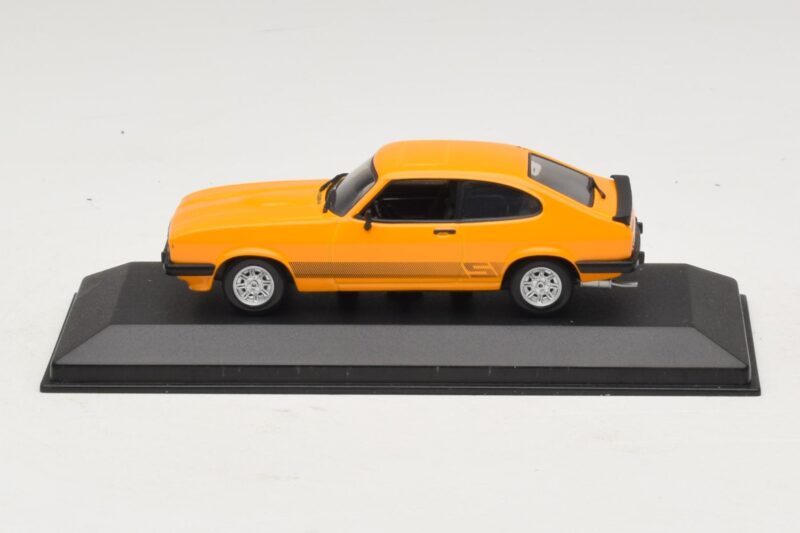
TL;DR: Minichamps' 1:43 diecast Ford Capri II reproduces the 1974 facelifted coupe in Signal Orange, a sealed one-piece casting with crisp shut lines, correct fastback proportions, and period trim. Europe's answer to the American pony car, scaled down in one of its boldest factory colors.
Ford sold the original Capri on one memorable line, the car you always promised yourself, positioning it as Europe's homegrown answer to the American pony car formula. The Capri II, introduced for 1974, softened the original's sharper lines and added a practical hatchback rear, and Minichamps renders it here in a color as confident as the marketing ever was.
When Ford launched the Capri in 1969, the pitch was deliberately aspirational: a genuinely sporty-looking coupe, long hood and short deck in the American pony-car tradition, priced within reach of buyers who would never afford a Mustang or a genuine European GT. It worked well enough that the Capri became one of Ford of Europe's defining successes through the 1970s. The Capri II, arriving for the 1974 model year, kept that basic recipe but addressed the original's practicality gaps, most visibly by replacing the old trunk with a proper hatchback, softening the roofline and rear glass area in the process. It was less radical than a redesign and more a considered refinement of a formula that already worked.
The 1970s were not a subtle decade for factory colors, and the Capri range leaned into that as much as any car of its era, offering bright oranges, yellows, and greens alongside its more conservative options. Signal Orange sits firmly in that bold camp, and Minichamps reproduces it with an even, properly saturated coat that holds its intensity across the hood, doors, and hatchback panel rather than looking washed out under shelf lighting. Against a row of more subdued 1970s coupes, this Capri announces itself the moment it goes on display.
The casting is a sealed, one-piece body, hood, doors, and hatchback molded into the shell rather than hinged, and that construction lets Minichamps hold tight, consistent shut lines along the long hood and around the compact hatchback opening, lines that stay level rather than widening toward one corner. The Capri II's proportions come through accurately: the extended hood, the low fastback roofline, and the wide C-pillar that gave this generation its distinctive rear three-quarter view are all captured without exaggeration. It reads immediately as a Capri rather than a generic 1970s coupe silhouette.
Zinc alloy gives the model real weight for its size, the kind of mass that signals genuine metal construction rather than a lightweight toy casting, and that density holds the body's shape reliably through years of display. Chrome trim around the grille and windows is cleanly separated from the orange paint rather than bleeding into it, the round headlamps and simple grille bar are sharply defined, and through the glazing the cabin shows a mapped dashboard and bucket-style front seats. That combination of weight and cabin detail is what separates a genuinely collectible Capri from a budget toy-aisle casting.
This Capri II works as a genuine color anchor on a shelf built around 1970s European coupes, the kind of piece that breaks up a row of silver and black with a color period buyers actually chose. It also pairs naturally with earlier Capri Mk1 models for anyone tracing the range's evolution from 1969 through the II's practicality-focused update. At 1:43, a full Capri generation fits into a modest footprint, and the accessible price point of this tier makes chasing several colors across the range a realistic project rather than an expensive one. For collectors drawn to the marketing promise as much as the car itself, this is the Capri that delivered on it.