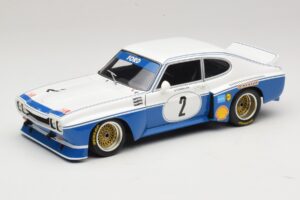
Last one

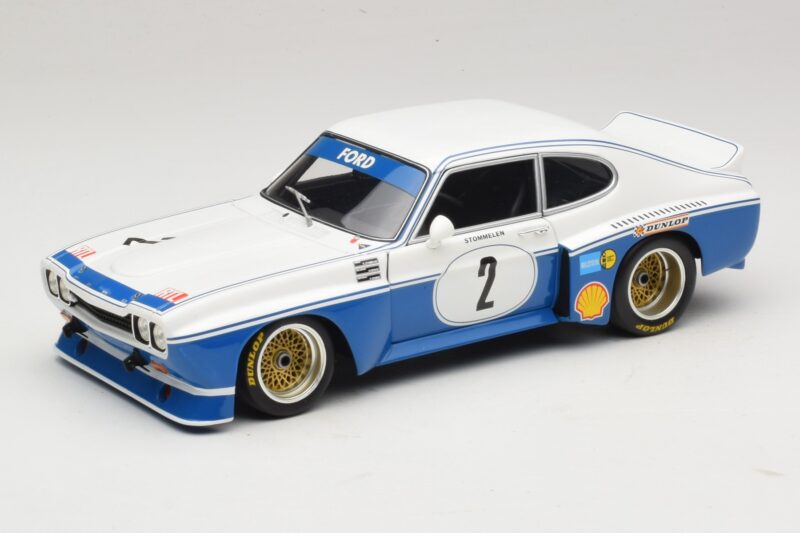
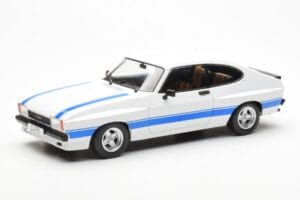
TL;DR: Minichamps' 1:18 diecast Ford Capri RS3100 recreates Rolf Stommelen's #2 car from the 1974 European Touring Car Championship at the Nürburgring, with doors and hood that open onto the racing cockpit. The homologation-special bodywork, widened and big-bumpered, carries the exact livery that made this Capri a works contender.
Ford built the RS3100 to legalize a wider, more aggressive Capri body for Group 2 racing, and the car's oversized rear spoiler and flared arches still look purposeful decades later. Stommelen's #2 entry carried that homologation special through the 1974 European Touring Car Championship, a season fought directly against BMW's CSL coupes on circuits across the continent.
Open the doors on this Capri and the fittings inside are stripped for competition: a roll bar, a bare dash, none of the trim a road-going RS3100 carried. The hood lifts to show an engine bay built for a race-tuned V6 rather than a showroom block, which is the real point of a model built around opening panels. On a sealed-body diecast, that detail would stay hidden behind glazing; here it's available to anyone who wants to look past the livery and into the mechanical story the bodywork only hints at.
The zinc alloy construction carries enough weight to feel substantial when it clears the packaging, and that density is also what lets the door and hood hinges hold their position through repeated handling without loosening. Minichamps built its name on exactly this kind of race-liveried diecast, where the sponsor decals and racing number need sharp edges to read correctly at 1:18. Panel gaps run a touch wider than a resin casting would allow, which is the usual trade diecast construction makes for the strength that keeps moving panels functional for years rather than fragile.
Group 2 touring car rules in the early 1970s let manufacturers widen arches and add aerodynamic addenda as long as a minimum number of road cars were sold with the same parts, and Ford built the RS3100 specifically to clear that bar. The big rear bumper, flared wheel arches, and distinctive spoiler weren't styling choices so much as homologation necessities, a wide body built to legally carry wider tires and more downforce on circuits that rewarded both.
Rolf Stommelen's #2 car ran that homologation special through the 1974 European Touring Car Championship, a season defined by Ford's rivalry with BMW's 3.0 CSL coupes, cars nicknamed the Batmobiles for their own aerodynamic excess. The Nürburgring, with its mix of long straights and demanding corners, suited the Capri's power advantage and made races there some of the era's closest. This model's livery and racing number reproduce that specific entry rather than a generic RS3100 scheme, which is the detail that separates it from a road-going Capri wearing similar colors.
A Capri RS3100 like this one sits naturally alongside period BMW CSL models on a shelf built around 1970s European touring car racing, since the two cars defined each other's competition on track. At 1:18, the widened bodywork gives the Capri noticeably more shelf footprint than a standard road car in the same scale, worth accounting for when planning cabinet space. The opening doors and hood reward a collector who wants to inspect the cockpit, not just admire the livery from a distance, and that hands-on access is the clearest reason to choose this over a sealed-body alternative of the same subject.