Last one

This model is currently sold out. Enter your email and we'll let you know when it's back in stock.
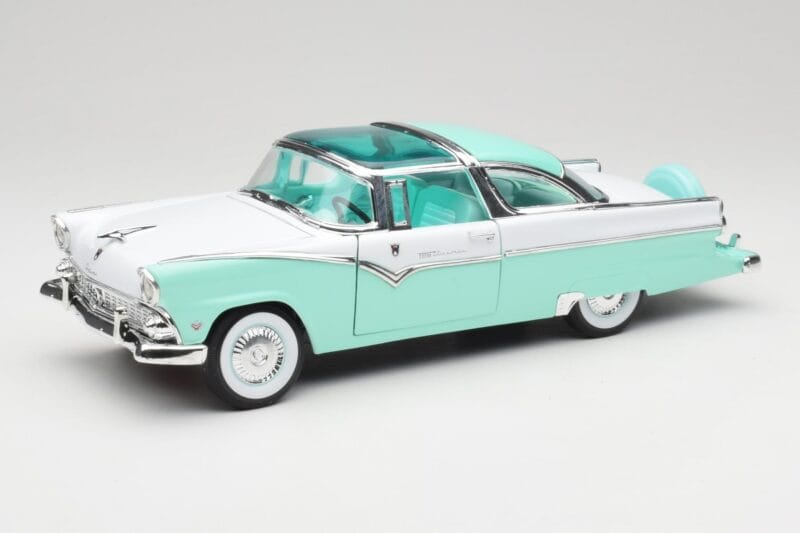
TL;DR: Road Legends' 1:18 diecast Ford Crown Victoria wears Seafoam Green and White, reproducing the 1955 model's signature tiara roof band and chrome trim. Entry-to-mid tier diecast, built for collectors assembling a 1950s American sedan shelf rather than a single showpiece.
Ford built the Crown Victoria as its styling flagship for 1955, and this diecast leans on that two-tone showiness rather than mechanical detail.
The zinc alloy body carries real weight, and that density helps sell the Crown Victoria's substantial, wide-bodied stance at 1:18. The signature tiara band across the roofline, a stainless steel strip that gave the car its distinctive look and optional glass-panel roof variant, is picked out cleanly in the two-tone Seafoam Green and White scheme here. Chrome trim around the grille and wheel arches reads with good reflectivity under direct light, appropriate for a car whose whole design language leaned on brightwork. Panel gaps sit at a level typical for this tier, tighter than budget diecast but without the razor edges a resin casting would show. Opening doors are standard for the format, and the cabin bench seating is simplified but recognizably period-correct.
The Crown Victoria sits above Ford's regular Fairlane lineup in the mid-1950s hierarchy, and a Seafoam Green and White example represents one of the more common but still visually striking factory color combinations from that period. At 1:18, its footprint runs larger than European sedans of the same era, so it commands real shelf presence when grouped with other American classics. This is a car built for cruising and showing off rather than racing, and the model follows that lead: no motorsport pretension, just chrome, two-tone paint, and postwar optimism rendered at a price that lets a collector build a full 1950s American row without hero-piece spending.