Used
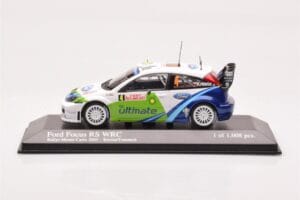
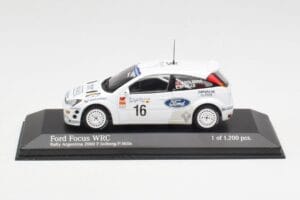
Ford Focus RS WRC #4 R. Kresta / J. Tomanek Rally Monte Carlo 2005 Minichamps 1:43
Only 2 left
Price:
103.00 €
This model is currently sold out. Enter your email and we'll let you know when it's back in stock.
TL;DR: Minichamps' 1:43 diecast Ford Escort 1600 Sport Mk2 reproduces the 1975 coupe in Orange as a sealed one-piece body with crisp shut lines and period-correct trim. The sportier coupe sibling to the everyday Escort sedan, scaled down for a compact 1970s Ford display.
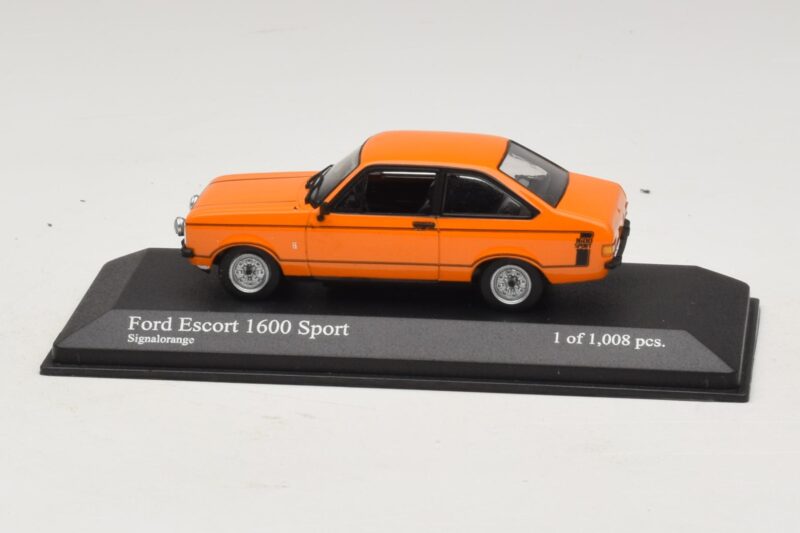
Ford badged certain Escort Mk2s 'Sport' to signal a step above the plain sedan without reaching all the way to the RS models chasing rally titles, and the 1600 Sport coupe sat right at that middle ground. This 1:43 replica in Orange, a genuinely period-correct hot color for the mid-1970s, captures that sportier two-door body Ford aimed at drivers wanting more character than the basic car offered.
The Escort Mk2 range ran from a strictly practical base sedan up to homologated rally weapons like the RS1800, and the 1600 Sport occupied the space in between: a two-door coupe body, the larger 1.6-liter engine, and sportier trim details without the flared arches or the price of a genuine RS. Ford aimed this version squarely at drivers who wanted their everyday Escort to look and feel quicker than the neighbor's sedan, even if the mechanical specification stayed close to the rest of the range. That accessible-sporty positioning is exactly why the 1600 Sport still has a following distinct from either the plain sedan or the serious rally replicas.
The coupe body drops the sedan's rear doors and pulls the roofline down slightly, giving the Mk2's already sharp 'Coke bottle' styling a leaner, more purposeful stance. Orange was a genuinely common color choice on sportier European cars of this exact period, and it plays well against the coupe's simpler two-door glasshouse and modest brightwork. At 1:43 that means fewer chrome details to resolve than on some contemporaries, but it also means the model has to get the coupe's specific roofline taper and shortened rear quarter panel correct, since there is little decoration to distract from the underlying shape.
As with nearly every 1:43 model, opening features are impractical at this size, so Minichamps casts the 1600 Sport as a single sealed shell rather than one with separately hinged doors. That construction keeps the coupe's shut lines thin and even along both the door edges and the trunk lid, which matters more on a coupe than a sedan because the proportions are more visible without extra doors breaking up the side profile. The zinc-alloy body carries real weight in the hand, distinguishing it immediately from lighter toy-grade Escort castings sold at a lower price point.
Judging this casting against the plain sedan version means checking a short list of specific details: the Sport's distinct wheel style, any exterior badging that marks the trim, and the slightly different bumper or grille treatment Ford applied to sportier Mk2s. Minichamps' small-scale work lives or dies on exactly these fine distinctions rather than dramatic bodywork, since the 1600 Sport and the base sedan share most of their basic shape. Getting the trim-specific details right is what actually separates a well-researched coupe casting from a sedan simply painted a different color.
The 1600 Sport works best displayed alongside the plainer Escort sedan and the later FWD Mk3 hatchback, showing how far Ford's small car moved across a single decade without ever losing its everyday, attainable character. At 1:43, that three-car span fits into roughly the cabinet space a single 1:18 model would occupy, making a genuine range comparison practical rather than aspirational. For a collector drawn to 1970s European hot coupes without committing to the price of a genuine RS replica, this is the honest, accessible way to own that sportier side of the Mk2 story, correctly proportioned and finished in a color the era actually wore.