Used

Ford Focus RS WRC #4 R. Kresta / J. Tomanek Rally Monte Carlo 2005 Minichamps 1:43
Only 2 left
Price:
103.00 €
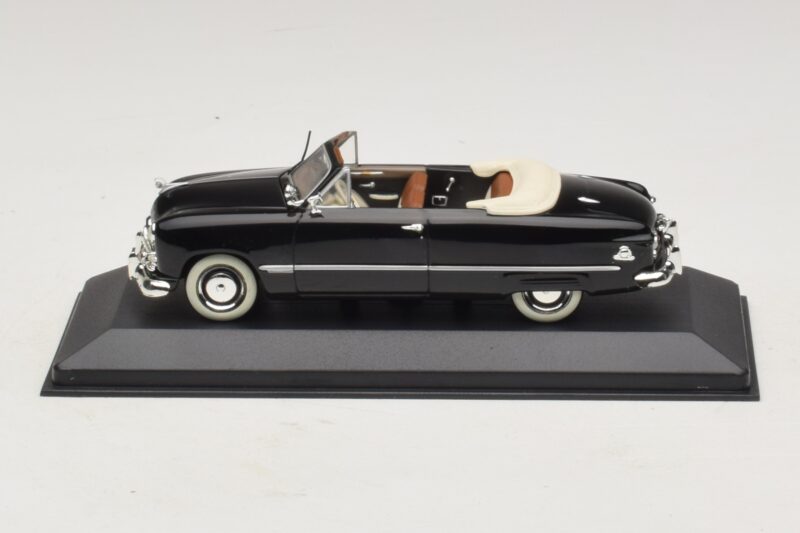
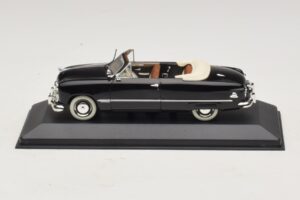
TL;DR: Minichamps' 1:43 diecast Ford FL Cabriolet reproduces the 1949 open-top in black, as a sealed one-piece body with crisp shutlines and softly rounded postwar styling, cataloged among Minichamps' vintage European-era Ford lineup.
The late 1940s were a transition point for automakers returning to civilian production after years of wartime manufacturing, and the rounded, flowing fenders that replaced prewar angularity became the era's defining visual signature almost overnight. Minichamps' Ford FL Cabriolet captures that moment in a quiet, open-top body rather than a flagship model, which is exactly where its appeal lies.
Postwar styling leaned heavily on continuous, flowing surfaces, fenders that merged into running boards, hoods that curved rather than creased, and a one-piece casting suits that language particularly well. With no doors or hood set to open, Minichamps holds the Cabriolet's rounded nose and sweeping fender line as a single unbroken surface, and the shutlines that do appear, around the trunk and the folded convertible top, stay tight and consistent because there is no hinge tolerance for the tooling to work around. At 1:43, that precision matters more than it would at a larger scale, since there is simply less surface for the eye to forgive imperfect lines.
Black was a common, practical choice for late-1940s cars, and Minichamps' finish carries real depth across the Cabriolet's rounded body despite the compact scale, catching light along the fender curves rather than looking flat. Modest chrome trim around the grille and headlamps reads cleanly without overwhelming the paintwork, a restrained approach that suits a car built for quiet postwar motoring rather than flashy display. The folded soft-top detail at the rear is cast with enough definition to read correctly as a cabriolet rather than a closed sedan wearing a different badge, a small but important distinction at this scale.
Automakers across Europe and America spent the years immediately following the war retooling factories that had shifted to military production, and when civilian models returned, most carried the rounded, pontoon-style fenders that defined the era's design language. Open-top cabriolet variants offered buyers a more personal, less utilitarian alternative to standard sedans during this period, appealing to customers looking for genuine open-air motoring rather than pure practicality. The FL Cabriolet reflects that broader transitional moment in automotive design, a car built at the hinge point between prewar styling conventions and the more sculpted shapes that would follow through the 1950s.
Minichamps has built a long-standing reputation for 1:43 vintage subjects handled with genuine attention to chrome, glazing, and trim proportion, qualities that matter disproportionately on a car this understated. A subject like the FL Cabriolet would rarely justify a premium 1:18 tooling investment given its modest commercial profile today, but at 1:43 it fits naturally into a broader shelf of postwar European and American classics. For collectors drawn to the quieter corners of automotive history rather than only its headline cars, that specialization is exactly the draw.
Black gives this casting a dignified, period-correct presence next to the brighter two-tone finishes more commonly seen on later 1950s diecast. At 1:43, the Cabriolet's compact footprint makes it easy to group with several other postwar classics without demanding much shelf width, building depth into a collection rather than a single statement piece. Judge fidelity first at the fender line and the folded top detail, the features most likely to separate a careful vintage casting from a generic one. Pair it with other late-1940s and early-1950s models to trace design moving from prewar angularity to rounded postwar shapes.