Last one

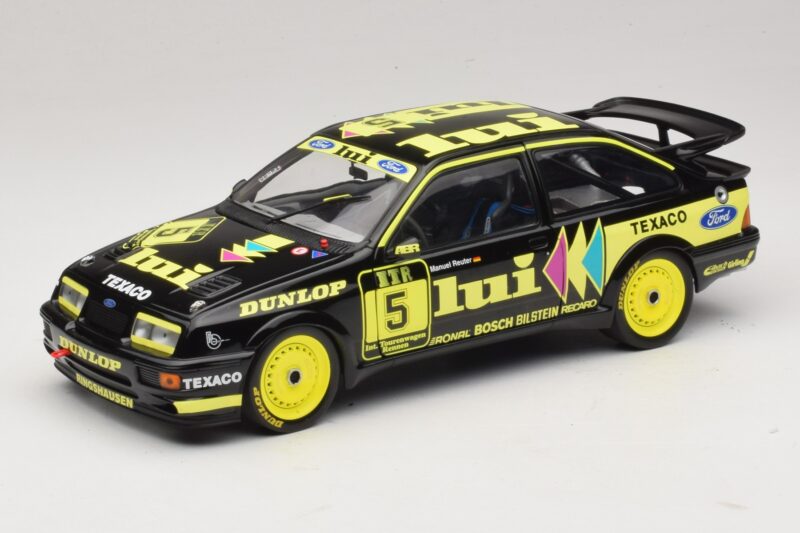
TL;DR: Minichamps' 1:18 Ford Sierra RS500 reproduces Manuel Reuter's number 5 car from the 1988 DTM season, hood hinged open over the Cosworth YB turbo engine behind the Sierra's signature whale-tail wing. This diecast captures the car widely credited with rewriting Group A touring car racing.
By 1988 the Sierra RS500 had become the car every rival Group A team feared, and Manuel Reuter's DTM entry shows exactly why. Minichamps renders the livery in diecast, hood hinged open over the Cosworth YB turbo engine that made this Sierra the benchmark touring car of its era.
Reuter's number 5 livery carries clean sponsor registration across the Sierra's distinctive bodywork, with the oversized whale-tail rear wing and front splitter that defined the RS500's homologation-special silhouette reproduced in sharp, separately molded detail. Minichamps keeps panel gaps tight around the doors and hood despite the car's aggressive wide-arch bodywork, and the wheels carry the correct period-appropriate design and offset that filled those flared arches on the real car. Window surrounds and roll cage bars are picked out where visible through the glazing, adding depth beyond a flat decal treatment.
Lifting the hood exposes the turbocharged Cosworth YB engine, the powerplant that turned the Sierra from a competent touring car into a genuinely dominant one once Group A tuners extracted its full potential. Intercooler piping and a reinforced bay structure are modeled with enough clarity to read clearly at this scale, and the opening hood mechanism holds position cleanly without disturbing the surrounding bodywork's shut lines. Diecast construction gives the model real weight once out of its tray, appropriate heft for a touring car built around genuine mechanical aggression.
Manuel Reuter was establishing himself through DTM competition during this period before going on to a career that eventually included overall victory at Le Mans, and his Sierra RS500 outings form part of that broader development as a touring and sports car driver. Driving one of the most capable Group A cars available in 1988 gave Reuter a genuine shot at results against the era's deepest touring car grid, a formative chapter before his later endurance racing success.
Ford homologated the RS500 specifically to legalize the wider turbo, bigger intercooler, and additional aerodynamic aids that tuners needed to make the Sierra dominant, and the formula worked almost too well. Through 1987 and 1988 the RS500 won touring car races across multiple national championships and international events, forcing rule changes that eventually reined in its advantage. Few homologation specials in touring car history achieved such immediate and overwhelming success before regulators intervened.
A Sierra RS500 this well documented pairs naturally with other Group A touring cars from the same era, forming the basis of a late-1980s touring car display built around the period's genuine giant-killers. Its whale-tail silhouette makes it instantly recognizable even from across a room, useful for a collection meant to draw attention rather than reward only close inspection. At 1:18 the wide-arch bodywork gives it noticeably more footprint than a standard road Sierra, worth factoring into shelf planning. Collectors comparing Sierra RS500 liveries should weigh Reuter's 1988 DTM season as a genuine high point of the car's competitive history.