Used
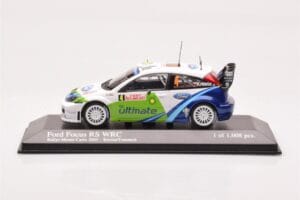
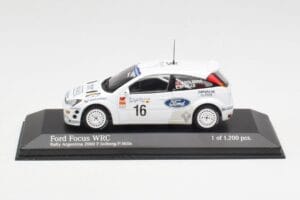
Ford Focus RS WRC #4 R. Kresta / J. Tomanek Rally Monte Carlo 2005 Minichamps 1:43
Only 2 left
Price:
103.00 €
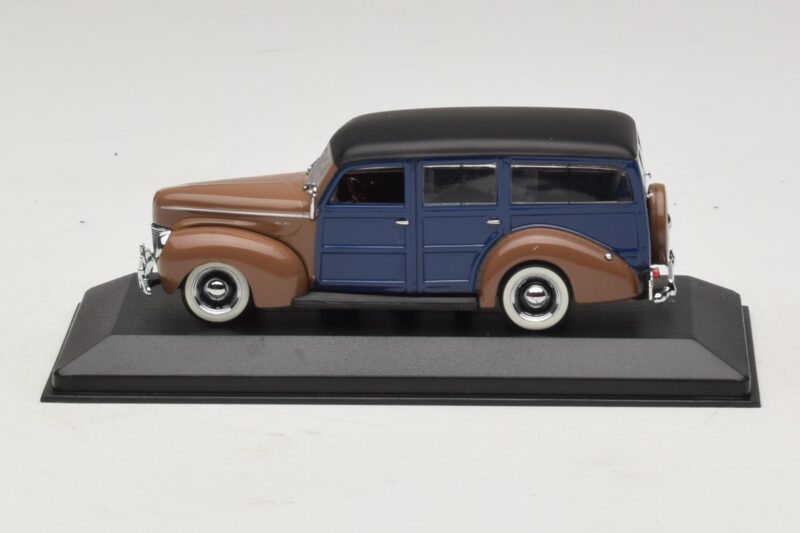
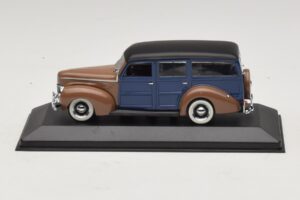
TL;DR: Minichamps' 1:43 diecast Ford V8 De Luxe Woody Wagon reproduces the 1940 original in brown and blue, a sealed one-piece casting with correct wood-paneled wagon proportions, crisp shut lines, and period trim. The pre-war wagon that later became the unlikely foundation of California surf culture's woody image.
Ford's own sawmill in Michigan supplied the actual wood used in its wagon bodies through the late 1930s into the 1940s, making the V8 De Luxe wagon a genuinely wood-built vehicle rather than a styling exercise. Decades later, aging examples of exactly this wagon became California beach culture's surfboard-hauling icon, an afterlife nobody at Ford could have predicted in 1940.
Ford's approach to the wood-bodied wagon was unusually vertically integrated: the company owned forest land and a sawmill operation in Michigan's Upper Peninsula, and lumber from those operations supplied the actual structural wood used in wagon bodies like this one, not a veneer applied over a steel shell for effect. The V8 De Luxe wagon, part of Ford's 1940 model-year lineup, used that wood construction for load-bearing structural framing as much as for appearance, which is part of why original examples required careful maintenance and why so few genuinely original wagons survive in good condition today. The wood was functional first, decorative second.
Nobody building this wagon in 1940 was thinking about surfboards, but by the 1950s and 1960s, aging wood-bodied Fords like this one had become cheap, spacious, readily available transportation for a growing California surf culture that needed something with room for boards and a roof rack. That adoption transformed the woody wagon from a practical pre-war family vehicle into a cultural symbol almost entirely disconnected from its original purpose. The wagon this model reproduces sits right at the origin point of that later legend, several years before anyone thought to load a surfboard into one.
This casting is a sealed, one-piece body, doors and tailgate molded shut rather than hinged, and that construction actually helps sell the wood-panel illusion: with no articulated seams competing for attention, the printed or painted wood-grain paneling along the flanks reads as a continuous, believable surface rather than being interrupted by a visible door gap. The brown wood-effect panels and blue-painted steel sections are cleanly separated, with sharp, consistent boundaries between the two finishes rather than any bleed or overlap. Getting that two-material look convincing in miniature is a harder job than a single-color body, and this casting handles it well.
Zinc alloy gives the model real heft, weight that holds the casting's shape and paneling detail reliably over years of display, and the wagon's proportions, the long, tall roofline and the practical rear cargo area, come through accurately rather than compressed to fit a generic sedan-based mold. Chrome trim around the grille and headlamps is sharply defined against the body colors, and through the glazing the cabin shows bench-style seating consistent with the wagon's family-hauling role. Few other body styles from this era demand as much attention to material contrast as a genuine woody wagon does.
This wagon stands out on a shelf of standard pre-war sedans and coupes simply through its body style and its two-tone wood-and-steel construction, a genuinely different silhouette from the coupes and sedans that usually fill a 1940s Ford lineup. It pairs naturally with later, more overtly beach-culture-styled woody wagons for collectors tracing that visual evolution across the decades, or sits comfortably in a straightforward pre-war American collection on its own merits. At 1:43, its longer wagon body still fits a standard display footprint, and its accessible price makes it an easy, distinctive addition. For anyone building a themed run of American wagons across decades, this is the honest starting point.