Last one
Used

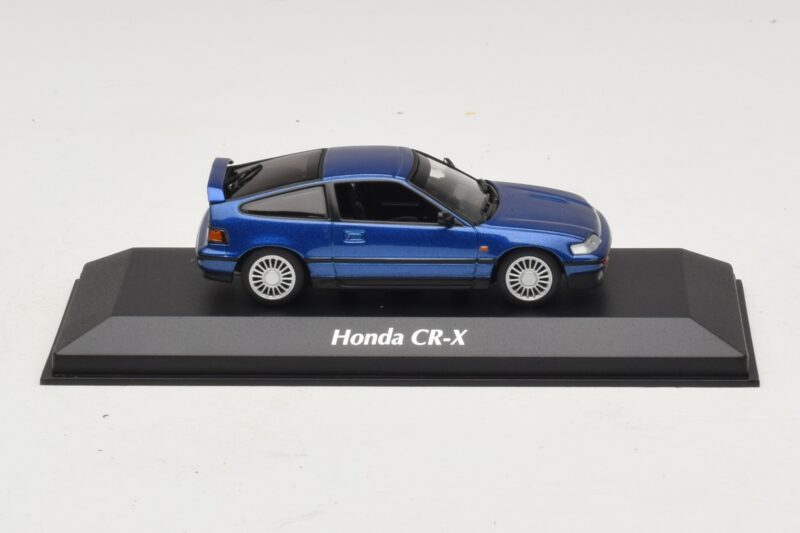
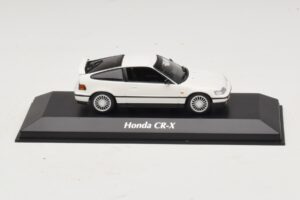
TL;DR: The Maxichamps Honda CR-X 1:43 in Blue Metallic is a diecast replica of the 1989 Japanese compact sports coupe, cast as a sealed one-piece body. About 9 cm long, it captures a short, wedge-shaped silhouette where stance, glass and metallic paint do the work.
Honda's CR-X proved that a sports car did not have to be large, loud or expensive to be fun. It was short, light and sharply drawn, and the Blue Metallic finish on this 1:43 casting shows off the cut of that body, from the low nose to the abruptly truncated tail.
Metallic paint at 1:43 is a balancing act. Flake that is too coarse looks like glitter on a toy; flake that is too fine reads as flat color. A good finish catches the light along the hood and roof in a soft, even shimmer, and a rigid zinc alloy body helps because the large panels stay flat and the gloss sits deep. Turn the model under a lamp and watch the highlight travel across the shoulder line: it should glide without breaking up. That is the quickest way to judge the paint on a sealed casting.
The second-generation CR-X is defined by its profile: a low, sloping hood, a compact cabin and a rear that ends abruptly in a steeply cut tail with a large glass hatch. Because nothing on this model opens, the body reads as one continuous form, and the roof, rear glass and tail panel meet without hinge-driven gaps. Look for glazing that sits flush and a crisp edge where the roofline drops to the tail. At roughly 9 cm, the whole shape fits in the palm, and the weight of the metal is the first sign this is more than a toy.
The second-generation CR-X kept its mass low, drove the front wheels and used double-wishbone suspension at both ends, which is unusual for a car this small and a big part of why it handled with such precision. It belongs to the era when Japanese manufacturers turned small, affordable coupes into genuine driver's cars, and that story is why the CR-X has stayed a favorite with enthusiasts long after production ended.
In the United States Honda sold the car as the CRX, without the hyphen, while the Japanese market name keeps it. This model sits in the JDM Sports class, and for American buyers it is a nostalgia piece from the years when compact imports filled school parking lots and tuner culture was taking shape. That generational recognition is a real part of its appeal on a display.
Placed beside larger European sports cars, the CR-X makes an argument about lightness. A themed row of 1980s Japanese coupes in 1:43 can run a dozen cars long in a single cabinet, and the blue metallic finish gives this one a cool tone against warmer reds and silvers. Be honest about the format: a sealed diecast gives you the exterior only, so judge the stance, the glass and the paint, since those carry the entire model. Keep it dust-free with a soft brush and out of long direct sunlight. Hobbyists who prefer to order compact JDM cars for a small display will find this an easy addition.