Used

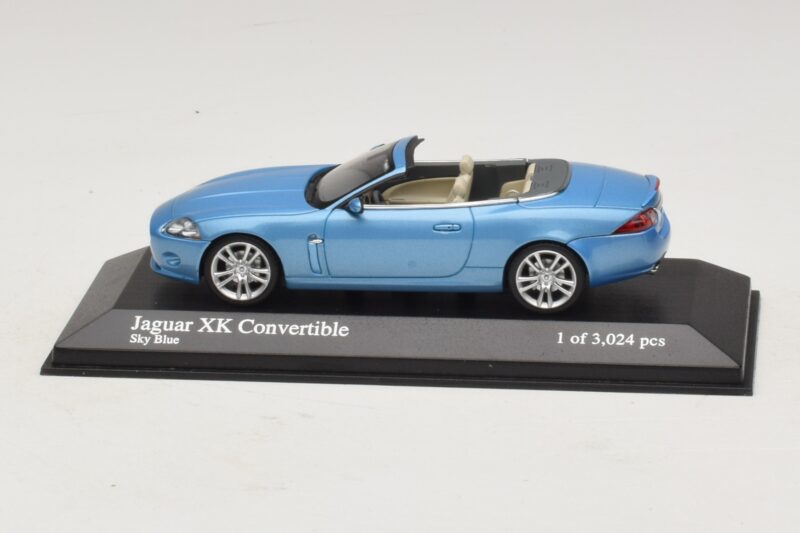
TL;DR: Minichamps' 1:43 diecast Jaguar XK X150 convertible in light blue metallic reproduces the 2006 grand tourer that replaced the XK8 under Ian Callum's styling direction. The casting is a sealed one-piece body with the soft top modeled closed, so the convertible's low beltline and long hood carry the design on their own.
Jaguar's X150-generation XK arrived in 2006 as a clean break from its predecessor, built on an aluminum platform and styled under Ian Callum with none of the XK8's softer curves. This convertible version strips away the roof entirely, leaving the car's proportions, long hood, short rear deck, low beltline, with nothing to hide behind.
Minichamps builds this XK as a single sealed casting, with the soft top modeled in its raised, closed position rather than tooled to open or fold. That is the practical choice for a 1:43 convertible: reproducing a functioning fabric top mechanism at this scale adds complexity without adding much visual payoff, so the model's case rests instead on getting the body's proportions and surface correct. The X150's long hood and short, tight rear deck are the hardest lines to get right on a GT convertible, since too much length in the wrong place throws off the car's entire stance, and Minichamps holds that balance well, with the beltline running low and level from the front fender through the door.
Light blue metallic is a flattering choice for this shape. The XK's bodywork relies on a handful of long, unbroken surfaces rather than sharp creases, and a lighter metallic paint lets those surfaces catch graduated light across their length rather than reading as flat panels. Zinc alloy diecast holds that smooth surfacing well, since the casting process does not introduce the small waviness a stamped sheet-metal panel can show, and the model's weight in the hand signals the same metal-shell construction the real aluminum-bodied Jaguar used, even though the materials themselves differ.
Chrome detailing around the grille and window surrounds stays crisp against the body color, which matters more on a convertible than a coupe since there is no roofline to break up the view of the car's flanks.
Jaguar launched the X150 XK in 2006 as a replacement for the outgoing XK8, and the change was more than cosmetic. The new car rode on a bonded and riveted aluminum platform shared in spirit with the contemporary XJ sedan, a construction method that cut weight significantly compared to the steel-bodied car it replaced, and gave Jaguar's engineers room to sharpen the XK's handling without sacrificing the comfort buyers expected from a grand tourer.
Ian Callum, who had already reshaped Jaguar's design language with the S-Type and XJ, drew the X150 with a tauter, more athletic stance than the outgoing model, trading some of the XK8's soft-edged 1990s curves for creased surfacing and a more aggressive grille treatment. The convertible variant, this model's subject, removed the roof without the scuttle shake that plagued earlier convertibles of this size, a direct benefit of the stiffer aluminum structure underneath.
As a grand tourer rather than a sports car, the XK's mission was always long-distance comfort paired with genuine pace, a formula Jaguar had pursued since the E-Type decades earlier but updated here with modern engineering. For American collectors, the X150 sits in an interesting position: modern enough to feel contemporary, yet already a generation removed from Jaguar's current lineup, which gives it the early stirrings of classic status without the decades of waiting that older Jaguars required.
At roughly 10cm, this XK sits in standard 1:43 territory, small enough to pair comfortably with other GT Convertibles on a single shelf tier without the glasshouse-heavy footprint a Jaguar coupe would need. Light blue metallic reads as a period-appropriate 2000s color choice, distinct from the darker British racing green and silver that dominate older Jaguar diecast.
Buyers comparing XK convertibles should look at wheel detail and windshield-frame thinness first, since both separate a well-executed 1:43 casting from a soft one. Against the XK8 it replaced, this X150 represents Jaguar's clearest styling break of the 2000s, which makes it a logical bridge piece between a classic Jaguar shelf and a modern one. Owners who already display the XJ or S-Type from the same Callum era will find this XK completes a coherent design-generation grouping.