Last one
Back in stock
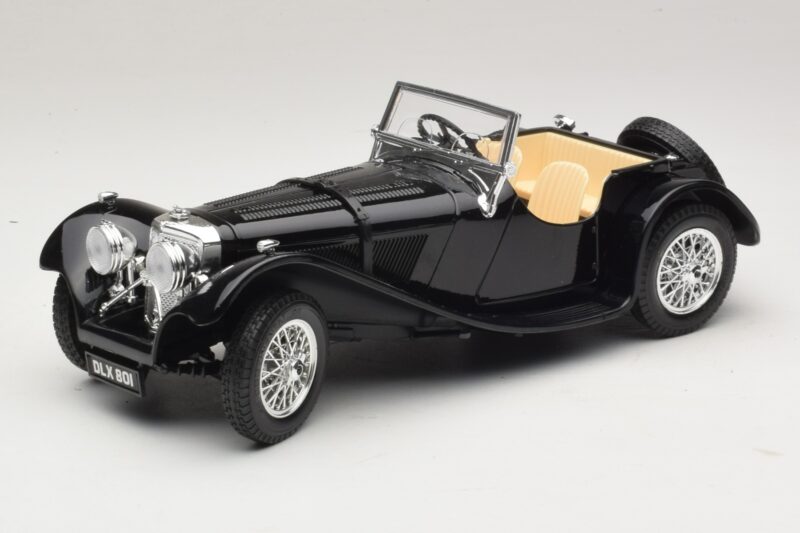
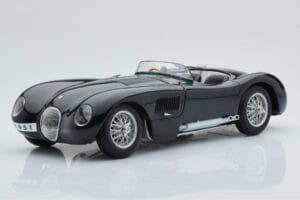
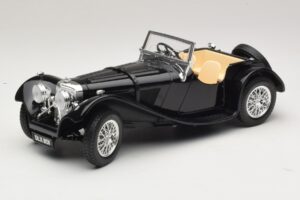
TL;DR: Bburago's 1:18 diecast reproduces the Jaguar SS100 roadster in black, the swept-fender pre-war sports car built by SS Cars before the company renamed itself Jaguar after the war. Opening panels accompany mid-tier diecast casting, making this a solid anchor piece for pre-war collectors.
Before Jaguar was Jaguar, it was SS Cars, a name the company abandoned after the war for reasons that need no explaining. The SS100 is the car most responsible for the reputation that survived that rename, a six-cylinder roadster whose long bonnet and swept fenders still define what a 1930s British sports car should look like.
Black suits the SS100's proportions, letting the long bonnet, sweeping front fenders, and exposed spare wheel read as pure shape rather than competing with a bright color for attention. Bburago's casting captures that fender sweep with real dimensional depth, the kind of compound curve that pre-war coachwork specialized in and that a diecast tool has to work hard to reproduce convincingly. Panel gaps around the doors and the long hood run to typical mass-market diecast tolerances, a touch wider than a premium casting would hold, but the overall silhouette comes through clearly. Chrome-finished trim around the headlamps and radiator grille catches light well against the black body.
This model's panels open, and the long hood is worth lifting first: beneath it sits the inline-six engine bay, cast with enough presence to suggest the real mechanical layout rather than a flat block. Hinge action carries the firm, slightly loose feel typical of zinc-alloy diecast construction, settling with a stop rather than drifting. That weight in the hand, substantial for a roadster this compact, confirms the metal build the moment it clears its packaging. The exposed two-seat cockpit, minimal weather gear and a single straight screen, is as much a part of the SS100's character as its fenders, and the casting captures that spartan layout faithfully.
William Lyons founded SS Cars in the 1930s, building increasingly sporting and well-proportioned automobiles under the SS badge through the decade. After the Second World War, the initials carried obvious and unwelcome associations, and the company rebranded entirely as Jaguar, a name borrowed from one of its own earlier model badges. The SS100 therefore occupies an unusual position in automotive history: a genuine Jaguar ancestor built before the Jaguar name existed on a chassis plate.
The SS100 took its name from a claimed top speed, a bold number for a 1930s road car, delivered through a six-cylinder engine in a lightweight chassis with minimal bodywork to slow it down. Its long bonnet, swept fenders, and low two-seat cockpit established a visual vocabulary that Jaguar's design language would echo for decades afterward. That influence is part of why the SS100 remains a popular diecast subject despite its age.
At 1:18, the SS100's compact roadster dimensions sit easily within standard cabinet depth, smaller than most postwar sports cars and a genuinely different silhouette from anything built after 1945. Bburago prices this release at an accessible, mass-market diecast tier, well below the specialist resin casts some pre-war subjects command, which makes it a practical way to anchor a vintage-themed shelf without a premium outlay. Buyers building a British marque collection will find this SS100 a useful bridge piece between SS Cars' pre-war identity and the Jaguar badge that followed.