Last one
Used

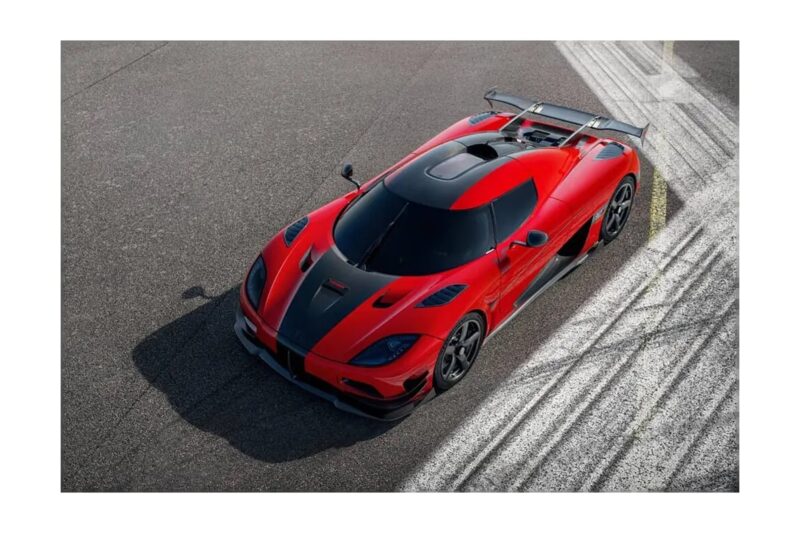
TL;DR: The GT Spirit Koenigsegg Agera RS 1:18 is a resin model of the Swedish hypercar in Draco Red. The body is a sealed one-piece casting, so low stance, sharp lines and the rear wing carry the build. At roughly 24 centimeters long, it suits hypercar displays and speed-record themes.
In November 2017 an Agera RS covered a closed stretch of Nevada highway at an average of more than 284 mph, taking the production-car speed record. The GT Spirit Koenigsegg Agera RS 1:18 puts that shape in resin, painted Draco Red, and lets you study the low, tight bodywork that made such speed possible from arm's length.
Koenigsegg builds the Agera RS in Ängelholm, Sweden, around a 5.0-liter twin-turbocharged V8 making over 1,300 PS on E85 fuel. In 2017 the car set the production-car top speed record on a closed section of highway near Pahrump, Nevada, averaging more than 284 mph over two runs in opposite directions. The record gives the car a link to US roads that few hypercars have. It also explains the body: a low, smooth shape with a prominent rear wing, built for stability as much as for speed.
Draco Red is the color name given for this model, and on a body full of ducts, scoops and sharp-edged creases it shows where light and shadow change. Saturated reds reveal paint quality: look for an even tone across the wide flanks, with no thin patches on edges and creases. Under a lamp, the highlight should follow the body's curve smoothly, bending over the shoulders and into the doors instead of breaking into ripples, which would signal uneven surface preparation.
Hypercar bodywork is full of tight curves and sharp creases: vents, ducts, a pronounced rear diffuser and a wing that stands proud of the tail. Resin reproduces those details with crisp edges that pressure-cast metal often softens, and it holds proportions accurately across a body that is low and wide. A one-piece body keeps shut lines narrow around the doors, which on the real car swing outward and upward on a distinctive hinge arrangement. The price of resin is brittleness, so protect the wing and splitter, the thin points most prone to chipping.
Look at the transitions where one surface meets another: the sweep from hood to windshield, the shoulder line, and the tail. Resin's fine tolerances let those transitions stay clean. Also check the wing: the thin plane and its uprights are a good test of casting quality, and a straight, even wing suggests careful work. No panel opens on this model, so all of this plays out on the exterior, and a hypercar's shape rewards exactly that scrutiny.
The Agera RS is a long, low car, and at 1:18 it comes out near 24 centimeters, shorter than a typical sedan model but wider than its length suggests. Plan shelf depth for the wing and the wide haunches, and leave space on each side. A low cabinet shelf at eye level shows the car's profile best, with a single side lamp creating long highlights. Keep red models out of direct sunlight, which over years can dull saturated pigments.
Red paint and a glossy surface will show dust quickly, so a closed cabinet is the best defense. Remove dust with a soft brush, and avoid cloth or paper towels, which can scratch the clear coat. Handle the model by the body near the wheels, never by the wing or mirrors. If you keep it for years, check from time to time that the model has not moved on its base and that the shelf stays level.
A hypercar shelf needs bookends, and the Agera RS works as the modern end, beside older cars that set earlier benchmarks. It stands out for its record and its Swedish origin, adding variety to groups dominated by Italian, German and British cars. Resin construction places it above entry-level diecast on finish, which suits a car whose appeal lies in exact lines. Buy it for the shape, the record and the color, in that order.
None of the doors or covers opens on this model. That keeps the red paint unbroken and the shut lines even, at the cost of interior access. For a car celebrated for its outer shape and its speed, this suits the subject well.