Last one
Used

Lamborghini Murcielago R-GT #53 Reiter Engineering 24 Hours of Le Mans 2007 GT Spirit 1:18
Only 1 left
Price:
189.00 €
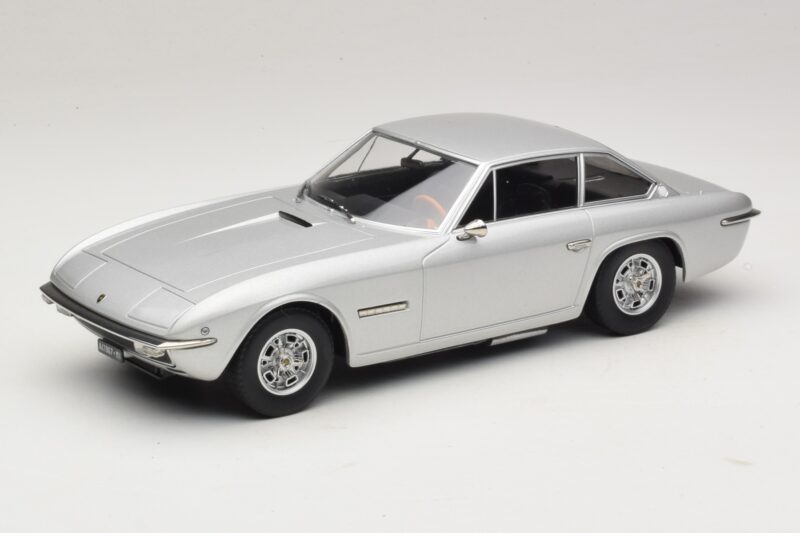
TL;DR: KK-Scale's 1:18 diecast Lamborghini Islero S reproduces the 1969 grand tourer in silver, a refined successor to the 400 GT that lived in the Miura's shadow. The body is a sealed one-piece casting, so the model's case rests on Marazzi's lines, paint depth, and stance rather than opening panels.
The Islero never got the poster-car treatment the Miura did, which is exactly why it rewards a second look. Bertone's mid-engine showpiece grabbed the attention in 1968, while Lamborghini's front-engine GT quietly carried on the brand's grand touring tradition with Carrozzeria Marazzi bodywork. KK-Scale's silver Islero S gives that overlooked model its due.
Lamborghini introduced the Islero in 1968 as the successor to the 400 GT, keeping the same 4.0-liter V12 and a chassis philosophy built around comfortable high-speed touring rather than outright drama. The name came from a bull that killed the matador Manuel Rodriguez in 1947, a darker reference than Lamborghini's later menagerie of fighting-bull names but consistent with the brand's habit of borrowing from the ring. The Islero S arrived in 1969 with a power bump and minor styling revisions, smoothing out some of the original's awkward details while keeping Mario Marazzi's boxy, understated profile intact. It never matched the Miura's sales or fame, and that scarcity is part of what makes it an interesting subject for a diecast model today.
KK-Scale's zinc alloy casting captures the Islero's slab-sided proportions honestly, without softening the car's somewhat severe lines into something more conventionally pretty. The body is a single sealed shell, doors, hood, and trunk all molded as one piece, which keeps the character lines along the flanks running unbroken from the front fender to the tail. That one-piece construction is standard practice at this scale and price point, and it pays off here specifically because the Islero's appeal is about surface tension and proportion rather than mechanical drama under an opened hood.
The silver finish suits the Islero's restrained styling better than a brighter color would, letting the body's creases and the long, flat hood do the visual work. Shut lines along the doors and trunk read as tight, even grooves rather than the slightly inconsistent gaps that cheaper tooling produces, a benefit of the sealed-body approach KK-Scale uses here. Chrome window surrounds and bumper trim separate cleanly from the silver paint rather than bleeding into it, and the glazing sits flush in its openings, which keeps the greenhouse looking correctly proportioned from the side.
Built and sold alongside the Miura, the Islero occupied a different, quieter niche: the Lamborghini for a buyer who wanted V12 performance without the mid-engine theatrics. Fewer than a few hundred Isleros and Islero S cars left the factory before Lamborghini replaced the model with the Jarama in 1970, which makes an accurate Islero S replica a genuinely uncommon subject in any collection, diecast or otherwise. Wheel detail on this casting carries the correct period wire-style pattern, and the stance at ride height avoids the too-tall look that affects some budget castings of low, long GT bodies. That rarity in the real car translates directly into rarity on the model shelf, and few manufacturers bother with the subject at all.
A collection built entirely around Miuras and Countaches tells only part of the Lamborghini story, and the Islero fills in the quieter chapter: the brand's grand-touring ambitions before the mid-engine cars took over the narrative. This silver example sits comfortably next to a 400 GT or an Espada if a collector is chasing that specific era, and its restrained styling makes a useful contrast against louder, later Lamborghinis on the same shelf. At 1:18, the Islero's roughly 24-centimeter footprint keeps it in line with other full-size GT castings without demanding extra shelf depth. For a buyer who already owns the obvious Lamborghinis, this is the one that fills a genuine gap rather than duplicating a shape already on display.