Last one
Used

Lamborghini Murcielago R-GT #53 Reiter Engineering 24 Hours of Le Mans 2007 GT Spirit 1:18
Only 1 left
Price:
189.00 €
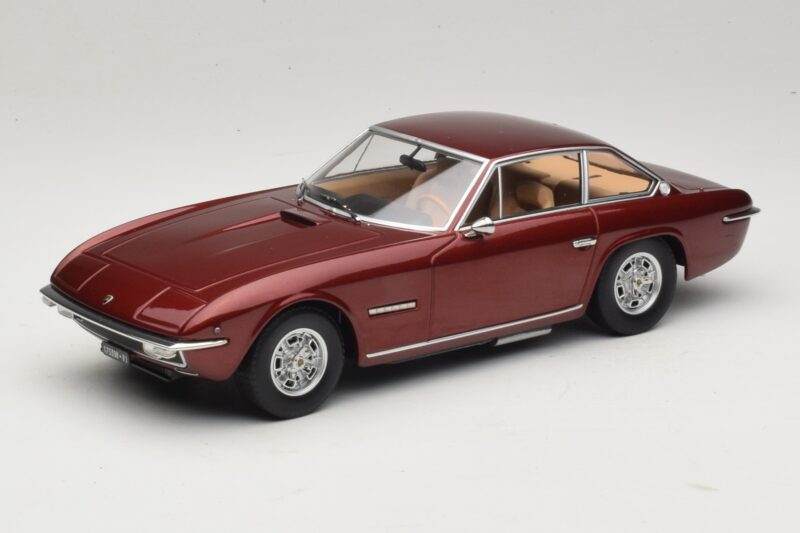
TL;DR: KK-Scale's 1:18 diecast Lamborghini Islero S reproduces the 1969 front-engine GT in red metallic, built as a sealed one-piece body with Marazzi's understated coachwork. Overshadowed in its day by the Miura, the Islero S rewards collectors who value Lamborghini's quieter grand touring side.
Lamborghini introduced the Islero in 1968 as a front-engine V12 grand tourer built to replace the 400GT, wrapped in a quieter, more conservative body from Carrozzeria Marazzi rather than the flamboyant Bertone styling that defined the Miura released the same year. The Islero S, launched in 1969, added more power and minor trim refinements to an already well-sorted chassis.
KK-Scale casts this Islero S in zinc alloy diecast, and the heft is immediately apparent lifting it from its packaging, a solidity that fits a car built around a long, front-mounted V12 rather than a lightweight exotic. The body is a sealed one-piece shell, with doors, hood, and trunk all molded closed, a construction approach that lets KK-Scale hold clean, consistent shutlines along the Islero's notably flat, slab-sided flanks, surfaces with very little visual drama to hide behind if the panel gaps run uneven. Marazzi's design leans on restraint rather than flourish, and a sealed body suits that restraint well, since there are no hinge lines to interrupt the car's long, quiet profile from nose to tail.
Red metallic paint holds strong under direct light here, with consistent depth across the hood and roof and no fading at the edges where the fenders meet the doors. The rectangular headlight units, one of the Islero's more distinctive front-end details compared to its contemporaries, are molded with sharp lens definition, and the chrome bumpers and window surrounds separate cleanly from the red bodywork. The Lamborghini badge on the nose and the Islero S script on the rear hold crisp detail under close inspection, and the wheels carry a period-correct pattern rather than a generic alloy design borrowed from another model.
Lamborghini built the Islero to replace the 400GT, its first true grand tourer, and tasked Carrozzeria Marazzi, a coachbuilder staffed partly by craftsmen who had previously worked at Carrozzeria Touring, with the body design. The result was a conservative two-plus-two shape built around a 3.9-liter V12 mounted up front, a configuration that placed the Islero firmly in the grand touring tradition rather than the mid-engine exotic territory Lamborghini had just entered with the Miura in 1966.
That timing worked against the Islero commercially: launched the same year the Miura redefined what a Lamborghini could look like, the Islero's restrained styling struggled to compete for attention against its sensational mid-engine stablemate, even though the Islero offered more usable space and arguably a more sorted chassis for long-distance touring. The Islero S arrived in 1969 with a power increase to around 350 horsepower, wider wheel arches, and a revised dashboard, refinements aimed at addressing early criticisms without altering Marazzi's original body design. Lamborghini built only a small number of Isleros and Islero S models combined before production ended in 1969, far fewer than the Miura, which paradoxically makes a well-preserved Islero today a rarer sight at concours events than the car that overshadowed it.
An Islero S brings a different kind of Lamborghini story to a shelf otherwise built around the Miura or Countach, one rooted in grand touring restraint rather than mid-engine drama. At 1:18, the model's roughly 20-centimeter length and long hood give the Islero's front-engine proportions proper room to read, distinct from the low, wide stance of its more famous siblings. Displayed alongside period rivals like the Maserati Ghibli, another front-engine GT from the same years, the Islero shows how differently two Italian manufacturers interpreted the same basic formula. For a collector who already owns the obvious Lamborghini icons, this Islero S fills a gap few other scale replicas address, the company's quieter, more conservative side built for touring rather than headlines.