Back in stock
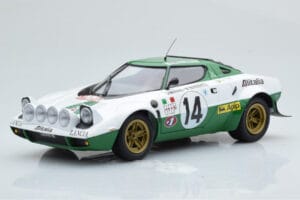
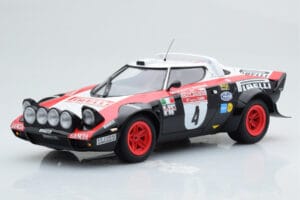
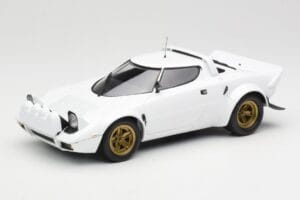
Lancia Stratos Alitalia #14 S. Munari / M. Mannucci Winners Rally Monte Carlo 1975 Minichamps 1:18
Only 2 left
Price:
131.00 €
This model is currently sold out. Enter your email and we'll let you know when it's back in stock.
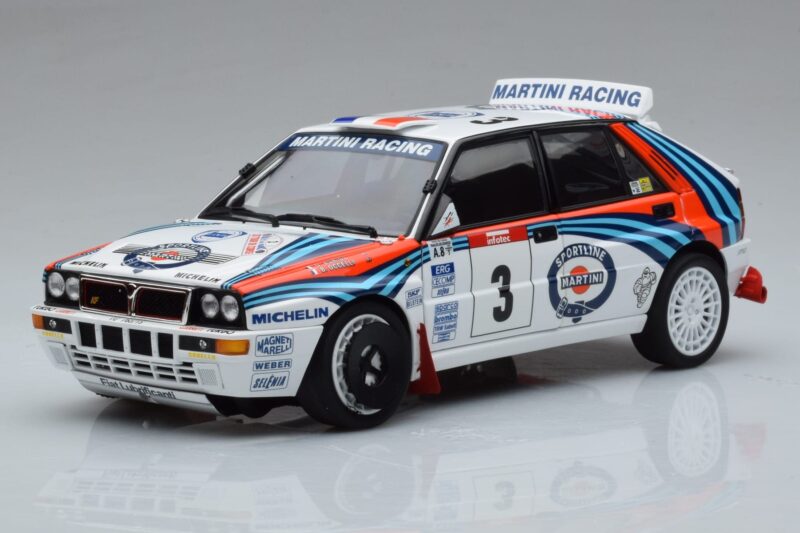
TL;DR: Kyosho's 1:18 diecast Lancia Delta HF Integrale Evoluzione recreates car #3, driven by Didier Auriol and Bernard Occelli at the 1992 Tour de Corse, the tarmac event where Auriol built his reputation as one of the era's sharpest asphalt rally specialists. Opening doors and hood suit a mid-tier diecast built for Group A livery collecting.
Some drivers earn a nickname from a single road. Didier Auriol earned his, Monsieur Corse, from Tour de Corse's endless mountain hairpins, and this Delta Integrale Evoluzione carries the livery from one of the events that built that reputation.
Kyosho casts the Delta's flared wide-arch bodywork, roof-mounted auxiliary lamps, and rally-spec front splitter with the correct proportions for the Evoluzione variant rather than a generic Integrale shape. Doors and hood swing open on metal hinges, exposing a simplified engine bay and a cabin fitted with bucket seats and a visible roll cage line, appropriate detail for a car built to compete rather than a road-going trim level. The white body carries the #3 door numbers and period sponsor decals in flat tampo print, registered tightly against the panel lines so the graphics read cleanly from a normal shelf viewing distance. Wheel arch depth and ride height sit correctly for a Group A rally car set up for tarmac stages, neither too low like a road car nor exaggerated like a gravel-spec casting.
This Auriol Delta occupies the same mid-tier diecast bracket as Kyosho's broader WRC range, well above entry-level fixed-panel castings but short of the sealed-resin tier that trades opening doors for sharper paint depth. For a rally subject built around a specific driver and event rather than a single hero car, that trade-off makes sense: a collector chasing several Tour de Corse liveries benefits from spreading a budget across multiple mid-tier pieces rather than concentrating it in one resin build. The opening features also let this car display with doors ajar next to closed liveries on the same shelf, adding visual variety a row of identical resin shells cannot offer.
The Delta HF Integrale Evoluzione represented the final and most developed form of Lancia's Group A rally car, with wider arches, a stiffer shell, and a more powerful turbocharged four-cylinder than the Integrale models that preceded it. That extra sharpness suited drivers who relied on precision rather than brute horsepower, and Auriol's driving style, patient and mechanically sympathetic, matched the car well on tarmac events where consistency across a long stage counted for more than outright speed. Lancia's factory program had already secured a run of manufacturers' titles through the Integrale family by this point, and the Evoluzione carried that dominance into its final competitive seasons before Lancia's factory withdrawal from top-level rallying.
Auriol's affinity for Tour de Corse's tight, tree-lined roads earned him several victories there across his career, and this #3 Delta Integrale Evoluzione from the 1992 event sits inside that stretch of results. Paired with the Sainz/Moya #2 car from the following season, the two liveries build a focused Tour de Corse display that traces how Lancia's Group A program handled the same demanding event across consecutive years, a pairing that rewards collectors building around one rally rather than one manufacturer's full season. At roughly 20 centimeters in length, the Delta's compact rally proportions fit comfortably alongside other WRC-era liveries in a standard display cabinet, leaving room to grow the collection over time.