Last one
Used
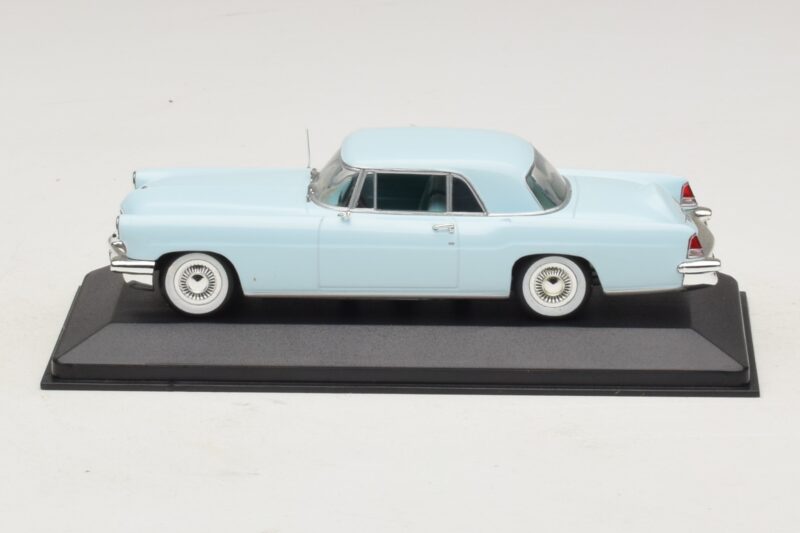
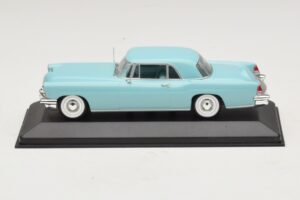
TL;DR: Minichamps' 1:43 Lincoln Continental Mark II captures the hand-built 1956 flagship coupe in light blue, cast as a sealed one-piece body with the model's signature trunk-lid spare tire hump. A two-year halo car reproduced with the restrained, fin-free styling that set it apart from its era.
Ford built the Continental Mark II for barely two model years, and reportedly lost money on every single car despite its steep price tag, because the division behind it was chasing prestige rather than profit. Minichamps renders that restraint in miniature, a coupe defined by clean lines at a moment when American design was reaching for ever taller fins.
This Mark II arrives as a fixed, one-piece casting, with no doors or trunk that open on the model. At 1:43 that construction choice suits a car whose design language was defined by restraint rather than ornament: flat, uninterrupted flanks, a shallow grille, and almost no extraneous chrome compared to the heavily finned Cadillacs and Chryslers it competed against. The one feature the real car could not do without, the raised hump on the trunk lid that echoed the spare-tire-mounted continental kits of earlier luxury cars, comes through as a crisp, well-defined bulge rather than a flattened afterthought.
The light blue paint sits evenly across the body's long, flat surfaces, a finish that shows up flaws readily if the tooling underneath is not accurate, and the body panels here read true without the waviness that cheaper small-scale diecast sometimes shows on long horizontal planes. Chrome trim around the windows and along the beltline is picked out cleanly rather than left as unbroken body color, and the wheel covers carry a pattern consistent with the understated luxury the Mark II was built to project. For a design built on subtraction rather than addition, holding those few details precisely is what makes or breaks the casting.
Ford created a standalone Continental division specifically to build the Mark II, positioning it above Lincoln as the company's answer to Rolls-Royce rather than just another trim level. Each car was largely hand-assembled, and the price Ford charged did not come close to covering what it cost to build one, a deliberate loss intended to buy the brand prestige rather than margin. That arrangement did not last. Ford folded the Continental division back into Lincoln after the 1957 model year, and the Mark II's two-year production run makes it one of the shortest-lived nameplates ever to come out of Dearborn.
The car traced its name back to the original 1940s Lincoln Continental, a design celebrated for its clean proportions, and the Mark II was built to recapture that reputation rather than chase the tailfin trend that dominated the rest of the American industry in the mid-1950s. That restraint has aged well; where many of its contemporaries now read as period pieces, the Mark II's flat flanks and minimal brightwork still look considered rather than dated. A car built deliberately at a loss, for prestige rather than profit, is an unusual subject even within vintage American luxury collecting.
At 1:43, the Mark II's long hood and low roofline translate into a compact footprint that fits easily alongside other mid-century luxury coupes without demanding a dedicated shelf. Its sealed body keeps attention on the paint and the trunk-lid detailing that define the car, rather than interior access most sedans of the period do not offer at this scale either. For a collector building a lineup of 1950s American flagships, the Mark II's short, money-losing production run makes it a natural centerpiece next to more conventional, higher-volume luxury models, worth placing where its clean lines contrast most sharply with its finned contemporaries.