Last one
Used
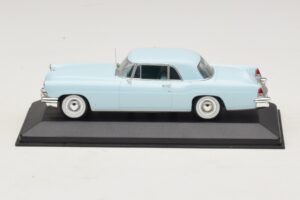
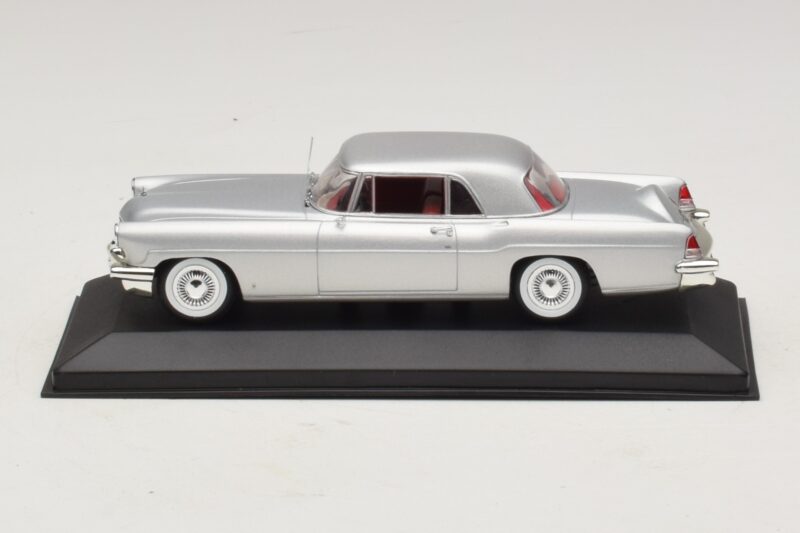
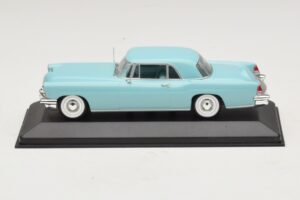
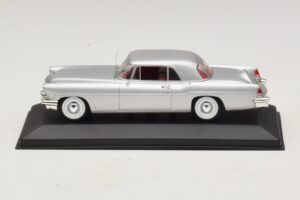
TL;DR: Minichamps' 1:43 Lincoln Continental Mark II in silver diecast reproduces the 1956 hand-built luxury coupe with a sealed one-piece body, clean formal lines, and deep gloss paint. A compact anchor for collectors tracing America's most exclusive postwar luxury experiment of the mid-1950s.
Ford's Continental Division built the Mark II almost by hand, at a price so high the company reportedly lost money on every one sold, chasing a level of exclusivity no mainstream American car had attempted. Minichamps renders that formality at 1:43 with a sealed body, letting the car's restrained, unornamented lines carry the entire presentation.
The Mark II's design philosophy was famously understated for an American luxury car of its era, with no tailfins, minimal chrome ornamentation, and a continental spare-tire hump on the trunk lid as its only real flourish. A sealed, one-piece casting suits that restraint well, since there is no opening panel to interrupt the car's long, flat flanks or the crisp line running the length of the body. Minichamps holds that line with real precision at this small scale, which is exactly where a formal design like this either succeeds or falls apart.
Silver is close to an ideal color for showing off a casting's surface quality, since it reveals every inconsistency in a panel line far more readily than a darker finish would. This Mark II holds up under that scrutiny, with the continental hump, the narrow chrome window surrounds, and the vertical taillights all rendered with clean, separated detail rather than smoothed into generic shapes. The grille and bumper chrome are picked out distinctly from the body silver, a small but important distinction at 1:43 where plating quality often separates a careful casting from a generic one. That level of finish is what justifies choosing a specialist manufacturer over a cheaper alternative for a subject this visually precise, where even small errors in proportion would be obvious.
The Continental Mark II launched for 1956 as Ford's answer to the question of whether an American manufacturer could build a true ultra-luxury car to rival anything from Europe. It was priced close to ten thousand dollars at a time when a typical new car cost a small fraction of that, assembled with hand-finishing and attention to detail that bordered on bespoke. Ford Motor Company reportedly lost money on every Mark II sold, treating the car less as a profit center than as a statement about what the brand was capable of building.
Production lasted only through 1957 before the Continental name moved to a more conventional, higher-volume model, making the Mark II a brief but memorable chapter rather than a long-running nameplate. Its exclusivity attracted a clientele that included entertainers and public figures of the period, reinforcing its reputation as one of the most genuinely prestigious American cars of the 1950s. For a collector, that combination of short production and outsized reputation makes the Mark II a meaningful anchor for any postwar luxury-themed shelf. Few American cars from this decade carry that specific mix of rarity and restraint, which is exactly why a well-rendered small-scale replica of it holds genuine collecting interest today, even outside dedicated Lincoln or Ford collecting circles.
At 1:43, the Mark II's understated lines translate cleanly without needing the larger scale a flashier car might demand to make an impression. It pairs naturally with other formal 1950s American luxury coupes, or stands in deliberate contrast against the chrome-heavy, tailfinned designs that dominated the decade elsewhere in Detroit's lineup. The sealed body means the silver finish and crisp lines will hold their precision indefinitely, with nothing to loosen or misalign over years in a cabinet, making it a low-maintenance centerpiece for a shelf organized around American design restraint rather than excess, a quiet, confident addition next to louder period contemporaries that rewards a second look more than a first glance, exactly as the real car intended.