Last one
Used
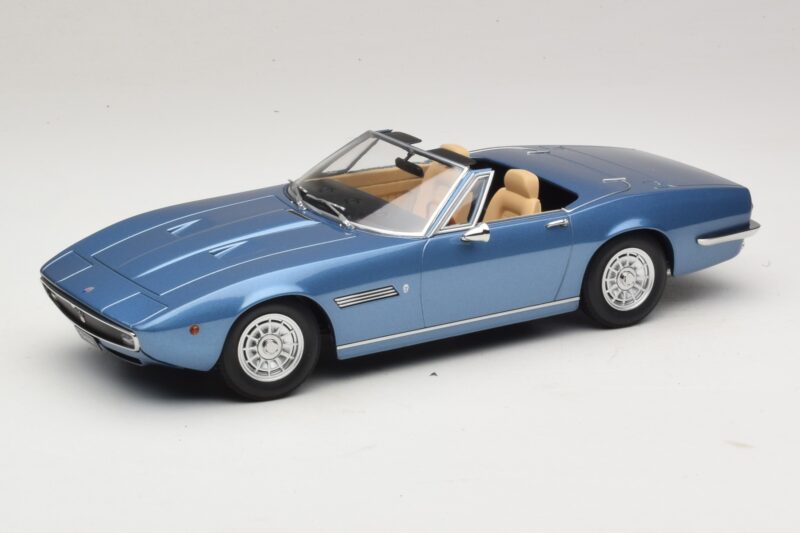
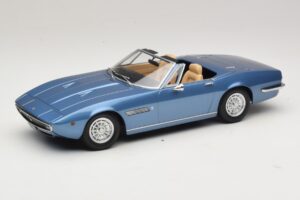
TL;DR: KK-Scale's 1:18 diecast Maserati Ghibli Spyder reproduces the rare 1970 open-top GT in light blue metallic, built as a sealed one-piece body with Giorgetto Giugiaro's low, wide lines. A quieter metallic alternative to KK-Scale's yellow edition, suited to collectors who want a more restrained Ghibli on the shelf.
Maserati built the Ghibli Spyder in far smaller numbers than the coupe between 1969 and 1973, a true open-top version of Giorgetto Giugiaro's low, flat-sided grand tourer rather than a targa conversion. This light blue metallic example trades the brighter, more attention-seeking yellow for a cooler, more understated presentation of the same rare body style.
This Ghibli Spyder is cast in zinc alloy diecast, carrying the same solid weight that defines the material at this scale, a heft that signals metal construction the moment the model leaves its packaging. KK-Scale builds the body as a sealed one-piece shell, with no opening doors, hood, or trunk, a construction choice that preserves the long, uninterrupted lines running the length of Giugiaro's low beltline without hinge gaps breaking up the surface.
Metallic paint behaves differently from a solid color under light, since the flake catches and scatters light across the surface rather than reflecting it evenly, and on this light blue finish that effect reads clearly across the long hood and front fenders, with the color shifting subtly in tone as the viewing angle changes. The soft-top boot behind the seats is molded closed as a single clean seam, and the windshield frame sits flush against the glass rather than standing proud of it. Chrome bumpers, headlight surrounds, and the Maserati trident badge on the nose carry crisp, well-defined edges, and the wire-style wheels hold the correct period spoke pattern. Compared to a flat solid color, a metallic finish like this one tends to reward display under varied or natural light more than under a single fixed spotlight.
The Ghibli Spyder entered production two years after the coupe, built in considerably smaller numbers as Maserati's answer to buyers who wanted the model's striking low-nose styling without a fixed roofline. Giorgetto Giugiaro designed the body while at Carrozzeria Ghia, drawing a long, flat hood and a cabin pushed rearward toward the back axle, proportions that read as even more dramatic on the open car, since the removal of the roofline exposes the full length of that hood uninterrupted.
Underneath, the Spyder shared its chassis and running gear with the coupe, including Maserati's quad-cam V8 in either 4.7-liter or later 4.9-liter displacement, a front-mounted, rear-drive layout that prioritized smooth long-distance cruising over outright agility. Convertible construction of this era typically compromised structural rigidity compared to a fixed-roof coupe, and Maserati reinforced the Spyder's chassis to compensate, adding a modest weight penalty that buyers of the period accepted in exchange for open-air motoring in a car this distinctive. Surviving Spyders are considerably rarer today than coupes, a scarcity that stems directly from the lower original production numbers rather than any difference in how well the two body styles have aged.
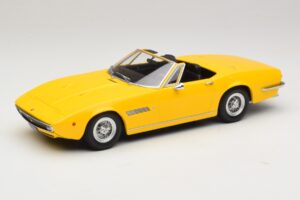
Set beside KK-Scale's yellow Ghibli Spyder, this light blue metallic edition shows how dramatically color alone can change the mood of an identical casting, one bright and attention-seeking, the other cool and reserved. At 1:18, both share the same roughly 23-centimeter footprint, so a collector can display them together without either one dominating the pairing. Beyond the color choice, both represent the rarer open-top Ghibli rather than the more common coupe, giving either one real standing in a 1970s Italian GT collection on its own merits. For a shelf built around subtlety rather than bold statement pieces, this light blue example makes the stronger case, letting the Ghibli's proportions carry the presentation rather than a loud finish doing the work for it.