Last one
Used

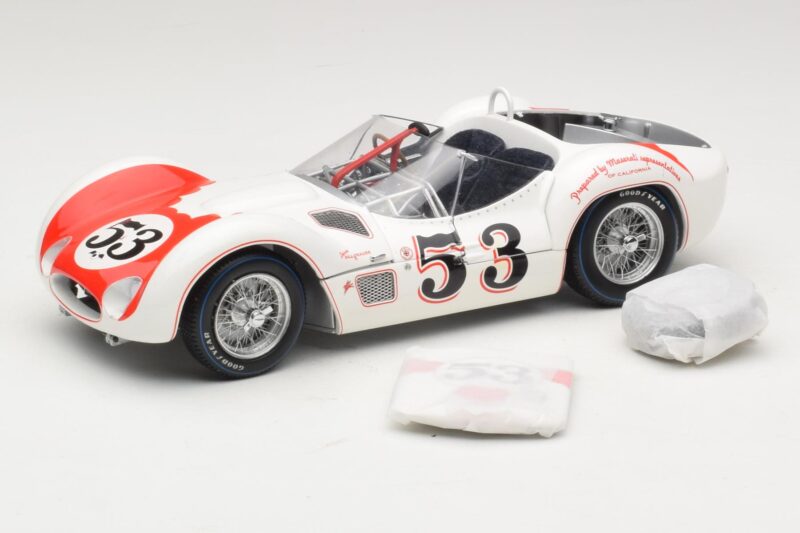
TL;DR: Minichamps' 1:18 diecast Maserati Tipo 61 Birdcage reproduces Bill Krause's #53 entry that won the 1960 Los Angeles Times Grand Prix at Riverside, its distinctive tubular space-frame chassis visible beneath opening bodywork over a 2.9-liter inline-four. Zinc-alloy weight anchors a piece rooted in America's early sports car racing scene.
Giulio Alfieri built the Tipo 61's chassis from hundreds of small-diameter steel tubes welded into a lattice so dense that mechanics nicknamed it the Birdcage, a structure light enough to make Maserati's sports racer competitive against far larger factory teams. Minichamps casts Bill Krause's #53 entry from the 1960 Los Angeles Times Grand Prix, a race deep in the American west coast road-racing scene that defined the era.
Maserati's engineering team, led by Giulio Alfieri, built the Tipo 61's chassis from an unusually dense network of small tubes rather than the larger, simpler space frames most rivals used, a construction method that kept the car remarkably light and stiff at once. The result was a chassis so visually distinctive that it gave the car its lasting nickname before most people ever knew its factory type number. Minichamps' casting exposes glimpses of that structure through the opening bodywork, letting a collector see the engineering that made the Birdcage genuinely competitive against larger-displacement rivals.
Where many of the Tipo 61's rivals ran larger six- and eight-cylinder engines, Maserati relied on a 2.9-liter inline-four to keep weight down, trusting the lightweight chassis to make up the difference in outright power. That combination of light structure and modest displacement made the Birdcage a genuinely different engineering approach from the brute-force sports racers competing alongside it, and it is part of why the car remains a favorite among collectors who value clever engineering over raw specification.
The Los Angeles Times Grand Prix was one of the marquee events on the early United States road-racing calendar, drawing factory and privateer entries to Riverside International Raceway at a time when American sports car racing was still finding its professional footing. Bill Krause's #53 Tipo 61 winning that race placed a European chassis squarely in an American racing story, the kind of crossover that still defines much of the country's sports car heritage today. Minichamps reproduces that specific #53 livery rather than a generic Birdcage finish, tying the model to a documented result rather than an anonymous race entry.
This Tipo 61 opens to reveal the tubular chassis and engine bay beneath its thin aluminum bodywork, a detail that matters more on a Birdcage than almost any other historic racer, since the chassis itself is the car's defining feature. Zinc-alloy construction gives the model the weight to feel substantial in hand despite the real car's famously light build, and the opening panels hold their fit reliably across repeated display changes. Few casting subjects reward opening the bodywork as much as a Birdcage does, since the lattice structure underneath is the entire engineering story the car is known for.
Historic sports racers from this era rarely carry documented American race wins in their model catalog descriptions, which makes this specific Tipo 61 more than a generic period racer reproduction. The Birdcage's broader competition record includes a celebrated Nürburgring endurance win the same year, giving the chassis design credibility on both sides of the Atlantic. Displayed on a shelf built around early 1960s sports car racing, this model bridges European chassis engineering and the American club and professional racing circuit that Riverside represented at the time. At 1:18, the Tipo 61's low, open-cockpit body measures a little over 23 centimeters, a compact footprint typical of early sports racers before regulations pushed the category toward larger designs later in the decade. Pairing this model with a contemporary Ferrari or Chevrolet Corvette entry from the same US racing seasons builds a themed shelf around the exact period when American road racing began attracting serious international competition. The car's lattice chassis, visible through the opening bodywork, also makes it a natural conversation piece for anyone curious about how sports car engineering diverged before regulations standardized much of the category.
This Tipo 61 suits a collector focused on historic sports car racing rather than modern GT subjects, valued for its documented Los Angeles Times Grand Prix win as much as for the Birdcage chassis it displays. The opening bodywork and zinc-alloy build place it in a solid mid-tier diecast bracket for a historic racing subject, priced sensibly given the specificity of the livery reproduced. Displayed with the bodywork open, the chassis lattice becomes the model's real focal point, a detail worth angling toward a shelf light rather than leaving tucked against a wall. Documented race wins like this one give a historic racing model a specificity that generic period liveries cannot match.