Used

McLaren 12C GT3 #82 Russian Team A. Vasiliev / D. Vasiliauskas / M. Asmer / B. Spengler Spa 24 Hours 2014 Minichamps 1:43
Only 2 left
Price:
46.00 €
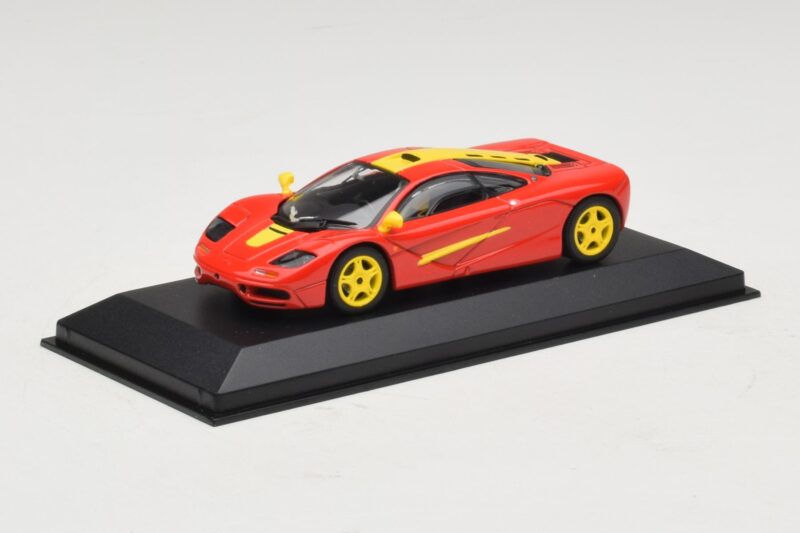
TL;DR: Minichamps' 1:43 diecast McLaren F1 wears red bodywork with yellow stripes, reproducing Gordon Murray's 1990s road-going hypercar. The sealed zinc alloy body holds the F1's low, compact proportions and central-seat glasshouse, a strong anchor for a 1990s supercar shelf given how few genuine F1s survive in private hands today.
Only a little over a hundred McLaren F1s were ever built across every version, road car, GTR racer, and long-tail LM, which makes any example, real or scaled, a genuinely rare thing to hold. This red and yellow road car represents the more attainable half of that story, the version meant for driving rather than racing.
The F1's body is famously compact and low for a car built around a central driving position, and Minichamps casts it as a single zinc alloy shell with the doors, hood, and rear clamshell all fixed rather than hinged. The yellow stripe running over the red bodywork is tampo-printed directly onto that shell, keeping the line straight and consistent as it crosses the car's compound curves, something a separately applied decal would struggle to do without stretching or misaligning. Because nothing opens, the door line and clamshell edge read as single continuous grooves, letting the F1's distinctive, almost teardrop-shaped profile come through without a hinge line interrupting it.
The model carries genuine heft for its size, the density of zinc alloy rather than a lighter material, which suits a car whose real-world reputation rested partly on extraordinarily light weight for its power output. The wheels are cast with a fine multi-spoke pattern typical of the period, sitting correctly within the F1's relatively narrow arches by 1990s supercar standards. Paint depth on the red bodywork holds an even gloss consistent with color applied to a hard metal surface, and the yellow stripe's edges stay crisp rather than feathering into the red beneath it.
Designer Gordon Murray built the F1 around a central driving position with two passenger seats set slightly back on either side, a layout chosen purely for handling balance rather than novelty, since it puts the driver's mass at the car's centerline. Power came from a naturally aspirated BMW V12 developed specifically for the project, producing over 600 horsepower in a car that weighed far less than most contemporaries thanks to extensive use of carbon fiber. That combination let a specially prepared F1 set a top speed record for a production car that stood for years afterward, a benchmark that gave the whole model line an outsized reputation relative to how few were actually built.
Total F1 production across all variants numbered barely over a hundred cars, built by hand over several years in the 1990s, which makes the car something enthusiasts study through photographs and scale replicas far more often than in person. That scarcity, combined with the car's genuine engineering ambition rather than marketing exaggeration, is why the F1 still commands serious respect among people who care about supercars built without compromise.
Few 1990s supercars carry the combination of engineering credibility and genuine rarity that the F1 does, which makes it a natural centerpiece for any collection organized around that decade rather than a supporting piece. At 1:43, it sits easily alongside contemporary Ferraris, Porsches, and Lamborghinis without demanding the display space a larger scale would need, while still commanding attention through color alone. For buyers building a hypercar-focused shelf rather than a manufacturer-specific one, a McLaren F1 fills a slot that few other cars from the era can genuinely claim. This red and yellow example, distinct from the more commonly reproduced silver press cars, adds visual variety to a corner of the hobby that can otherwise start to look repetitive.