Last one
Used

McLaren MP4-20 Mercedes G. Paffett Interim Test Car 2006 Minichamps 1:18
Only 1 left
Price:
161.00 €
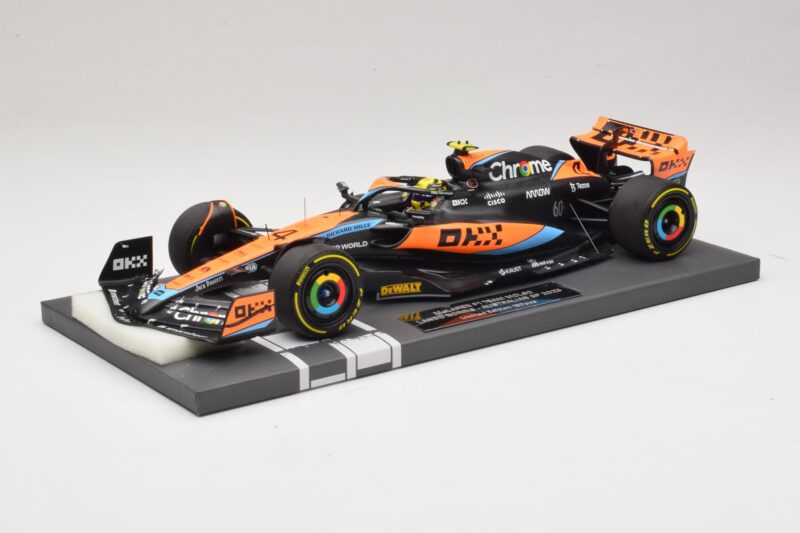
TL;DR: Minichamps' 1:18 resin McLaren MCL60 reproduces Lando Norris's #4 car at the 2023 Australian Grand Prix, one of the early rounds in a season that started slowly before McLaren's mid-year upgrades. The sealed one-piece body carries the car's launch-specification aerodynamic package.
The MCL60 that raced in Melbourne in early 2023 was not yet the car that would fight for podiums by mid-season. Minichamps' resin casting captures that honest, unglamorous early chapter rather than the upgraded car that followed.
The MCL60 launched for 2023 struggled to match its rivals' pace through the opening rounds, and the Australian Grand Prix at Melbourne's Albert Park circuit, a bumpy street-adjacent track known for testing car setups differently than permanent circuits, fell within that slow start before McLaren introduced substantial floor and sidepod upgrades roughly a third of the way through the season. Norris, in his fourth full season with the team by this point, carried the #4 number he had used since his rookie year, and this early livery documents the car before it found the performance that eventually delivered podium finishes later in the year.
This model has no opening cockpit or engine cover; it is a sealed one-piece resin body. The MCL60's early-season sidepod and floor design differ noticeably from the upgraded package introduced later that year, and this casting reflects the car's original launch geometry rather than the revised aerodynamics. Resin's casting precision holds the car's narrow sidepod inlets and floor edges with clean definition, and the papaya-and-blue livery's high-contrast panels need sharp color separation to read correctly at scale, a standard Minichamps maintains across this specific livery.
For collectors tracking McLaren's 2023 season specifically, this early-race livery matters precisely because it looks different from the car's later, more competitive specification, and displaying both versions side by side tells the story of a mid-season turnaround more effectively than either car alone. At 1:18 scale the MCL60 measures roughly 25 centimeters, consistent with other current-generation F1 liveries in a mixed shelf display. This piece rewards a collector who values documented technical progression over a single flattering result.
The bright papaya base shows fingerprints readily under direct light, so a dust-free cabinet and careful handling by the underbody preserve the finish over time. Early-season liveries from a car that later received major upgrades hold specific documentary value for collectors following in-season development stories. Paired with a mid-season MCL60 livery showing the revised floor and sidepods, this Australian GP car completes a two-piece before-and-after display.
No. It is a sealed one-piece resin casting, with all aerodynamic and cockpit detail built into the fixed exterior body.
It reflects the MCL60's original launch specification before McLaren introduced significant floor and sidepod upgrades roughly a third of the way through the season.
Melbourne's Albert Park combines street-circuit characteristics with a semi-permanent layout, testing car setups differently than fully purpose-built tracks.
Yes, displaying it alongside a mid-season upgraded MCL60 livery documents the team's in-year performance turnaround visually.