Back in stock
This model is currently sold out. Enter your email and we'll let you know when it's back in stock.
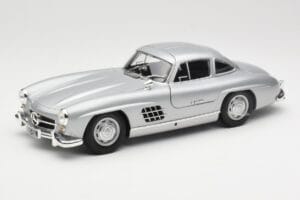
TL;DR: Minichamps' 1:18 diecast Mercedes 300 SL Gullwing reproduces the 1955 W198 coupe in Dark Blue, with doors that swing upward rather than out, a direct result of the car's tubular spaceframe chassis. Descended from Mercedes' Le Mans and Carrera Panamericana-winning race car, it anchors any serious vintage Mercedes collection.
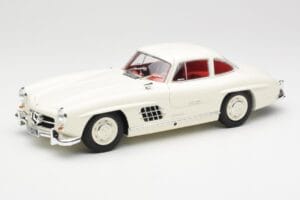
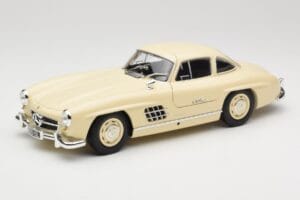
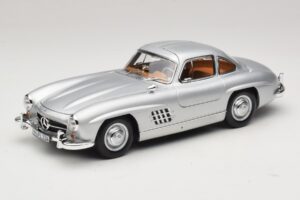
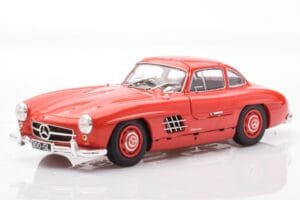
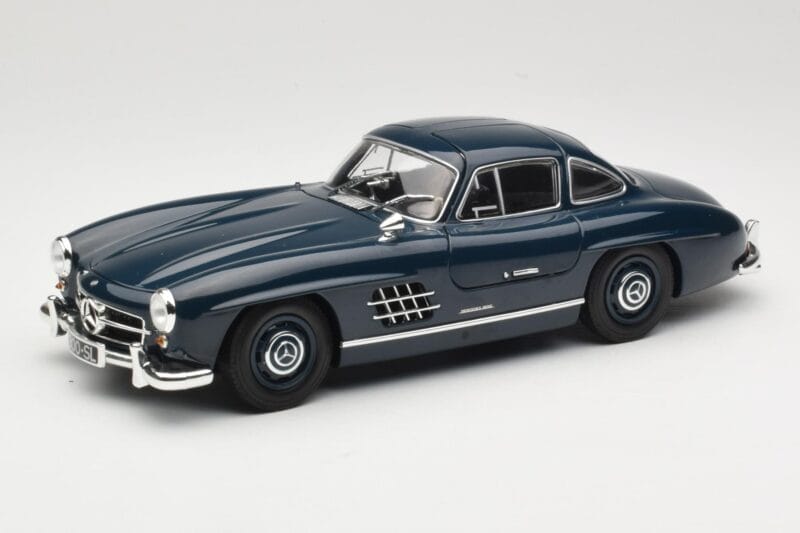
Few production cars have doors as famous as their engines, but the 300 SL's upward-swinging Gullwing doors were never a styling flourish; they were a structural necessity. Minichamps renders that solution in Dark Blue, a finish that lets the car's sculpted flanks and prominent wheel arches read clearly under any light.
The 300 SL's bodywork is defined by muscular wheel arches and a long, tapering hood, surfaces that reward a paint finish with genuine depth, and this Dark Blue holds that depth convincingly under direct light, shifting subtly across the car's curves rather than sitting flat. Chrome trim around the headlamps, grille, and bumpers is applied with enough precision to catch the eye without overwhelming the body color, a balance the real car's designers understood well. Panel lines around the doors follow the correct, slightly unusual path dictated by the Gullwing mechanism itself, a detail that separates a considered reproduction from a generic coupe casting.
The doors on this diecast open the way the real car's did, hinged at the roofline and swinging upward rather than outward, and Minichamps captures that motion with hinges substantial enough to hold the panel open for display. Behind them sits an interior that reflects the 300 SL's blend of luxury and purpose: leather-look seats, a full instrument cluster, and the distinctive banjo-style steering wheel that period photographs show clearly. Getting that door mechanism right matters more on this subject than almost any other classic, since the Gullwing doors are the single detail every 300 SL model is judged against first.
The 300 SL's doors swing upward because Mercedes built the car around a lightweight tubular spaceframe chassis, a lattice of steel tubes that ran high along the sides where a conventional door hinge would normally sit. Conventional doors simply were not possible without cutting through structurally critical tubing, so engineers designed doors that opened from the roof instead, turning a structural constraint into the car's most memorable visual signature. It is a rare case in automotive history where an engineering limitation became more famous than the solution it was meant to hide.
The 300 SL also holds the distinction of being the first production car fitted with direct fuel injection, a technology borrowed straight from Mercedes' W194 racing program, which had already won the 1952 Carrera Panamericana and taken class honors at Le Mans. That racing pedigree, transferred almost directly into a car customers could buy and drive on public roads, is what elevated the 300 SL from a stylish coupe into a genuine performance benchmark of its era, and it explains why the model remains one of the most consistently sought classic Mercedes subjects among collectors today.
At roughly 24 centimeters long, the 300 SL occupies a modest footprint for a car with this much history behind it, fitting comfortably beside other 1950s European coupes without dominating the shelf by size alone. Its significance comes entirely from what it represents rather than its dimensions: the moment a genuine racing chassis and its lessons went directly into a car regular buyers could own. For a collector building a chronology of postwar Mercedes sports cars, the 300 SL Gullwing is the obvious starting point, the model every subsequent Mercedes coupe gets measured against. Minichamps' attention to the door mechanism and cabin detail here makes this a defensible centerpiece rather than a supporting piece.