Back in stock
This model is currently sold out. Enter your email and we'll let you know when it's back in stock.
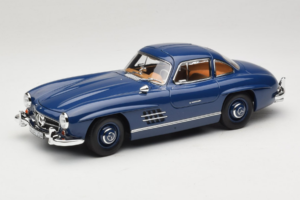
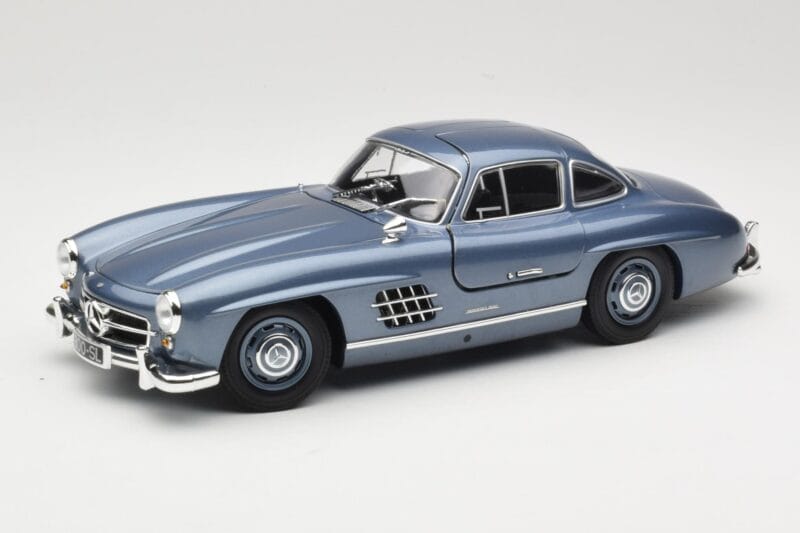
TL;DR: Minichamps' 1:18 diecast Mercedes 300 SL W198 Gullwing reproduces the 1955 coupe in Light Blue Metallic, with functioning upward-opening doors and a detailed straight-six engine bay. Built around the era's most distinctive door mechanism, it anchors a 1950s sports car display at accessible diecast pricing.
The 300 SL earned its doors, not the other way around. Mercedes-Benz's racing department needed a lightweight tube-frame chassis strong enough to win Le Mans, and that frame left no room for conventional doors cut into the sills.
The 300 SL began life as a competition car, winning the 1952 Carrera Panamericana and taking a class result at Le Mans that same year before Mercedes-Benz turned the design into a road-going production model for 1954. That racing origin explains the W198's tubular space-frame chassis, a structure so rigid it demanded high sills the doors had to clear rather than slice through, which is the actual engineering reason behind the gullwing hinges rather than a styling flourish added afterward. The 300 SL was also among the first production cars fitted with mechanical fuel injection, borrowed straight from the racing program, giving the road car genuine performance to match a shape everyone already recognized from competition.
Minichamps hinges the doors at the roofline rather than the sill, and they swing upward through the same arc the real car used, clearing the tall door sill the space-frame chassis required. That single mechanical detail is the reason this subject gets modeled at all outside dedicated Mercedes collections; no other production car from the era opens quite this way. The hinge holds the door open at a set angle without drooping, letting the model display with both doors raised the way owners often pose the real car at shows. Getting that hinge geometry believable in miniature is harder than it looks, since the arc has to clear the sill exactly as the full-size car does.
The body is cast in zinc alloy, giving the model real heft when lifted from its case, and Minichamps applies the Light Blue Metallic finish evenly across the coupe's long hood and low, curved roofline. Shut lines around the gullwing doors stay tight when closed, which matters more here than on a conventional car since the door's upward arc makes any gap along the roof edge immediately visible. The chrome trim around the windows and the twin-vent hood louvers pick out the 300 SL's most recognizable surface details without looking applied on top of the paint rather than part of it.
Lift the hood and the model reveals the tilted straight-six engine, canted to one side in the engine bay just as Mercedes-Benz mounted it in the real car to clear the low hood line. Inside, the cabin carries the 300 SL's distinctive banjo-style steering wheel and seat detailing, with door panels shaped to follow the car's high sill line. It's a cabin worth seeing, and Minichamps treats the opening doors as an invitation to look rather than a gimmick, mapping the dashboard and console with the same care given to the exterior paint.
At roughly 24 centimeters long, the Gullwing needs a bit more depth in a display case than most coupes its size, since the doors swing outward and up rather than staying tucked against the body. Owners building a 1950s sports car theme often pair it with contemporary Jaguar or Porsche coupes to show how differently designers solved the same era's engineering problems. Diecast at this tier puts the 300 SL within reach without the price jump a sealed-resin or hand-built alternative would carry, a fair trade for a subject whose defining feature, the doors, is exactly what diecast opening mechanisms are built to show off.