Back in stock
This model is currently sold out. Enter your email and we'll let you know when it's back in stock.
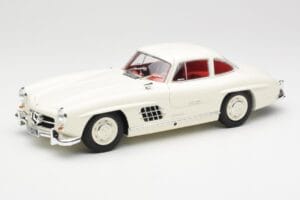
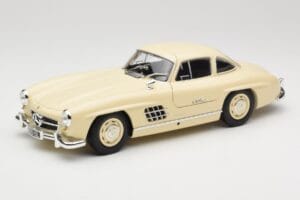
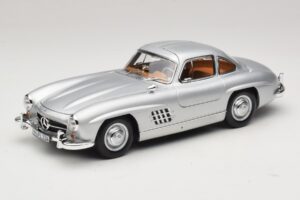
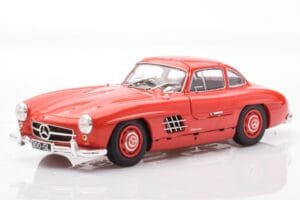
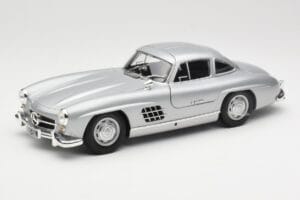
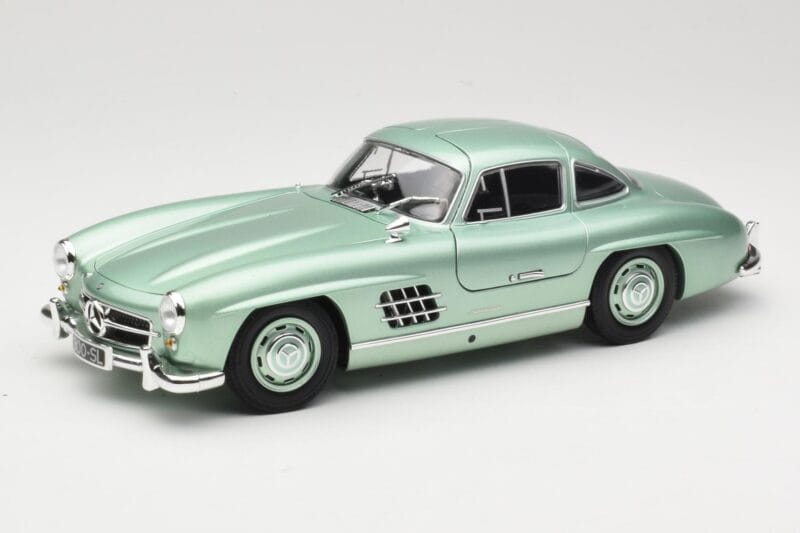
TL;DR: Minichamps' 1:18 diecast Mercedes 300 SL Gullwing wears Light Green Metallic, a less common factory shade on the 1955 icon built from Mercedes' W194 racing chassis. Upward-swinging doors reveal a fuel-injected straight-six and mapped cabin, making this a natural second colorway for collectors already holding the more familiar silver Gullwing.
Silver gets all the attention when people picture the Gullwing, and for good reason, but Mercedes offered several other factory colors in period. Light Green Metallic is the quieter option, easy to overlook and worth seeking out for exactly that reason.
Mercedes built the original 300 SL in a handful of factory colors, and while silver has become the shade most associated with the car in popular memory, several cars left the factory in muted greens and other period tones that rarely appear in modern reproductions. Minichamps' Light Green Metallic captures one of those less-photographed originals, applied with the same evenness across the car's rounded fenders as the more common silver casting, but with a cooler, more restrained presence on a shelf. Under direct light the metallic flake reads closer to a sage tone than a bright green, subtle enough that it will not clash with brighter cars nearby, and distinctive enough that a collector who already owns the silver version will notice the difference immediately. Mercedes catalogued its 1950s color options with a formality that later decades abandoned, and a handful of surviving original-color 300 SLs in greens and blues occasionally surface at concours events, reminding modern collectors that silver was always one option among several rather than the car's defining shade.
Regardless of exterior color, every 300 SL Gullwing carries the same mechanical reason for its upward-opening doors: the tubular space frame inherited from the W194 racing chassis ran its structural rails through the door sills, leaving no room for a conventional hinge without cutting into the car's rigidity. Minichamps models that hinge geometry the same way across every colorway, with the door holding its raised position without drooping and the sill visible through the opening exactly as it would be on the real car. The cabin carries the same low-set bucket seats and visible sill structure across every color variant, a cockpit layout that traces directly back to the W194 racer's minimal, function-first interior rather than any road-car comfort standard of the period. Lifting the hood reveals the fuel-injected straight-six that made the 300 SL the first series-production car sold with gasoline direct injection, an engineering story that belongs to the car itself rather than to any single paint option.
A second Gullwing in a different factory color solves a real display problem: two identical castings in the same paint read as a duplicate purchase, while two different period colors read as a deliberate study of how Mercedes actually sold the car in 1955. Light Green Metallic beside a silver example lets a collector show that variety without needing a rarer competition version or a different scale to create visual interest. At roughly 21 centimeters, both castings share the same footprint, so the pairing works in a single cabinet row without one model needing extra clearance. Collectors who prefer breadth over duplication often extend this approach beyond the Gullwing itself, pairing period-correct color variants across an entire 1950s sports car shelf, using paint choice the same way a period buyer would have: as a personal signature on an otherwise identical car.