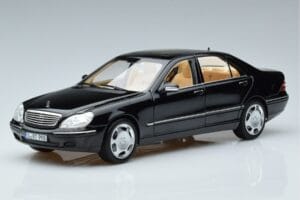
Mercedes S-Class W220 S600 Limited Edition Norev 1:18
Price:
91.00 €
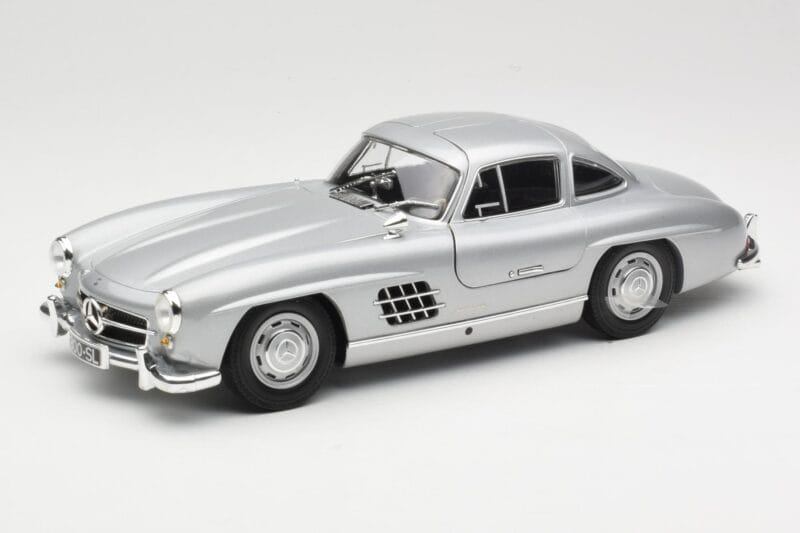
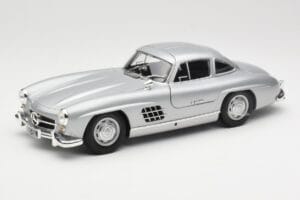
TL;DR: Minichamps' 1:18 diecast Mercedes 300 SL Gullwing in silver reproduces the 1955 road car built from Mercedes' W194 racing chassis, with upward-swinging doors, a fuel-injected straight-six engine bay, and mapped cabin trim. As the first series-production car with gasoline direct injection, the 300 SL anchors any 1950s sports car collection.
Few road cars carry as direct a line back to a racing chassis as the 300 SL. Its doors go up, not out, for a genuinely mechanical reason rather than a styling flourish, and that reason is worth explaining before anything else.
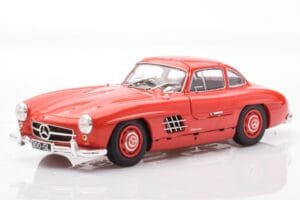
Minichamps engineers the model's doors to swing upward and forward the same way the original SL's did, a design forced by the car's tubular space frame, whose door sills ran high enough to make conventional hinged doors impossible without cutting into structural tubing. The diecast hinge holds the door open at a wide angle without drooping, a mechanical detail that matters more here than on most opening-door models, since the Gullwing's raised doors are the single feature every collector checks first. The silver paint sits smooth across the car's rounded fenders and low nose, with the trademark side vents and rocker-panel louvers picked out crisply rather than blurred into a single stamped line.
The 300 SL began life as the W194, a competition car built to return Mercedes to international racing after the Second World War, and its lightweight tubular frame was designed purely for rigidity and speed rather than everyday practicality. When Mercedes decided to sell a road version, the frame's high sills stayed, and the upward-opening doors became the only workable solution rather than a deliberate styling choice. Minichamps' cabin reflects that racing-derived layout, with a wide, low sill visible through the open door and bucket-style seats set close to the floor, the same low seating position that made the racing chassis so effective.
Mercedes' racing department campaigned the W194 through European endurance events in the early 1950s, and its success on tracks like the Nürburgring and in the Carrera Panamericana built the reputation that convinced Mercedes to greenlight a production version. That production 300 SL, introduced for the 1955 model year, carried over the racing pedigree in one crucial technical detail: it used a mechanically fuel-injected straight-six, making it the first series-production car sold with gasoline direct injection, a technology most manufacturers would not adopt widely for decades. The result was genuine performance for the era, with a top speed that outran most contemporary sports cars and grand tourers. Minichamps models the injected engine's plumbing and induction detail under the hood with enough separation between components that the layout reads as a genuine engine rather than a single molded block, appropriate for a car whose engineering, not just its doors, defined it.
Silver was one of the original 300 SL's most common factory colors, and it suits the car's racing lineage better than louder paint choices, echoing the bare-metal look of the earlier W194 competition cars before Mercedes' road-going color charts expanded. On a shelf built around postwar sports cars, the Gullwing works as an anchor piece precisely because so much of what followed, from later Mercedes coupes to unrelated marques chasing similar performance, can trace some design or engineering thread back to it. At roughly 21 centimeters, the model's proportions sit smaller than many modern 1:18 sports cars, a reminder of how compact genuine 1950s performance machinery actually was. That compactness is worth confirming against a display shelf before buying multiple 1950s subjects side by side, since era-correct scale accuracy can make an early sports car look almost toy-like beside a contemporary supercar casting.