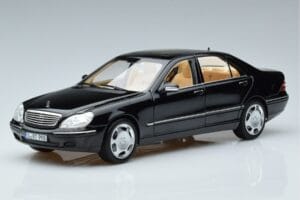
Mercedes S-Class W220 S600 Limited Edition Norev 1:18
Price:
91.00 €
This model is currently sold out. Enter your email and we'll let you know when it's back in stock.
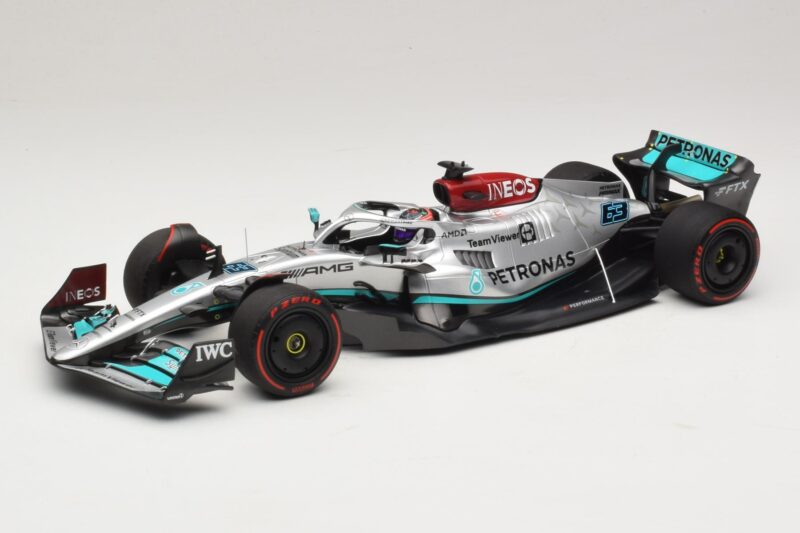
TL;DR: Minichamps' 1:18 diecast Mercedes-AMG Petronas W13, #63, reproduces George Russell's car from the 2022 Spanish Grand Prix at Barcelona, his rookie season with the team and a year defined by the W13's severe porpoising under Formula 1's new ground-effect regulations. The sealed one-piece body carries printed Petronas livery.
2022 brought Formula 1's biggest technical overhaul in a decade, and Mercedes' W13 struggled with the new ground-effect rules more than almost any car on the grid, bouncing violently at speed in what the paddock called porpoising. George Russell, in his first season with the team, still extracted strong results from a genuinely compromised chassis.
Formula 1's 2022 rule change reintroduced ground-effect aerodynamics, using venturi tunnels beneath the floor to generate downforce more efficiently than the previous generation's wing-heavy approach. Mercedes' interpretation of those rules produced a car that bounced uncontrollably at high speed once the floor stalled, a problem several teams saw in testing but few experienced as severely as Mercedes did through the early rounds. The team spent much of the season redesigning the car's floor and suspension to manage the issue rather than eliminate it outright, and the W13 never fully matched the sport's fastest cars that year despite the effort. It's a car defined by a real engineering fight rather than outright dominance.
Minichamps casts the W13 as a sealed one-piece diecast body, standard for Formula 1 diecast at this scale since a single-seater chassis has no doors or hood to render as separate pieces. The narrow, heavily sculpted sidepods, a distinctive feature of Mercedes' 2022 aerodynamic approach compared to rival teams' wider designs, come through clearly in the casting. The Petronas silver-and-black livery is printed directly onto the body, and the halo and front wing detail are captured in the same casting rather than added as separate fragile pieces, keeping the model sturdy for regular handling.
Russell joined Mercedes for 2022 after three seasons developing his craft at Williams, a team without the resources to challenge for wins, making the step into a factory Mercedes seat a genuine leap in expectation. Facing a compromised car in his first year at a top team wasn't the ideal circumstance, but Russell's performances that season established him as a genuine long-term contributor within the team rather than a driver still finding his footing. This #63 livery from Barcelona captures him mid-transition, still building the results record that would define his Mercedes tenure.
The Circuit de Barcelona-Catalunya has long served as both a mid-season Grand Prix venue and a preseason testing site, meaning teams typically arrive with detailed knowledge of how their cars behave there before the race weekend even begins. That familiarity makes it a useful benchmark race for judging real season-long form rather than a one-off surprise result. For a car like the W13, still working through its porpoising issues at this point in the season, Barcelona offered a smoother, more predictable circuit than some of the bumpier venues on the calendar where the bouncing had been most severe.
This W13 works well for collectors tracking Formula 1's technical history as much as its results, capturing a season where the sport's biggest rule change in years exposed real engineering vulnerabilities even at a team with Mercedes' resources. Paired with earlier championship-era Mercedes diecast, it shows the contrast between total dominance and a genuine rebuilding year, a more honest arc than most manufacturer collections bother to represent. Sealed diecast construction here matches the standard across the F1 diecast segment, so buyers should judge the piece on livery accuracy and casting sharpness rather than expecting opening panels a single-seater never had. For a Russell-specific collection, it also marks an important early chapter in his Mercedes career.