Last one
Used
This model is currently sold out. Enter your email and we'll let you know when it's back in stock. We'll also send you news about new models. Unsubscribe anytime.
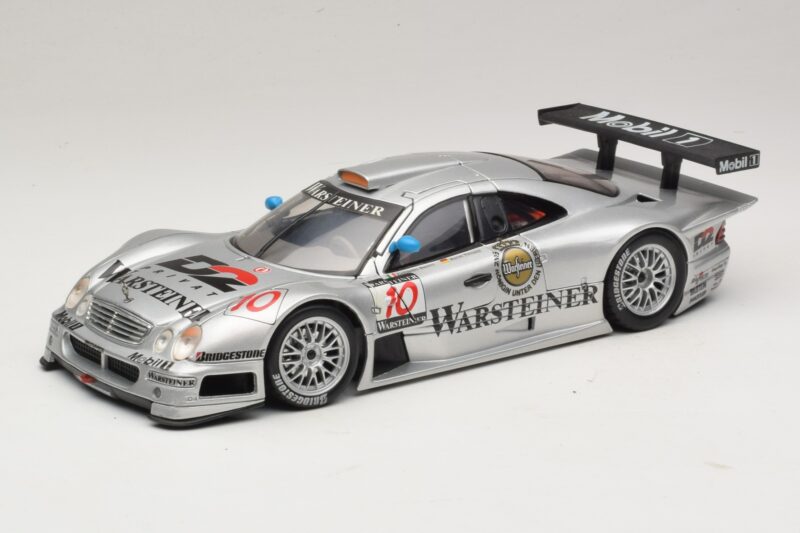
TL;DR: Maisto's 1:18 diecast Mercedes CLK GTR #10 reproduces the 1999 Warsteiner-liveried GT1 racer, with an articulated body and the wide, low-slung aerodynamics AMG built to dominate the FIA GT championship. The CLK GTR won races from its debut season and claimed back-to-back titles before this car carried sponsor colors into 1999.
AMG developed the CLK GTR from a clean sheet to meet the FIA GT1 class's loose homologation rules, and the result won races from its debut season. By 1999 the factory-backed Mercedes effort, carrying sponsorship liveries like Warsteiner, had already claimed back-to-back championships, making this particular livery a late chapter in a genuinely dominant run.
GT1 cars of this era carried enormous rear wings, vented hoods, and flared fenders designed purely for downforce rather than road use, and those flat, deliberate surfaces suit diecast tooling well. Maisto's casting holds the CLK GTR's wide rear wing and vented bodywork with clean definition, and the Warsteiner livery's bold lettering and sponsor panels sit with sharp registration across the body's long, low flanks. Getting a racing livery right is mostly about color placement and edge sharpness rather than shape, and this casting keeps the decal lines crisp where a lesser casting would show bleed or misalignment at panel breaks.
The body articulates, and lifting the hood reveals a layout that bears little resemblance to the road-going CLK the car borrowed its name from, since the GTR was a purpose-built racing chassis wearing a production-adjacent shell purely to satisfy homologation rules. The hinge holds its position with real resistance, a small sign of build quality at this tier. Inside, cockpit detail stays simplified compared to the real car's stripped-out racing interior, which is the expected trade-off at a mass-market price point, and it does not undercut the model's main draw, which is entirely about livery and silhouette.
AMG built the CLK GTR specifically to exploit the FIA GT1 class's lenient homologation requirements in the mid-1990s, producing just enough road-going versions to satisfy the rules while focusing almost entirely on the racing program. Drivers including Bernd Schneider and Klaus Ludwig carried the car to championships across the 1997 and 1998 seasons, establishing Mercedes as the class's benchmark manufacturer during that stretch. By 1999, when this Warsteiner-liveried car raced, the CLK GTR's competitive peak had already passed into GT1 history, but the factory effort remained a serious force through the end of its run.
Collectors chasing a premium resin GT1 replica will find specialist options with tighter panel tolerances and more individually finished decal work, typically at a considerably higher price and in smaller production runs. Maisto's mid-tier diecast answers a simpler question: can a collector own a genuinely dominant factory racing program's car without committing to investment-tier spending. For a shelf organized around a themed run of late-1990s GT1 machinery rather than a single hero piece, that accessibility is the more useful trade-off.
Warsteiner's gold and white livery stands apart from the more common silver-arrow Mercedes racing colors, giving this casting a distinct identity next to other factory Mercedes race models on the same shelf. At 1:18 the CLK GTR's wide, low stance needs real lateral space, more than a road-going coupe at the same scale, so plan cabinet width accordingly. Judge fidelity first at the rear wing mounts and the livery registration along the door, where a cheaper casting tends to lose sharpness first. Pair it with other period GT1 entries to build a genuine late-1990s GT1 grid rather than a single isolated piece.