Last one
Used
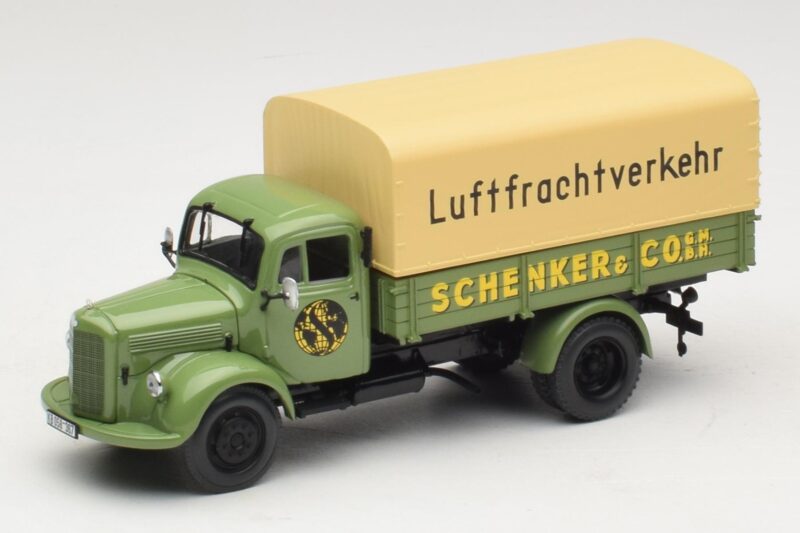
TL;DR: Minichamps' 1:43 diecast Mercedes L 3500 reproduces the 1950 flatbed truck in Schenker livery, a sealed one-piece casting with crisp chassis detail and deep, even paint over the truck's rounded postwar cab, cast in dense zinc alloy for lasting shelf presence.
Mercedes-Benz's L 3500 helped rebuild West Germany's freight network in the years right after the war, its rounded cab and dependable diesel engine becoming a common sight on reconstruction-era roads. This Schenker-liveried example ties the truck to one of Germany's oldest and best-known logistics operators.
Minichamps casts this L 3500 in zinc alloy, and the weight registers immediately given how much metal sits in a cab-and-chassis this substantial. The truck is a single sealed casting, with no opening doors, hood, or tailgate, and on a shape defined by rounded postwar styling, that construction keeps the cab's curves flowing as one continuous surface rather than interrupted by a shut line. The Schenker livery's paint sits deep and even across the cab and flatbed sides, with the company's lettering rendered in fine tampo printing that holds crisp edges rather than the slightly raised look a decal transfer would leave.
Minichamps captures the L 3500's distinctive split windshield, rounded fenders, and upright grille with genuine period accuracy, details that place the truck firmly in its early-1950s design language rather than a generic postwar silhouette. The flatbed itself shows correctly spaced structural ribbing and stake pockets along its edges, and the wheels sit beneath the cab at the correct narrow track that gave these early postwar trucks their slightly top-heavy, upright stance. Nothing on this casting opens, and for a working truck built to be viewed as a complete cab-and-bed unit, that sealed construction is the sensible choice, putting the tolerances into keeping the rounded cab surfaces smooth rather than into hinges a display piece has no real use for.
Mercedes-Benz built the L 3500 as part of its early postwar truck range, a period when West Germany's freight network needed rebuilding almost from scratch after wartime destruction and years of underinvestment. The truck's rounded cab styling, shared visually with several other Mercedes commercial vehicles of the era, reflected the design language of the period more broadly, a look that favored simple, cost-effective panel shapes over the more angular styling that would follow later in the decade.
Schenker, the logistics operator represented in this livery, traces its roots back to the nineteenth century and grew into one of Germany's most established freight forwarding companies, a name that carried real weight with shippers long before the modern DB Schenker brand became a familiar sight on the autobahn. Pairing an L 3500 with a historic operator like Schenker gives the model a documentary value beyond a generic truck casting: it places a specific, real freight operator's rolling stock in a specific, real period of postwar reconstruction. Trucks like the L 3500 rarely survive in preserved running condition compared with the passenger cars of the same era, making an accurately liveried scale model one of the more practical ways to study a specific operator's early-1950s fleet. For collectors tracing German commercial transport history, a well-executed L 3500 in period Schenker colors documents exactly the kind of everyday freight work that built the country's postwar economy.
At 1:43, this L 3500 sits at a scale that suits a broader commercial vehicle display, its rounded cab and flatbed reading clearly even next to larger coach models from the same decades. Early postwar trucks form a specific niche within commercial vehicle collecting, appealing to enthusiasts interested in reconstruction-era Germany rather than later, more modern truck designs. The Schenker livery adds genuine historical weight, tying the model to one of the country's oldest logistics names rather than a fictional or generic operator. Paired with a Kässbohrer trailer or a Mercedes coach from the same period, this L 3500 rounds out a shelf documenting how West Germany moved both goods and people in the years right after the war.