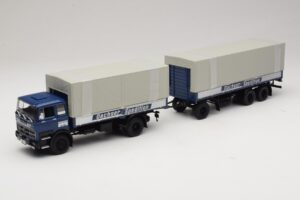
Last one
Used
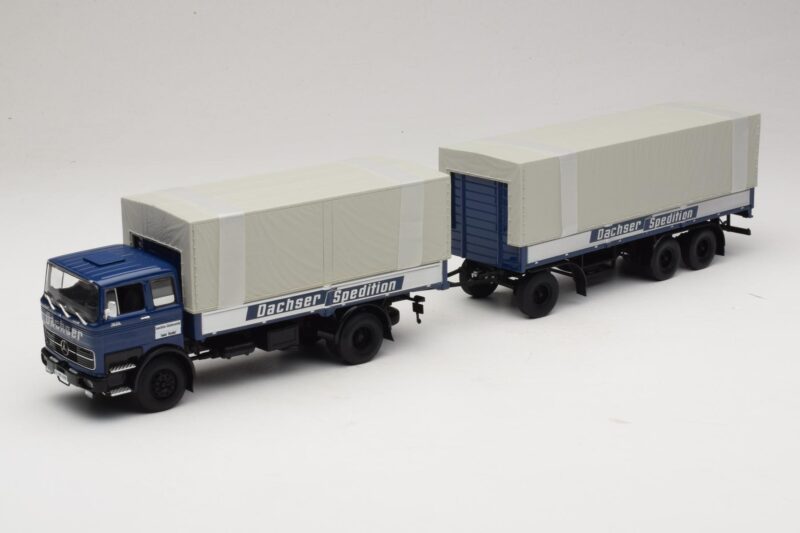
TL;DR: Minichamps' 1:43 Mercedes LP1624 is a zinc alloy diecast of the cab-over flatbed-and-trailer combination liveried for Dachser, the German freight forwarder, dated to 1969. The body is sealed with no opening panels, so cab proportions, trailer alignment, and tampo-printed branding carry the entire presentation.
By the late 1960s, Mercedes had moved its truck line to the flat-fronted cab-over layout, trading the rounded prewar-derived hood for a shorter overall length and a bigger load bed within the same wheelbase. The LP1624 represents that generation, paired here with a full drawbar trailer and dressed in the livery of Dachser, a freight-forwarding operator still running today.
Moving the driver over the front axle rather than behind a long hood let Mercedes shrink the truck's overall length without shrinking the cargo area, a packaging gain that pushed the whole German trucking industry toward cab-over layouts through the 1960s. The LP1624 sits within that generation, its flat face and low beltline a clear departure from the L-series trucks the marque built only a decade earlier. Minichamps' casting keeps the cab's slab-sided proportions correct, including the shallow windshield rake and the stepped bumper line, details that place this specific truck firmly in its own design era rather than blurring it with either older or newer Mercedes commercial vehicles.
Dachser has operated as a freight-forwarding business in Germany for generations, and the branding on this rig follows the kind of corporate identity a real hauler would have carried on its fleet: the company name across the trailer side, consistent lettering, and a color scheme built for visibility on the road rather than decoration. Because the truck and trailer are cast and painted as a matched combination, the livery reads as one continuous message running the length of the rig, from the cab door through to the trailer's rear panel, exactly as it would on the road. That kind of small-operator branding is exactly what a livery-focused collector looks for, since it ties the model to the texture of everyday postwar haulage rather than to a famous manufacturer showcase piece.
With no opening doors or moveable trailer coupling, the entire rig is built and finished as connected sealed units, and the discipline that construction demands shows up in how well the cab, flatbed, and drawbar trailer line up along a common ride height and beltline. A rig that sits unevenly, with the trailer riding higher or lower than the truck bed, looks wrong immediately even to a casual eye, and Minichamps avoids that mistake here. The trailer's drawbar meets the truck's coupling point at a fixed, correct angle rather than an approximate one, which keeps the whole combination reading as a single vehicle rather than two mismatched pieces parked together.
The flatbed's side rails and the trailer's load deck carry fine molded ribbing that mirrors the pressed-steel construction of the real truck bed, and the paint sits deep enough in those recesses to avoid looking flat under a display lamp. Dachser's lettering is tampo-printed directly onto the surface rather than applied as a decal, which keeps the type crisp at the edges and avoids the silvering that cheaper transfer methods show after a few years on a shelf. That printing method matters most on a subject like this one, where the entire commercial identity of the model depends on legible branding rather than sculpted detail.
Collectors who specialize by hauler rather than by truck model will recognize this approach immediately, since the appeal here sits less in the LP1624's engineering and more in seeing a real, still-operating freight company's colors on a shelf. Pairing this rig with other liveried Mercedes trucks from the same era builds a display that reads as a slice of period German road transport rather than a random assortment of trucks. At 1:43, several rigs like this one fit along a single shelf without dominating a display case the way a larger scale would. It is a subject that rewards patience, since building a coherent haulage lineup takes time to assemble one livery at a time.