Last one
Used
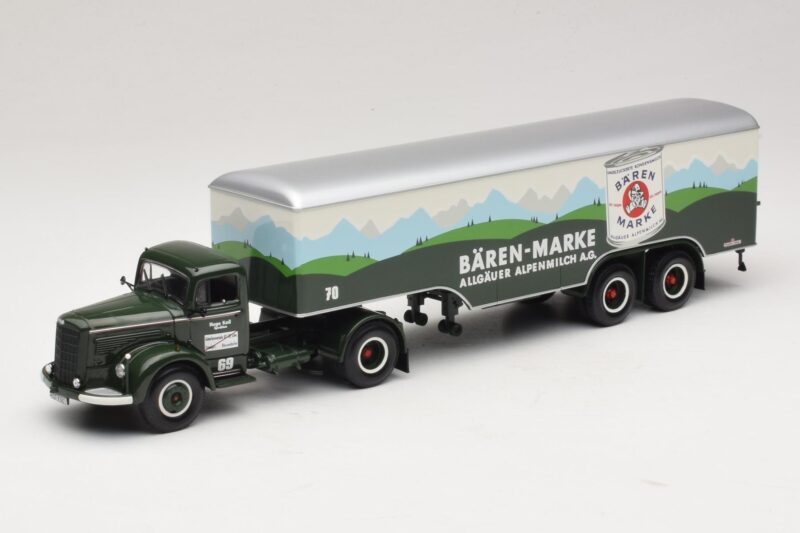
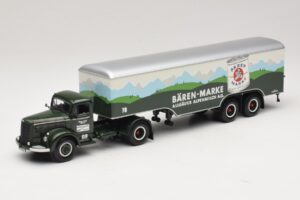
TL;DR: Minichamps' 1:43 Mercedes LS315 pairs the early forward-control tractor with a box-trailer body liveried for Bärenmarke, the German condensed-milk brand, dated to 1950. The body is sealed with no opening parts, so the box trailer's panel lines, the bear-logo tampo print, and the tractor coupling carry the presentation.
Bärenmarke built its brand around a bear cub logo stamped on tins of evaporated milk across German kitchens for generations, and that same friendly mark once traveled the country's roads on delivery trucks like this one. Minichamps mounts the box-trailer body on the same early LS315 forward-control tractor used elsewhere in its lineup, giving this 1950 rig a distinct cargo type.
A Koffersattelzug, a box-bodied semi-trailer combination, carries a completely different silhouette than the rounded tanker built on the same LS315 tractor: flat, upright side panels instead of a curved barrel, and a taller, squarer roofline that changes how light falls across the trailer's flanks. Where the tanker relies on a smooth curve to hold its paint convincingly, this box body depends on flat, consistent panel surfaces and crisp corner edges, a different casting challenge with its own failure points if the tolerances run loose. Minichamps keeps the box's corners sharp and its side panels flat rather than slightly bowed, the detail that separates a well-tooled box trailer from a cheaper one.
The bear cub mascot sits prominently on the trailer's side panel, rendered in tampo print with clean, unbroken outlines rather than the soft edges a lower-resolution printing method would produce. Getting a character logo like this right matters more than plain lettering, since any blur or misregistration on a recognizable mascot is immediately obvious even to someone who has never seen the real brand. Minichamps keeps the bear's outline crisp and the surrounding lettering legible at the small scale, which is the standard a character-branded livery has to clear to satisfy a collector who already knows what the logo should look like.
The box trailer's sides are molded with the fine vertical ribbing typical of period sheet-metal trailer construction, and that ribbing catches light differently than the tanker's smooth curve, giving the two LS315 variants a genuinely different visual texture even at a glance from across a room. Roof seams and corner posts are picked out as raised lines rather than left flat, adding surface detail that separates a considered box-trailer casting from a slab-sided placeholder shape. That texture is worth studying up close, since it is the kind of detail a photograph on a listing page rarely conveys but a shelf under direct light reveals immediately.
As with the tanker version, this box trailer has no opening rear doors and no moving coupling mechanism, so the tractor-to-trailer connection is the one place where two separately molded pieces have to meet convincingly. Minichamps sets the box trailer at the same ride height as the tanker trailer, keeping both variants visually consistent when displayed together despite their very different cargo bodies. It is a subtle form of quality control: a tractor tooled to work convincingly with two different trailer bodies has to get its rear frame height right just once, rather than compromising for whichever trailer happens to be attached that day.
Set beside the Esso tanker built on the same tractor, this Bärenmarke box trailer tells a broader story about how one truck platform served completely different industries on 1950s German roads, from fuel distribution to food logistics, without needing a different tractor for each job. Displayed together, the pair highlights how much a trailer body changes a rig's character even when the front half is identical casting to casting. For a collector drawn to character-branded livery, the bear logo is the more immediately charming of the two, while the Esso tanker carries wider brand recognition for an American audience. Either one stands on its own, but the two together make the stronger case for the LS315 as a versatile period tractor rather than a single-purpose truck.