Last one
Used
TL;DR: Minichamps' 1:43 diecast Mercedes-Benz O 3500 bus reproduces the rounded postwar bread-loaf body in Sadar livery, cast as a sealed zinc-alloy shell with mapped side glazing. Dated to 1950, it suits a commercial-vehicle shelf rather than a sports-car display, at an accessible price point.
Bus and truck models occupy a smaller corner of the diecast hobby than sports cars, but that corner has its own devoted following. Mercedes-Benz's O 3500 sits near the start of that story, one of the first bus designs West Germany produced after the war, and Minichamps treats the subject with real care.
Mercedes-Benz introduced the O 3500 at the end of the 1940s as one of the first fully new bus designs West Germany produced after the war. Where prewar buses generally used a bonneted chassis borrowed from trucks, the O 3500 wore a rounded, fully enclosed body that collectors and enthusiasts nicknamed the bread loaf for its curved nose and roofline. That shape, paired with a rear-mounted diesel engine, became one of the defining silhouettes of early postwar European bus travel, and the design was influential enough that it saw licensed production in several countries beyond Germany.
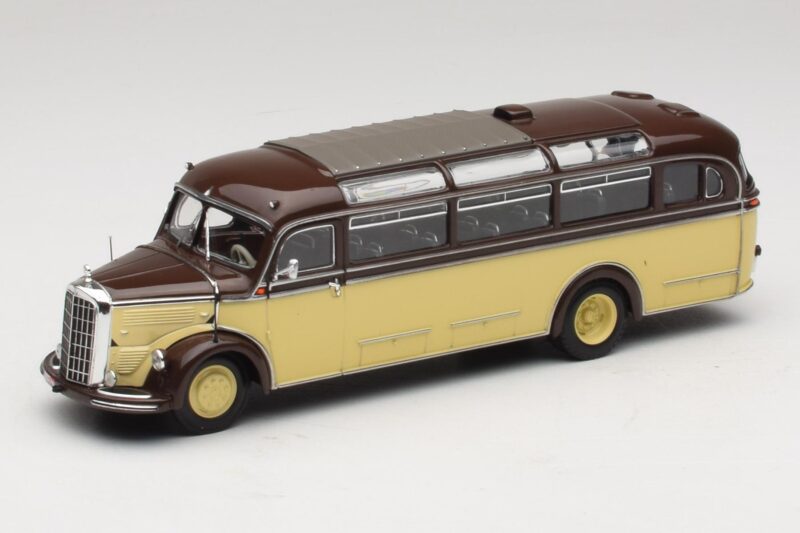
This particular casting wears a livery lettered for Sadar, one of the operators that ran buses of this type during the model's period. Minichamps applies the scheme as period-correct decoration on the O 3500 shell rather than reworking the tooling, which keeps the proportions and window count faithful to the real vehicle while giving the model its own regional identity. For a subject built in 1950, in a body style that most collectors only encounter through this kind of miniature, that livery accuracy matters more than it would on a more commonly reproduced car. At 1:43, the O 3500's real-world length translates into a model just over ten centimeters long, small enough to sit alongside sedans of the same era without dominating a shelf built primarily for cars.
Minichamps casts the O 3500 as a sealed, one-piece zinc-alloy body, and on a bus that shape works in the model's favor. A vehicle this long has more flank to keep straight than a coupe does, and a fixed shell lets the tooling hold a single, unbroken window line down each side rather than negotiating hinge gaps across a dozen window bays. The metal itself brings real weight to the hand, more than a resin casting of the same size would, and that density is part of what a zinc-alloy diecast is chosen for at this scale.
Paint sits on the hard shell with the kind of depth that reads well under a display light, and the O 3500's rounded nose and roofline give the painter a continuous surface to work rather than a series of interrupted panels. The side glazing is mapped as a single clear insert with printed window dividers rather than individual pieces, a sensible approach on a vehicle with this many bays, and the wheels and mirrors hold their proportions against the tall, narrow body. At the price this model occupies, that combination, correct stance, consistent glazing, and clean livery printing, is what a buyer should expect rather than a bonus. Kept out of direct sun and handled by the chassis rather than the roof, a casting like this holds its finish for decades on a display shelf.
Commercial-vehicle models like this O 3500 rarely headline a collection, but they give a shelf built around sedans and coupes real texture. At 1:43, a full-size bus reduces to a model roughly the length of a large sedan, so it sits comfortably among period cars from the same decade rather than requiring its own display case. Collectors assembling a postwar-Europe or transport-themed shelf tend to reach for pieces exactly like this one: a subject other manufacturers rarely tool, in a livery specific enough to anchor a story. It is not a hero piece, and it is not priced like one, but for the collector chasing breadth over another sports car, that is precisely the point. A small-scale bus like this also travels well between shelves, light enough to reposition as a themed display grows.