Last one
Used

This model is currently sold out. Enter your email and we'll let you know when it's back in stock.
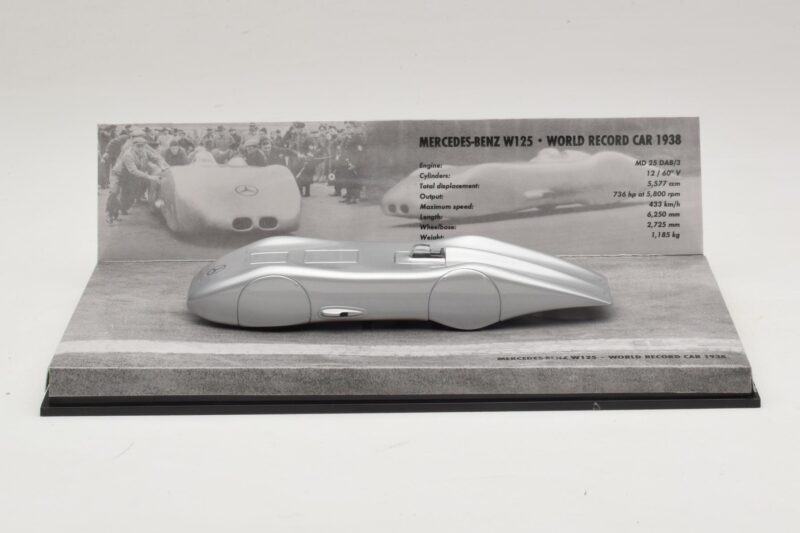
TL;DR: Minichamps' 1:43 diecast reproduces the Mercedes-Benz W125 streamliner that Rudolf Caracciola drove to a 268-mph public-road speed record on the Frankfurt-Darmstadt Autobahn in January 1938, a mark that stood for decades. The sealed body captures the record car's enclosed, teardrop bodywork in fixed diecast.
Some model subjects need context; this one carries its own. The number is simple to state and hard to fully absorb: a road car, on a public highway, at nearly 269 miles per hour, in 1938, years before jet engines made such speeds routine anywhere.
On 28 January 1938, Rudolf Caracciola drove a specially streamlined Mercedes-Benz W125 to a two-way average of roughly 268 miles per hour on a closed stretch of the Frankfurt-Darmstadt Autobahn, a record for a car running on a public road that stood unbroken for decades. The run was part of a government-sanctioned series of high-speed demonstrations meant to showcase German engineering on the new Autobahn network, with Mercedes-Benz and rival Auto Union each fielding purpose-built record cars. Later that year, Bernd Rosemeyer died attempting to beat Caracciola's mark in an Auto Union streamliner on the same road, a tragedy that ended the era of public-road record runs almost as abruptly as it had begun.
This record car shared its designation with Mercedes-Benz's dominant W125 Grand Prix chassis but wore an entirely different skin, a fully enclosed, low-slung body designed purely to cut through air at speeds no open-wheel racer would ever see on a circuit. Wheels sat concealed behind smooth fairings, the cockpit canopy sat nearly flush with the beltline, and every surface curved toward minimizing drag rather than generating downforce, since downforce was irrelevant on a straight-line run. The result looked less like a racing car and more like an aircraft fuselage on wheels, an engineering answer to a very specific, very narrow question.
A shape built entirely around airflow leaves a diecast manufacturer nowhere to compromise: every panel line, wheel fairing, and canopy curve either reads correctly or the model looks wrong to anyone who has seen a photograph of the original. Minichamps' casting follows the enclosed wheel arches and the tapering tail faithfully, and the proportions hold at 1:43 in a way that smaller-scale interpretations of the same subject sometimes lose. Because the real car's entire purpose was minimizing surface disruption, a diecast reproduction of it is judged almost purely on outline and surface smoothness, criteria a sealed one-piece body happens to satisfy naturally rather than by necessity.
There is no opening panel on this model, and for a subject this streamlined that is the honest choice rather than a limitation: the real car's bodywork was designed as one continuous enclosure, with no visible shut lines to begin with. Minichamps' zinc alloy construction gives the piece real weight and keeps the long, low profile stable on a shelf rather than prone to tipping, a practical concern on a body this narrow. Paint reads in the silver associated with German factory racing of the period, applied evenly across curves that leave nowhere for a flaw to hide.
Few subjects in scale model collecting carry a story this concrete: an exact date, an exact speed, a name still cited whenever public-road record runs come up in conversation. That specificity makes this W125 record car work two ways on a shelf, as a highlight in a broader Mercedes-Benz chronology stretching from pre-war Grand Prix racers to modern GT programs, or as the centerpiece of a narrower collection built specifically around land-speed and record-breaking machinery from any era or marque. At 1:43, the car's genuinely unusual proportions, long, low, and narrow, stand out even next to conventional 1930s racers on the same shelf. For a collector who values documented history over racing results alone, this is among the more substantive pre-war subjects available in the format.