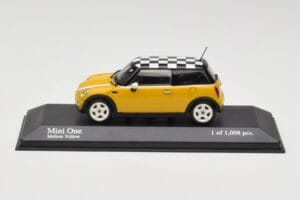
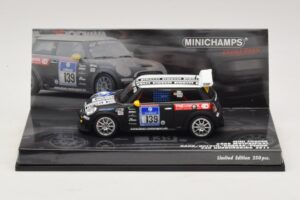
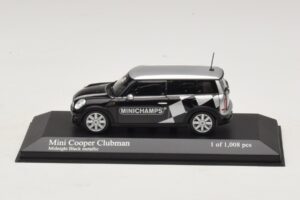
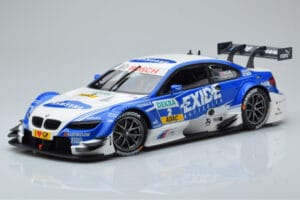
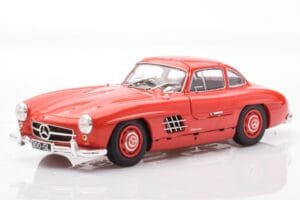
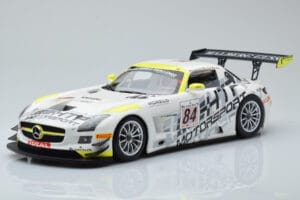
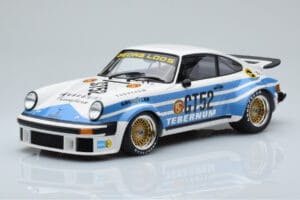
MINI Cooper R50 Black Minichamps 1:43
Price:
55.00 €
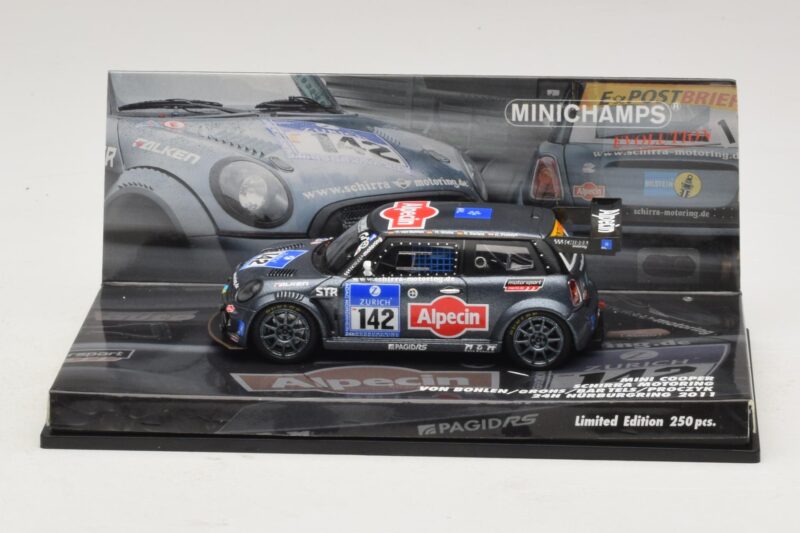
TL;DR: Minichamps' 1:43 diecast reproduces the #142 Mini Cooper that Schirra Motorsport entered at the 2011 Nurburgring 24 Hours, driven by Von Bohlen and Franz Grohs. The sealed zinc alloy body carries the racing shell's flared arches and tampo-printed sponsor livery, a modern counterpoint to the older touring cars Minichamps also covers.
The Nurburgring 24 Hours has run compact, production-based touring cars alongside GT machinery for decades, and a Mini Cooper entry fits that tradition well. This #142 car, campaigned by Schirra Motorsport in 2011, represents the smaller-displacement end of a grid that has always rewarded reliability as much as raw pace.
This Mini Cooper is cast as a sealed zinc alloy shell at 1:43, the flared arches and roll-cage-era stance molded into the body rather than assembled from separate panels. That construction keeps the Schirra Motorsport sponsor graphics, the #142 roundel, and the driver credits crisp as tampo prints, holding sharp edges even at this compact scale. The finish carries a hard, even gloss, and the smaller Mini shell shows off zinc alloy's weight advantage over a lighter promotional casting almost more than a larger prototype would. That weight-to-size ratio is part of what makes small-scale racing castings satisfying to handle, even when the car itself is a compact hatchback rather than a full-size prototype.
Compared with a street Mini Cooper casting, this entry carries wider arches, a roof-mounted number panel, and racing livery graphics that replace the factory paint scheme entirely. Checking those details, arch width, livery registration, and the racing wheel and tire proportions, against period photography of the actual Schirra Motorsport car is the clearest way to judge this casting's accuracy. Nurburgring entries also tend to carry more roll-cage and safety equipment detail than shorter-format touring car liveries, since the 24-hour format demands it. Minichamps molding those wider arches and the roof panel directly into a sealed shell keeps the racing silhouette convincing without relying on fragile separate parts at this scale.
The Nurburgring 24 Hours has always drawn its character from grid diversity, GT3 and GT4 machinery running alongside production-based touring cars like this Mini Cooper on the same circuit and often in similar lap times through the Nordschleife's twists. That format gives smaller-displacement entries genuine relevance rather than relegating them to a token class, since a well-driven touring car can post competitive results within its own category across 24 hours of racing. That mix of categories on one circuit is a big part of the Nurburgring 24 Hours' enduring appeal, and it's why a Mini Cooper casting can sit comfortably beside GT3 machinery on the same shelf.
Teams like Schirra Motorsport represent the backbone of Nurburgring's touring car classes, privateer outfits running production-based cars on a fraction of a factory GT programme's budget. Franz Grohs brought decades of touring and GT racing experience to entries like this one, the kind of veteran presence that keeps a smaller team competitive across a demanding 24-hour format. That experience matters more over 24 hours than it would in a shorter sprint race, where car and driver both need to hold together lap after lap without a single costly mistake. This #142 entry is a small but genuine part of that endurance tradition, built on consistency rather than headline pace.
Set against 1980s and 1990s touring car liveries, this 2011 Mini Cooper shows how little the sport's underlying logic has actually changed, production-based shells, privateer teams, and grid diversity all still defining endurance racing decades later. Check the arch width and livery registration against reference photography, then place it beside older Group A entries to see the throughline. That contrast between eras is worth building a shelf around, rather than sticking to one decade alone. A modern entry like this one keeps an endurance-focused collection from feeling frozen in the 1980s and 1990s. It's a small, honest addition, and a useful bridge between older and newer touring car eras on the same shelf. That bridge role is exactly what a well-detailed modern casting like this one should provide.