Used

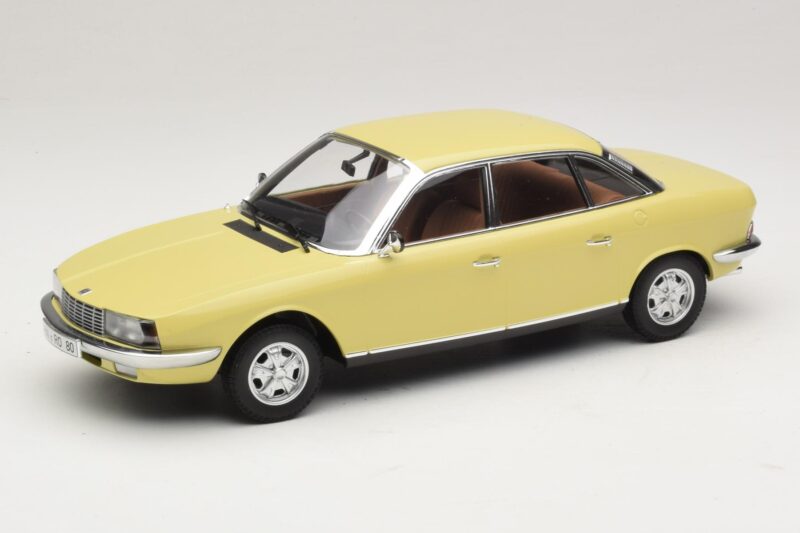
TL;DR: Minichamps' 1:18 diecast reproduces the NSU Ro80 in yellow, the 1972 sedan whose Wankel rotary engine and wind-cheating aerodynamic body made it one of the era's most technically ambitious designs. The sealed shell captures the Ro80's smooth, unbroken lines, a shape that influenced later Audi styling after NSU's absorption into the VW Group.
The Ro80 looked like nothing else on German roads in 1967, and it still doesn't quite resemble anything from its own decade. NSU built its reputation on that risk, betting on a rotary engine and a slippery, low-drag body years before either idea became mainstream, and Minichamps' 1:18 casting gives that gamble the careful surface treatment it deserves.
The Ro80's entire design premise rested on drag reduction, a wedge-nosed profile with a low, sloping roofline and minimal ornamentation that looked years ahead of the boxy sedans surrounding it in showrooms. Minichamps casts this replica as a fixed, one-piece body, and for a car whose original appeal was pure surface continuity, that construction choice suits the subject well. There is no hinge line to interrupt the beltline crease running the length of the car, and the roof-to-pillar transition holds the same smooth, unbroken curve the real Ro80's stylists worked to achieve. The yellow paintwork sits with genuine depth on the diecast shell, catching light differently across the sloped hood and rear deck than it would on a flatter, more conventional sedan silhouette. Chrome trim around the windows and along the bumpers is finished with a bright, distinct finish rather than left as a dull, uniform gray, and the wheel design reflects the period-correct steel wheel and hubcap pattern rather than a generic aftermarket substitute. Badging on the nose and trunk carries correct NSU lettering, small but legible under close inspection. Interior detail, visible through the glazing, follows the Ro80's genuinely modern-for-its-time dashboard layout rather than a generic 1970s sedan cabin. For a car whose reputation rests almost entirely on its silhouette rather than mechanical drama visible from outside, a sealed body lets that silhouette speak clearly, uninterrupted by a shut line the original design never needed to disguise.
NSU built the Ro80 around a twin-rotor Wankel engine, a genuinely novel powertrain choice for a mainstream manufacturer in the late 1960s, and the car won European Car of the Year honors in 1968 largely on the strength of its engineering ambition and aerodynamic design. The rotary engine offered smoothness and a compact footprint that let NSU's designers push the cabin forward and lower the bonnet line, directly enabling the body shape this model reproduces. Reliability proved to be the Ro80's undoing: rotor tip seals wore prematurely under real-world conditions, leading to widespread engine failures and warranty claims that NSU's finances could not absorb. The resulting costs contributed directly to NSU's 1969 merger into Volkswagen's Audi division, effectively ending NSU as an independent manufacturer within a few years of the Ro80's launch. Audi inherited NSU's engineering culture and, indirectly, some of the aerodynamic thinking behind the Ro80, a lineage visible in Audi's own styling emphasis on smooth surfaces in later decades. By 1972, the year this specific casting represents, the Ro80 remained in production but NSU's independent future was already effectively settled. Few sedans carry this particular combination: a genuinely influential design wrapped around a mechanical gamble that ultimately cost the manufacturer its independence, which gives the Ro80 a significance well beyond its modest sales figures.
The Ro80 suits a collection built around design history rather than racing pedigree, sitting naturally alongside other aerodynamically ambitious sedans from the same period or early Audi models that inherited its styling language. At 1:18, its low, wide stance takes up more shelf width than a taller, boxier contemporary sedan, worth accounting for when planning cabinet layout. This is a niche subject for the US market specifically, where the Ro80 was never officially sold, making a well-detailed casting one of the more practical ways American collectors will ever encounter the car's shape up close. Yellow paintwork, less common than the car's period white or silver options, adds a distinctive accent for anyone building a color-varied vintage German lineup.