Last one
Used
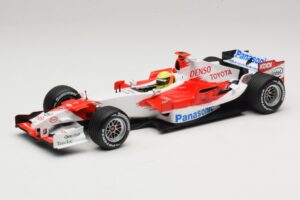
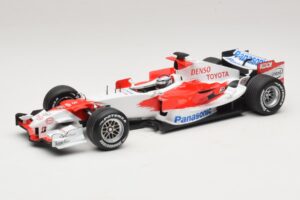
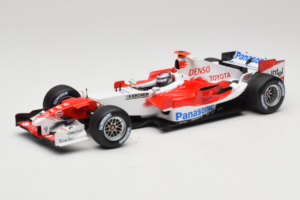
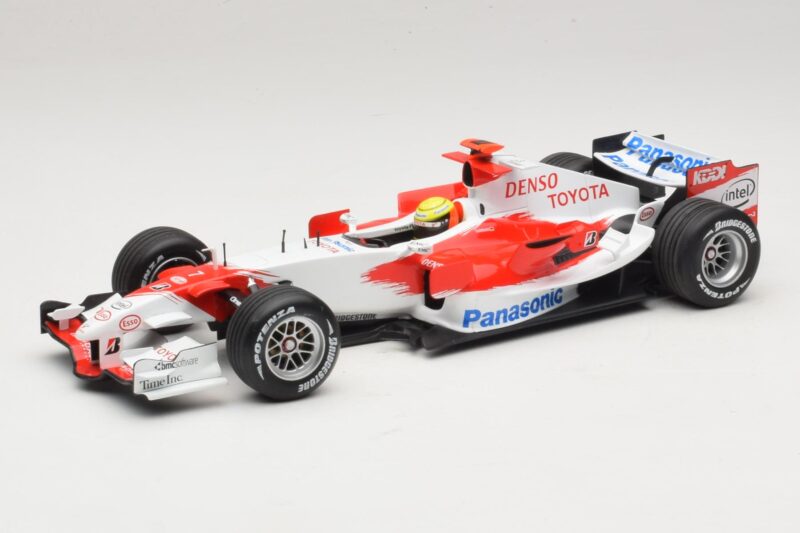
Panasonic Toyota Racing TF106 #12 R. Schumacher Presentation 2006 Minichamps 1:18
Only 1 left
Price:
104.00 €
This model is currently sold out. Enter your email and we'll let you know when it's back in stock.
TL;DR: Minichamps' 1:18 diecast reproduces Ralf Schumacher's #12 Panasonic Toyota Racing TF106 from the 2006 Formula One season, the year the sport switched from V10 to V8 engines. Cast as a single sealed shell, it captures the works team's white and red livery with tight tampo-printed sponsor graphics, a mid-premium anchor for a period F1 grid display.
Ralf Schumacher arrived at Toyota in 2005 with a résumé built at Williams and Jordan, joining a factory team that engineered its own chassis and engine in Cologne. The TF106 he raced in 2006 wore Panasonic Toyota Racing colors through Formula One's biggest engine change in over a decade. Minichamps renders that car in 1:18 diecast, letting sponsor decals and aero details read clearly on the shelf.
Toyota entered Formula One in 2002 running a genuine works program, designing both chassis and engine at its Cologne technical center rather than buying power units from an outside supplier the way most midfield teams did. That distinction set the team apart from customer outfits filling out the rest of the grid. The TF106 arrived for 2006, the works team's fifth full season, continuing that manufacturer commitment through a year that would reshape every car on the grid regardless of budget or pedigree. Few of Toyota's rivals could claim the same level of self-sufficiency, which is why the TF106 carries more engineering weight than its results alone suggest.
That year Formula One retired the high-revving 3.0-liter V10 for a smaller 2.4-liter V8, a regulation change that forced every manufacturer to develop a new powertrain over a single winter. Toyota built its own RVX-06 rather than sourcing an engine, staying true to the full manufacturer commitment that defined the team since its debut. Aerodynamic surfaces were reworked for the new formula: a tall front wing, sculpted bargeboards ahead of the sidepods, and a rear wing and diffuser tuned for the lower-revving unit. Toyota spent eight seasons in Formula One without a race win, a fact worth stating plainly rather than glossing over, but the works-team ambition behind the TF106 is exactly what makes its diecast reproduction worth a close look.
Ralf Schumacher spent six seasons at Williams after two years at Jordan, building a reputation as a fast, occasionally combustible teammate before Toyota signed him for 2005. Being the younger brother of Michael Schumacher gave him name recognition few grid regulars carried, and it followed him to Cologne when he switched from a customer chassis to a full works seat. He carried car number 12 through the TF106's single season, running behind teammate Jarno Trulli's number 11 on a two-car works entry fielded straight from the factory.
The Panasonic branding across the nose, sidepods, and engine cover marks this as a factory-sponsored livery rather than a generic team scheme, and Minichamps' tampo printing has to register that sponsor typography cleanly against the white body panels for the model to read correctly at a glance. The red accents running along the sidepod intakes and rear wing endplates break up what would otherwise be a stark white shell, and getting that transition sharp, without bleed or misalignment, is one of the first things a collector should check when evaluating a boxed example. Schumacher's and Trulli's numbers sit close together on the grid order, a small piece of collecting logic for buyers assembling the complete 2006 Toyota garage.
An open-wheel car does not give a diecast manufacturer the doors, hoods, or trunks that road-car models rely on for feature lists, so Minichamps casts the TF106 as a single sealed shell with no moving panels. That is simply how a Formula One diecast at this scale should be built. There is no engine bay to open, no depiction of what sits under the composite bodywork, because the whole point of an open-wheel chassis is that it has no bodywork to lift off. What the fixed casting has to get right instead is the aero package: the front wing's cascade elements, the sidepod inlet shapes, the rear wing and diffuser, and the exposed cockpit that lets a driver figure or seat detail sit visible from above, exactly as it would on the real car parked in the paddock. Zinc alloy gives the model real heft for its size, denser than the plastic toy-grade F1 replicas found in big-box stores, and that weight is one of the fastest ways to tell a mid-premium diecast apart from a lower-tier one when handling it in the box. Panel gaps are not a consideration here, but paint depth and decal registration are, and Minichamps has built its reputation in the motorsport diecast segment specifically on getting sponsor typography, number panels, and helmet-scale detail sharp enough to survive close inspection under a display light.
At 1:18, a Formula One car this long comes out to roughly 26 centimeters nose to tail, low and wide enough that it needs more shelf depth than height, unlike the sedans and coupes that dominate most cabinets. Pairing this Schumacher car with the matching Trulli TF106 gives a complete two-car works entry from a single season, which is the kind of set collectors specializing by team rather than by manufacturer tend to chase. Minichamps sits in a mid-premium tier here: above mass-market toy diecast, below the ultra-limited resin runs that some specialist makers produce for grid cars in far smaller numbers. That positioning is honest rather than aspirational. It buys sharp tampo work and real metal weight without the price of a hand-finished resin piece, and for a season that produced no wins, that is the right amount of investment for the story this car actually tells.