Last one

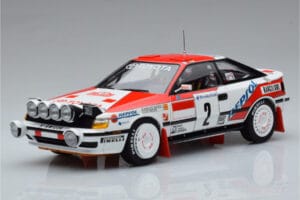
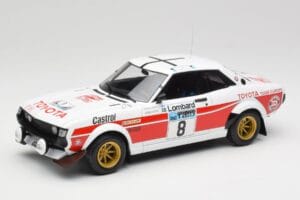
Toyota Celica GT-Four ST165 #3 B. Waldegard / F. Gallagher Winner Safari Rally 1990 Kyosho 1:18
Only 1 left
Price:
252.00 €
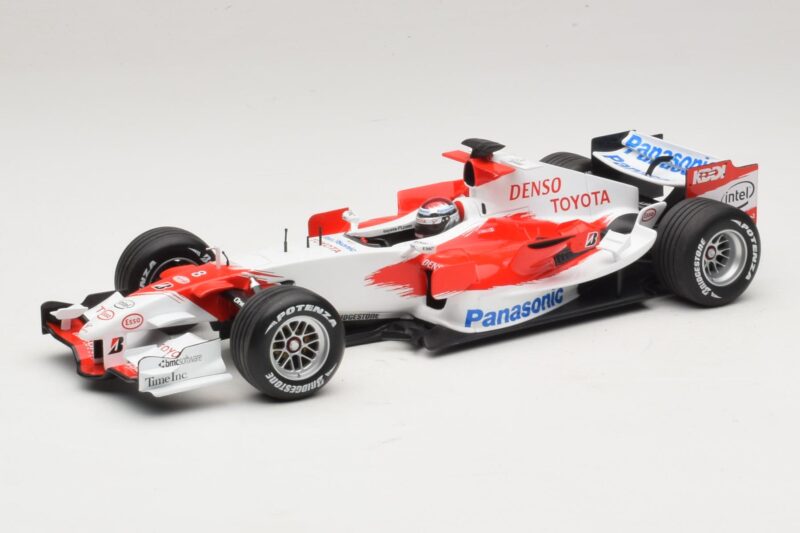
TL;DR: Minichamps' 1:18 diecast reproduces Jarno Trulli's #11 Panasonic Toyota Racing TF106 from the 2006 Formula One season, built on the works team's own chassis and Toyota's first V8-era engine. Cast as a single sealed shell, the model carries the Panasonic livery's white and red scheme with tampo-printed sponsor graphics, a mid-premium companion to the matching Schumacher entry.
Jarno Trulli won the 2004 Monaco Grand Prix at Renault and built a reputation for blistering qualifying laps that outran his race-day results, a trait that earned him the nickname the Trulli train. He carried that reputation to Toyota's factory team, taking car number 11 for the TF106 in 2006. Minichamps casts that car in 1:18 diecast, scaled to display the sponsor decals and aero surfaces the works effort ran.
Trulli's route to Toyota ran through Minardi, Prost, and Jordan before he landed at Renault in 2002, where he took his only Formula One win at the 2004 Monaco Grand Prix, a street circuit that rewards exactly the kind of clean, precise lap he was known for. He left Renault before that season ended and finished 2004 at Toyota, then stayed on as a full-time driver when the TF106 arrived for the works team's fifth year on the grid. That continuity of a single works team across three seasons is unusual in a sport where drivers change teams almost every year, and it gave Trulli a level of familiarity with Toyota's engineering culture that few rivals could match.
That continuity mattered because Toyota's 2006 program required drivers already familiar with a team that engineered its own chassis and its own engine rather than buying power units the way most of the midfield did. The TF106 itself marked the start of Formula One's V8 era, the sport having retired the high-revving 3.0-liter V10 for a 2.4-liter V8 that every manufacturer had to develop from scratch that winter. Toyota's version, the RVX-06, was built at the same Cologne facility that produced the chassis, a genuine manufacturer effort rather than a chassis constructor renting an engine deal. Trulli spent that season learning Toyota's new V8 powertrain in a car built entirely in-house.
Trulli carried car number 11 through the 2006 season, one slot ahead of teammate Ralf Schumacher's number 12, the standard arrangement for a team's nominally lead entry. His reputation as one of the fastest qualifiers of his generation, fast enough to be dubbed the Trulli train by rivals who found him difficult to pass once the race got underway, made him a fixture near the front of Saturday sessions even when Sunday results lagged behind. That contrast between one-lap pace and race pace is part of what makes a driver's specific car worth collecting rather than any generic entry in the same livery.
The Panasonic Toyota Racing scheme carried its sponsor's name across the nose cone and both sidepod flanks in the team's signature red lettering against white bodywork, with the number 11 rendered in a contrasting panel ahead of the cockpit opening. Minichamps' tampo work has to keep that number crisp and correctly sized relative to the surrounding sponsor graphics, since a car identified by number as much as by driver name loses its collecting identity if the digits blur or sit off-register. The exposed cockpit shows a seated driver figure in period Toyota team colors, a detail that separates a serious motorsport diecast from a simplified toy-grade version of the same subject.
Formula One cars carry no doors, hoods, or trunks, so a sealed one-piece diecast body is not a compromise on this subject the way it might be on a road car with a lift-off hood. Minichamps builds the TF106 as a single zinc alloy casting, with every aero surface, from the front wing's multi-element cascade to the rear diffuser's fins, fixed in place exactly as the real chassis left the factory. The open cockpit is part of the car's design rather than a movable feature, so the driver figure, seat, and steering wheel sit visible from above without any panel needing to lift for the detail to show. Weight is the first thing worth checking against a lower-tier alternative: zinc alloy gives this model a density in the hand that lightweight plastic toy versions of the same TF106 simply cannot replicate, and that heft is a fair proxy for the tooling investment behind it. Paint and decal work carry more of the burden on an open-wheel subject than on a saloon car, since there are no shut lines or panel gaps to judge and the entire visual argument comes down to livery accuracy. Sponsor typography, number panels, and the transition between the white body and red accent zones all need to sit sharp and correctly registered, which is the standard Minichamps has built its motorsport reputation on.
At 1:18, the TF106's low, wide proportions come out to roughly 26 centimeters long, a footprint that asks for shelf depth rather than height and sits oddly next to taller road-car models unless grouped with other single-seat racing subjects. Set beside the matching Schumacher car, this Trulli entry completes the full 2006 Panasonic Toyota Racing lineup, which is the more natural way to collect works-team liveries than chasing one famous name in isolation. Minichamps occupies a mid-premium spot in the F1 diecast hierarchy, ahead of mass-market toy versions and behind the small-run resin pieces some specialist makers reserve for grid cars in far smaller numbers. That is an honest place to sit for a season in which Toyota, for all its manufacturer investment, never reached the top step. The model earns its price through construction and livery accuracy rather than through result-driven prestige, which is exactly what a season like this one calls for.