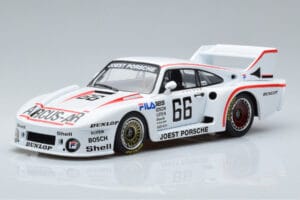
Porsche 935J #66 J. Mass Joest Racing Nurburgring DRM 1981 MCG 1:18
You save 7.00 €
Lowest price in the 30 days before the reduction: 51.00 €
VAT included
You save 25.00 €
Lowest price in the 30 days before the reduction: 224.00 €
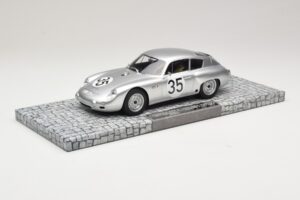
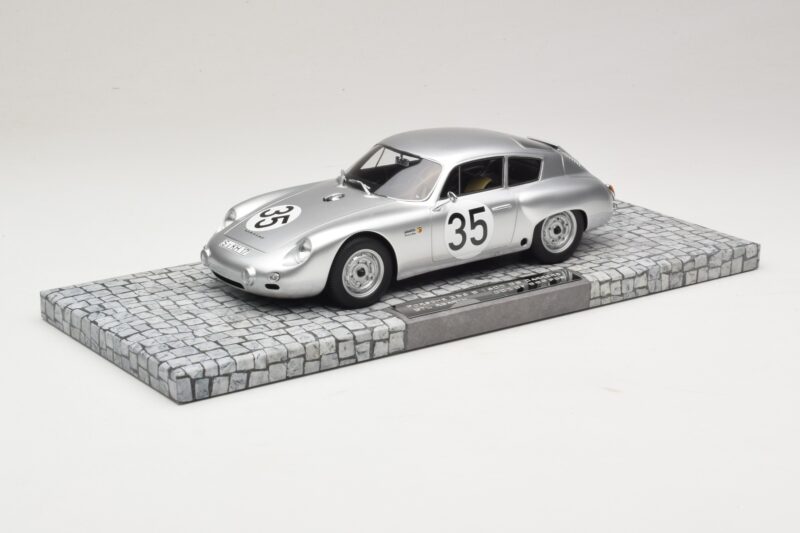
TL;DR: The Minichamps Porsche 356 B 1600 GS Carrera GTL Abarth 1:18 is a resin replica of the #35 car shared by H. Linge and H. Walter at the 1960 24 Hours of Le Mans. A sealed one-piece body puts the Abarth-bodied coupe lines and race livery at the center of the display.
Light, low and built for long straights on a small engine, the Carrera GTL Abarth is the 356 at its most single-minded. Minichamps' 1:18 Porsche 356 B Carrera GTL Abarth gives historic GT collectors a Le Mans entry that reads as pure competition, not a dressed-up road coupe.
Resin is cast, not pressed, and a coupe this compact shows why collectors reach for it. The roofline flows into the rear deck without the softened edges pressure-cast metal tends to leave, and the shut lines trace the body as single fine grooves because nothing on this model opens. That is the collecting priority here: surface precision over interior access. Lifted off the shelf, the piece feels lighter than a zinc-alloy 1:18 of similar length, which suits a car that was itself built light. The trade-off is brittleness. Resin forgives a gentle hand but not a drop, so handle the model by its base, never by mirrors or lamps.
Racing coupes of 1960 carried their identity on the outside: a number roundel, a few painted or printed panels, and very little else. On this model the #35 sits where the entry carried it, and the fidelity test is simple. Check that number edges are crisp, that the glazing sits flush without a visible rim of glue, and that the wheels sit centered in their arches at a believable ride height. Under a direct lamp, the paint should read smooth and even, free of orange-peel texture, with the lettering lying flat against the surface rather than standing proud of it.
The 356 B Carrera used Porsche's four-cam 1.6-liter engine, the 1600 GS of this model's designation, and the GTL variant wore lightweight coachwork built by Abarth. The result looks quite different from a standard 356: a smoother, more aerodynamic shape with a tail that clearly belongs to a competition car. Minichamps keeps that distinction legible in the casting, which is the first thing a historic Porsche collector checks when a standard 356 coupe sits on the shelf nearby. Seen side by side, the proportions tell the story before any badge or lettering does.
Le Mans in 1960 ran over twenty-four hours in June, and small-capacity GT cars like this one raced in classes shaped around endurance and reliability rather than outright speed. The model is dated by the event: H. Linge and H. Walter shared the car, and the #35 livery pins this piece to one race rather than to the 356 in general. Collectors who like a themed run, such as Le Mans GT entries of a single era, will find that specificity useful. No result claim is needed to justify the choice; the entry itself is the story, and the replica carries it faithfully.
At 1:18 the real car's length of roughly four meters becomes a model near 22 cm, small enough for a standard cabinet shelf yet large enough to show lettering and wheel detail. It pairs naturally with other historic GT and sports-racing resin from the same era, where its modest proportions create a pleasing contrast with larger prototypes. Minichamps resin sits in the mid-premium segment: finer than mass-market diecast, short of hand-assembled metal builds. Accept the plain trade-off, no opening panels in exchange for surface crispness. Keep it out of direct sun, dust it with a soft brush, and place it where a lamp can rake across the roof and shoulder. Buyers building a Le Mans timeline will find this a natural 1960 entry.