Used
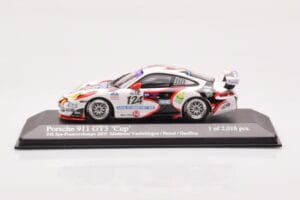
Porsche 911 997 GT3 Cup #124 Mattheus / Geoffroy / Vanbellingen / Fumal 24 Hours of Spa 2005 Minichamps 1:43
Only 3 left
Price:
33.00 €
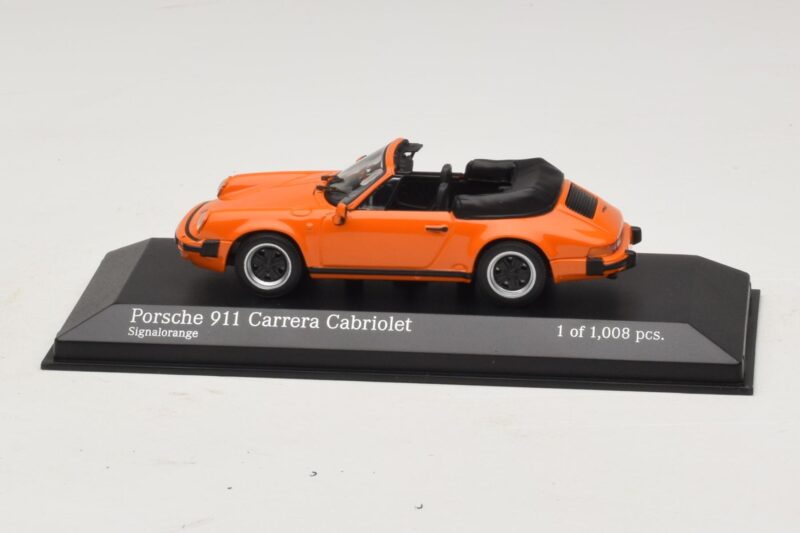
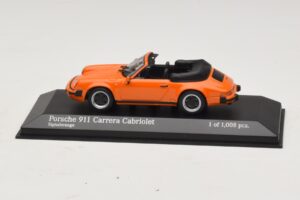
TL;DR: Minichamps' 1:43 diecast Porsche 911 930 Carrera Cabriolet in orange reproduces 1983's first factory 911 soft-top in a bold period color, wide Turbo-derived hips and folded fabric roof cast as a sealed one-piece body, giving a mostly grey-and-silver 1980s Porsche shelf its brightest accent piece.
Same shape, different statement: this Cabriolet shares its widebody stance and folded soft-top with the grey metallic version Minichamps also produces, but orange changes the entire read of the car. Where grey lets the silhouette do the work, orange draws immediate attention to the widened Turbo-derived hips from across a room, a period-correct choice that many 1983 buyers actually made.
Orange was a genuine, if attention-grabbing, factory option across Porsche's range in the early 1980s, and it suits the Cabriolet's widened Turbo-derived arches better than a subtler tone might. The wide hips and broad rear track that define this body style read as an intentional design statement under orange rather than an incidental one, and Minichamps' casting keeps those flared arches generously filled by the rear tires, avoiding the pinched look that undersized wheels can create on a scaled-down body. The wraparound rear bumper, correct G-series headlamp height, and the raised rear deck lid all carry over from the same tooling used for less vivid colorways, but the paint choice here changes how the whole shape is read on a shelf.
The fabric top sits closed and stowed behind the seats, cast as molded surface detail on a sealed one-piece body rather than a separate hinged piece. That construction keeps the fold lines in the top and the transition into the trunk lid crisp, something a moving mechanism would struggle to hold this consistently at 1:43. Bright orange paint makes any inconsistency in that shutline more visible than a darker color would, so the finish quality on this casting is held to a higher visual standard than a grey or black example would face. Chrome windshield trim and mirror housings provide the contrast points the eye actually settles on first.
Bright, saturated colors like this orange are harder to apply evenly than metallics or darker tones, because any thin patch or overspray reads immediately against a high-contrast finish. Minichamps holds the color consistent across the hood, doors, and rear deck without visible mottling, a sign of a controlled painting process rather than a quick dip. The zinc alloy body underneath gives the casting real weight leaving its case, and that mass is part of what makes the bright color feel substantial rather than toy-like. Panel lines stay shallow and even despite the high-contrast paint making every seam more visible than on a subdued color.
The Fuchs-style alloy wheels carry their deep-dish, five-spoke pattern with the correct offset, and against orange paint their polished detail stands out more sharply than it would against grey. Window glazing sits flush at the corners, avoiding a gap that would be far more noticeable under this finish than under a darker one. Chrome bumper trim and door handles separate cleanly from the body color, and the Porsche crest badging holds its edges under a loupe. Bright colors are, in a sense, a harder test for a manufacturer's finishing standards, and this casting passes that test.
Most 1980s 911 diecasts lean toward grey, black, silver, or white, factory colors that were common but visually reserved, so an orange Cabriolet earns its place as the piece that breaks up a row of muted tones. Displayed beside the grey metallic version of this same Cabriolet, the pair demonstrates how dramatically color alone changes the perceived aggression of an identical widebody shape, a genuinely useful side-by-side for anyone curious about period Porsche color strategy. At 1:43, adding a second colorway of the same model costs little shelf space, making it easy to justify owning both. For a collector already building a run of G-series 911s, this orange example is the one that gets noticed first.