Used

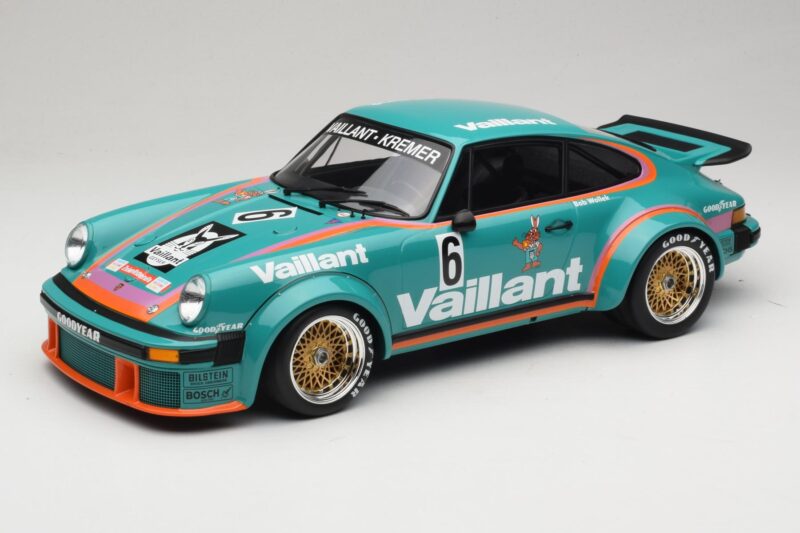
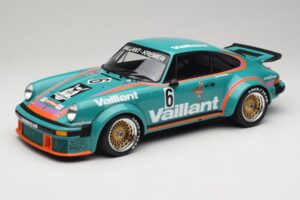
TL;DR: Minichamps' 1:12 diecast Porsche 911 934 reproduces the Vaillant-liveried #6 car Toine Hezemans drove to victory in the 1976 DRM round at Norisring. The one-piece zinc alloy body carries the livery in commanding museum-scale presence, built for display rather than mechanical inspection.
Vaillant's blue-and-white livery was one of the more recognizable sponsor liveries running through the DRM in the mid-1970s, and Minichamps picks the exact car and the exact round that livery is remembered for. At twelfth scale, that choice of subject carries real weight, literally and otherwise, on a shelf built around large-format display pieces.
Minichamps didn't pick this subject at random: the combination of car, livery, and result gives the casting a documented identity rather than a generic race-liveried shell.
Porsche built the 934 for the 1976 FIA Group 4 season, and the recipe stayed close to the road-going 911 Turbo underneath a single-turbo 3.0-liter flat six pushed well past its showroom output. Group 4 regulations kept the steel bodywork, glass, and bumpers largely production-spec, with wider arches bolted over the stock body rather than the flared composite panels the later Group 5 935 wore. That link back to a car customers could actually order is part of why the 934 reads as a genuine 911 rather than a pure racing prototype, and it is the exact shape Minichamps casts at twelfth scale.
The Vaillant livery carried through the Deutsche Rennsport Meisterschaft's mid-1970s seasons, and the number 6 configuration reproduced here ties to one specific result: Toine Hezemans took the win at Norisring in 1976, a tight street circuit through Nuremberg that stood among the DRM's signature rounds. Hezemans arrived at Porsche competition with an established touring car pedigree, and a win on a circuit as demanding as Norisring's city streets carried real weight within the series. Minichamps documents that exact result rather than a generic paint scheme, which is the detail a DRM collector checks first before anything else on the shelf.
This casting is a one-piece body: doors, hood, and decklid are molded into the shell, and nothing on the model opens. At twelfth scale that construction choice pays off directly, because the Vaillant graphics and the number 6 panel work run continuously across the door and quarter-panel lines with no hinge gap breaking the artwork. The shut lines instead read as single, consistent grooves, holding to the same width from the sill to the roofline rather than widening where a hinge would normally sit. Paint sits on the hard metal shell with real depth under a display light, and the glazing sits flush rather than proud, which matters more at this size than it would at a smaller scale where the eye forgives more.
Twelfth scale is a large-format commitment, roughly half again the footprint of a 1:18 piece, and that extra surface area leaves nowhere for soft tooling to hide. Zinc alloy brings real weight into the hand the moment it clears its packaging, a density no resin casting reaches, and that mass carries the wheel arches and rocker panels without the flex a lighter material would show. Wheel and tire proportions hold correctly against the arch, badge printing stays legible under close inspection, and the model's stance sits level rather than nose-high, the kind of detail that separates a considered large-scale release from a shrunken toy. Pieces at this scale and subject sit toward the upper end of the diecast range, a fair trade for the surface a collector actually gets to study.
A twelfth-scale Group 4 Porsche sits at a different point in a collection than the same subject at 1:18: less shelf density, more presence per piece, and a size that suits a handful of hero cars rather than a full DRM grid. Paired against 935s from the same series, or against Alfa and BMW rivals that ran the mid-1970s German championship, this 934 reads as one entry in a broader Group 4 and Group 5 story rather than an isolated racing subject. It suits a collector already committed to 1970s European touring and GT racing over the more common American motorsport diecast segment, and it rewards a display spot with clean, direct lighting where the sealed body's shut lines and Vaillant graphics can actually be seen rather than a case built around Le Mans regulars.