
Porsche 959 Sport Grand Prix White GT Spirit 1:12
New arrival
1
/
2
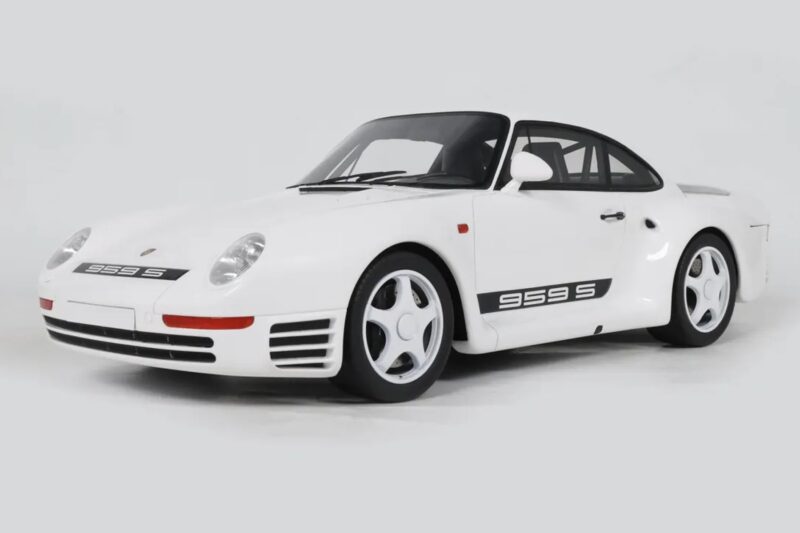
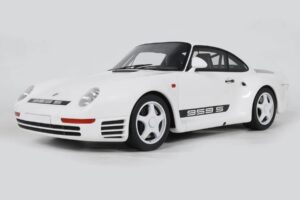
GT Spirit's 1:12 resin Porsche 959 Sport in Grand Prix White gives the Group B-era supercar the large-scale treatment it rarely gets. The body is a one-piece casting with no opening panels, so the shut lines stay tight and the paint runs unbroken over the wide haunches. At roughly 35 centimeters long, it is a centerpiece for a 1980s Porsche shelf.
1 / 2
[{"index":0,"id":"1696588","thumb":"https:\/\/models118.com\/wp-content\/uploads\/2026\/10\/porsche-959-sport-grand-prix-white-gt-spirit-1-12-gt1006-1-1-300x200.jpg","medium":"https:\/\/models118.com\/wp-content\/uploads\/2026\/10\/porsche-959-sport-grand-prix-white-gt-spirit-1-12-gt1006-1-1-800x533.jpg","full":"https:\/\/models118.com\/wp-content\/uploads\/2026\/10\/porsche-959-sport-grand-prix-white-gt-spirit-1-12-gt1006-1-1.jpg","srcset":"https:\/\/models118.com\/wp-content\/uploads\/2026\/10\/porsche-959-sport-grand-prix-white-gt-spirit-1-12-gt1006-1-1-800x533.jpg 800w, https:\/\/models118.com\/wp-content\/uploads\/2026\/10\/porsche-959-sport-grand-prix-white-gt-spirit-1-12-gt1006-1-1-300x200.jpg 300w, https:\/\/models118.com\/wp-content\/uploads\/2026\/10\/porsche-959-sport-grand-prix-white-gt-spirit-1-12-gt1006-1-1-480x320.jpg 480w, https:\/\/models118.com\/wp-content\/uploads\/2026\/10\/porsche-959-sport-grand-prix-white-gt-spirit-1-12-gt1006-1-1-64x43.jpg 64w, https:\/\/models118.com\/wp-content\/uploads\/2026\/10\/porsche-959-sport-grand-prix-white-gt-spirit-1-12-gt1006-1-1.jpg 1800w","sizes":"(max-width: 1023px) 400px, 640px","srcsetAvif":"https:\/\/models118.com\/wp-content\/uploads\/2026\/10\/porsche-959-sport-grand-prix-white-gt-spirit-1-12-gt1006-1-1-800x533.jpg.avif 800w, https:\/\/models118.com\/wp-content\/uploads\/2026\/10\/porsche-959-sport-grand-prix-white-gt-spirit-1-12-gt1006-1-1-300x200.jpg.avif 300w, https:\/\/models118.com\/wp-content\/uploads\/2026\/10\/porsche-959-sport-grand-prix-white-gt-spirit-1-12-gt1006-1-1-480x320.jpg.avif 480w, https:\/\/models118.com\/wp-content\/uploads\/2026\/10\/porsche-959-sport-grand-prix-white-gt-spirit-1-12-gt1006-1-1-64x43.jpg.avif 64w, https:\/\/models118.com\/wp-content\/uploads\/2026\/10\/porsche-959-sport-grand-prix-white-gt-spirit-1-12-gt1006-1-1.jpg.avif 1800w","srcsetWebp":"https:\/\/models118.com\/wp-content\/uploads\/2026\/10\/porsche-959-sport-grand-prix-white-gt-spirit-1-12-gt1006-1-1-800x533.jpg.webp 800w, https:\/\/models118.com\/wp-content\/uploads\/2026\/10\/porsche-959-sport-grand-prix-white-gt-spirit-1-12-gt1006-1-1-300x200.jpg.webp 300w, https:\/\/models118.com\/wp-content\/uploads\/2026\/10\/porsche-959-sport-grand-prix-white-gt-spirit-1-12-gt1006-1-1-480x320.jpg.webp 480w, https:\/\/models118.com\/wp-content\/uploads\/2026\/10\/porsche-959-sport-grand-prix-white-gt-spirit-1-12-gt1006-1-1-64x43.jpg.webp 64w, https:\/\/models118.com\/wp-content\/uploads\/2026\/10\/porsche-959-sport-grand-prix-white-gt-spirit-1-12-gt1006-1-1.jpg.webp 1800w","alt":"Porsche 959 Sport Grand Prix White GT Spirit 1:12 GT1006 Resin"},{"index":1,"id":1696590,"thumb":"https:\/\/models118.com\/wp-content\/uploads\/2026\/10\/porsche-959-sport-grand-prix-white-gt-spirit-1-12-gt1006-1-300x200.jpg","medium":"https:\/\/models118.com\/wp-content\/uploads\/2026\/10\/porsche-959-sport-grand-prix-white-gt-spirit-1-12-gt1006-1-800x533.jpg","full":"https:\/\/models118.com\/wp-content\/uploads\/2026\/10\/porsche-959-sport-grand-prix-white-gt-spirit-1-12-gt1006-1.jpg","srcset":"https:\/\/models118.com\/wp-content\/uploads\/2026\/10\/porsche-959-sport-grand-prix-white-gt-spirit-1-12-gt1006-1-800x533.jpg 800w, https:\/\/models118.com\/wp-content\/uploads\/2026\/10\/porsche-959-sport-grand-prix-white-gt-spirit-1-12-gt1006-1-300x200.jpg 300w, https:\/\/models118.com\/wp-content\/uploads\/2026\/10\/porsche-959-sport-grand-prix-white-gt-spirit-1-12-gt1006-1-480x320.jpg 480w, https:\/\/models118.com\/wp-content\/uploads\/2026\/10\/porsche-959-sport-grand-prix-white-gt-spirit-1-12-gt1006-1-64x43.jpg 64w, https:\/\/models118.com\/wp-content\/uploads\/2026\/10\/porsche-959-sport-grand-prix-white-gt-spirit-1-12-gt1006-1.jpg 1800w","sizes":"(max-width: 1023px) 400px, 640px","srcsetAvif":"https:\/\/models118.com\/wp-content\/uploads\/2026\/10\/porsche-959-sport-grand-prix-white-gt-spirit-1-12-gt1006-1-800x533.jpg.avif 800w, https:\/\/models118.com\/wp-content\/uploads\/2026\/10\/porsche-959-sport-grand-prix-white-gt-spirit-1-12-gt1006-1-300x200.jpg.avif 300w, https:\/\/models118.com\/wp-content\/uploads\/2026\/10\/porsche-959-sport-grand-prix-white-gt-spirit-1-12-gt1006-1-480x320.jpg.avif 480w, https:\/\/models118.com\/wp-content\/uploads\/2026\/10\/porsche-959-sport-grand-prix-white-gt-spirit-1-12-gt1006-1-64x43.jpg.avif 64w, https:\/\/models118.com\/wp-content\/uploads\/2026\/10\/porsche-959-sport-grand-prix-white-gt-spirit-1-12-gt1006-1.jpg.avif 1800w","srcsetWebp":"https:\/\/models118.com\/wp-content\/uploads\/2026\/10\/porsche-959-sport-grand-prix-white-gt-spirit-1-12-gt1006-1-800x533.jpg.webp 800w, https:\/\/models118.com\/wp-content\/uploads\/2026\/10\/porsche-959-sport-grand-prix-white-gt-spirit-1-12-gt1006-1-300x200.jpg.webp 300w, https:\/\/models118.com\/wp-content\/uploads\/2026\/10\/porsche-959-sport-grand-prix-white-gt-spirit-1-12-gt1006-1-480x320.jpg.webp 480w, https:\/\/models118.com\/wp-content\/uploads\/2026\/10\/porsche-959-sport-grand-prix-white-gt-spirit-1-12-gt1006-1-64x43.jpg.webp 64w, https:\/\/models118.com\/wp-content\/uploads\/2026\/10\/porsche-959-sport-grand-prix-white-gt-spirit-1-12-gt1006-1.jpg.webp 1800w","alt":"Porsche 959 Sport Grand Prix White GT Spirit 1:12 GT1006 Resin - image 2 of 2"}]
Porsche 959 Sport Grand Prix White GT Spirit 1:12
Current price:
210.00 €
In stock
Ships by Nov 14, 2026
Shipping rates by country
5% discount on your first order — create a free account
Shipping to 79 countries
Worldwide delivery
Prices incl. 23% VAT
No hidden costs
Shipping rates by country
Tracked & insured
Pay in EUR €
Local currency
100% authentic
Direct from manufacturers
5-layer carton
Foam-filled interior
Easy returns
14 days from delivery
Secure payment
256-bit SSL encryption
About the Porsche 959 Sport Grand Prix White GT Spirit 1:12
TL;DR: The GT Spirit Porsche 959 Sport 1:12 is a resin model of Porsche's 1987 all-wheel-drive supercar in Grand Prix White. The body is a one-piece casting with no opening panels, so shut lines and paint depth carry the build. At roughly 35 centimeters long, it works as a large-scale centerpiece for 1980s Porsche or supercar displays.
Few 1980s cars reward a big scale the way the Porsche 959 does. Its wide hips, ducted nose and rear wing were all working parts of an engineering exercise, and at 1:12 they get the room to be read. This GT Spirit Porsche 959 Sport 1:12 arrives in Grand Prix White, a clean finish that lets every curve and vent show.
The 959 Sport Behind the Model
Porsche built the 959 to satisfy Group B homologation, then turned it into a road car that carried technology well ahead of its time. A 2.85-liter twin-turbocharged flat-six drove all four wheels through an electronically managed system that shifted torque between the axles, and the suspension allowed ride height to be adjusted. The Sport version, which this model represents, was the lighter and more focused of the two road specifications. A Dakar-spec 959 won the 1986 Paris-Dakar Rally, which gave the all-wheel-drive hardware a very public proof. That story rewards a large replica.
Grand Prix White on a Wide Body
Solid white is an unforgiving color on resin. Pale, flat shades show every sink mark, ripple and dust nib that a metallic finish would hide, so a clean Grand Prix White surface tells you the casting and paint stages were well controlled. On the 959 the wide rear haunches and the sloping hood give light plenty of surface to travel across. Under a directed lamp the highlights should roll smoothly rather than break into orange peel. Check the shoulder line over the rear arches first; that is where an uneven finish shows earliest.
The GT Spirit Porsche 959 in 1:12 Resin
Resin is cast rather than pressed, which lets a manufacturer hold crisp edges and fine detail on compound curves such as the 959's bulging rear arches. A one-piece body adds to that: with no hinge clearances to allow for, the shut lines can be cut narrow and kept consistent along each door edge. At 1:12 the casting is large enough that the material's low mass for its size matters, since a zinc body of the same dimensions would be a serious weight on a shelf. The trade-off is brittleness. Resin tolerates a firm hand but not a drop.
What to Inspect on the Exterior
This model has no opening panels, so inspection happens on the outside. Start with stance: the 959 sits wide and fairly low, and the wheels should fill the arches evenly front to rear. Next look at the glazing, where thin pillars and clear windows depend on tidy edges, and at the badges and the rear wing mount, where a weak casting turns soft. Finally, tilt the model under a lamp and follow the shut lines along the doors and rear cover. They should read as even, continuous grooves with no wandering.
Scale and Shelf Presence at 1:12
Divide the real car's length by twelve and the 959 comes out at roughly 35 centimeters, noticeably more than the 24 or so a 1:18 model of the same car would occupy. That extra size is the point: wheel spokes, vent louvers and window frames carry more detail at 1:12 than a smaller scale can physically resolve. It also means planning. Measure cabinet depth and shelf height before you order, because a model this size needs clearance on all sides and looks cramped when squeezed between neighbors.
Light, Dust and Handling
Resin ages well in a stable room, but sunlight is the enemy of any painted surface, so keep the model out of direct window light. A glass cabinet with soft, indirect lighting shows a white finish at its best and keeps dust off the wing and vents. When you need to move it, lift from the underside of the body rather than from the wing or mirrors, which are the thinnest parts of the casting. Use a soft brush for dust, never a dry cloth, since fine grit can scratch the clear coat.
Placing the 959 Among 1980s Supercars
A 1:12 Porsche 959 makes a natural anchor for a Porsche shelf that runs from early 911s to the 2010s, or for a 1980s supercar group built around the decade's wedge and wing shapes. Its white finish contrasts well against darker neighbors. Because the scale is so large, one 959 can hold its own as the only big piece on a shelf of smaller models. Buyers who want a single statement piece rather than a run of 1:18 cars will find this size does that job.
A Sealed Body, Stated Plainly
The one-piece body means no doors, hood or rear cover move, so this is a display piece judged by its surface, not its interior. Anyone who wants to examine mechanical detail should look at models built to open. Those who care about line, stance and finish get that here without the compromises hinges bring. At this size and in resin, it sits in the premium end of the hobby rather than in entry-level territory.
From the same collection
New arrival
Last one
Collectors also bought
Browse all 1:12
Rimac Nevera Orange GT Spirit 1:18
Price:
109.00 €
Last one


Last one
Used

Lamborghini Murcielago R-GT #53 Reiter Engineering 24 Hours of Le Mans 2007 GT Spirit 1:18
Only 1 left
Price:
189.00 €
Aston Martin Valkyrie Racing Blue GT Spirit 1:18
Price:
105.00 €

Recently viewed
{"id":1695912,"name":"Porsche 959 Sport Grand Prix White GT Spirit 1:12","price":"210.00 €<\/span><\/bdi><\/span>","image":"https:\/\/models118.com\/wp-content\/uploads\/2026\/10\/porsche-959-sport-grand-prix-white-gt-spirit-1-12-gt1006-1-1-400x400.jpg","permalink":"https:\/\/models118.com\/porsche-959-sport-grand-prix-white-gt-spirit-1-12-gt1006\/","brand":"Porsche"}