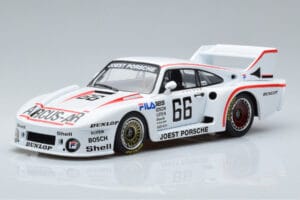
Porsche 935J #66 J. Mass Joest Racing Nurburgring DRM 1981 MCG 1:18
You save 17.00 €
Lowest price in the 30 days before the reduction: 61.00 €
VAT included
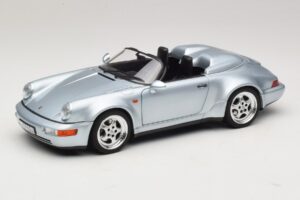
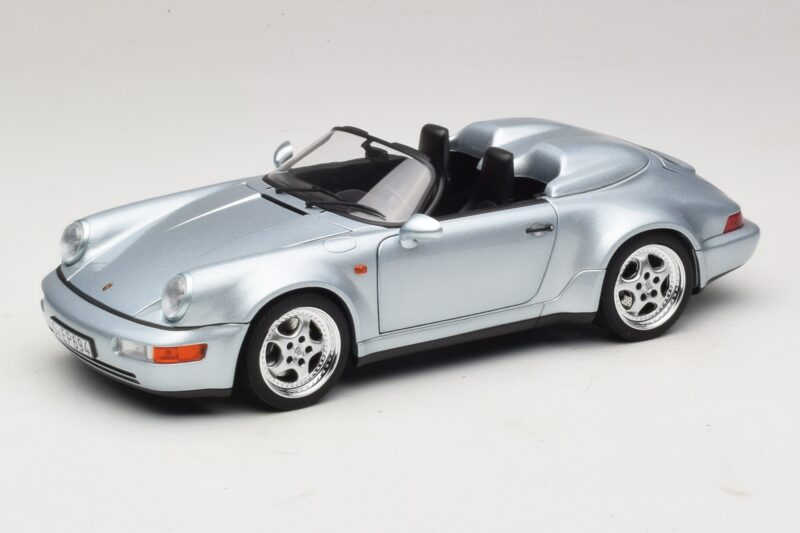
TL;DR: The Norev Porsche 911 964 Speedster WTL 1:18 is a zinc-alloy diecast of the 1993 open-top Porsche, finished in Polar Silver Metallic and built with moving panels. Its low windscreen and Turbo-look WTL bodywork set it apart from standard 964 cabriolets, making it a distinctive air-cooled addition to a Porsche 911 shelf.
Porsche called it a Speedster, and the name carries weight. The Norev Porsche 911 964 Speedster 1:18 revives a body style that goes back to the 1950s, with a windscreen raked low enough to look slightly sinister and a rear cover that hides the seats behind two humps. In Polar Silver Metallic it reads clean, almost understated.
Few Porsches pack as much character into so little roof. The 964 generation, built from the late 1980s into the mid-1990s, modernized the 911 platform while keeping the air-cooled engine, and the Speedster was its most playful variation.
The first Porsche Speedster was a stripped, lightweight 356 of the 1950s, sold to buyers who wanted a simple open car. The idea returned on the 964 in the early 1990s, built on the Carrera 2 with a manual folding top, a low windscreen and a tonneau-style rear cover. It was a fair-weather car by design, and that shapes how the model should look: a long, low profile with the roofline cut down compared with the standard cabriolet.
WTL stands for Werks Turbo Look, the factory option that gave the car a wider body with flared rear haunches in the style of the 911 Turbo. Beneath that bodywork the engine remained the air-cooled flat-six of the regular 964, so the look promised more than the badge delivered, a quirk collectors now treat as part of the charm. On the model, the wider rear is the first thing to check. The hips should bulge convincingly over the rear wheels, giving the broad, planted stance that separates a WTL from a narrower Carrera cabriolet.
Polar Silver Metallic is a pale, cool metallic that rewards a metal body. Paint on zinc alloy sits on a hard, dense shell, so the gloss tends to look even and the flake stays fine instead of blotchy. Under a lamp, silver shows form better than almost any color: the Speedster's shoulder line, the flared arches and the hump behind the seats all pick up gradient light. It also hides dust better than black. The weight in the hand, cool and dense, confirms the metal construction before you look at anything else.
This model is built with moving panels, so it behaves like a handled piece rather than a sealed display body. An open-top car also leaves its cabin in plain view, which raises the stakes on seat shape, dashboard and steering wheel detail. Hinge clearances on diecast mean slightly wider gaps than a sealed resin version would hold, and the panels reward slow, gentle movement. If you collect to study cars, that interaction is a real advantage. If you collect to admire surfaces, it is a modest compromise.
Open-top cars live on their glasswork. Start at the windscreen: on the real Speedster it is cut down and raked back sharply, which gives the car its low profile, and a model that stands the glass too upright loses the whole character. Next, follow the line from the doors to the tail, where the two humps of the rear cover should rise smoothly from the beltline and meet the rear deck without a hard step. Check the Turbo-look rear: the arches should flare visibly wider than the front, and the rear wheels should fill them without a large gap. In silver, those curves read through gradient light, so use a single lamp from above and slightly behind, and watch how highlights travel from the shoulder into the haunch. Smooth, uninterrupted gradients mean good tooling. Choppy ones point to sloppy casting. Inside, look at the shape of the seats and steering wheel, since nothing hides them, and make sure nothing looks oversized for 1:18. Wheels and tires should show crisp spokes and sidewall lettering, and the Porsche crest at the nose should be clean and legible. Take your time here; small things decide the whole impression.
At roughly 24 centimeters in length at 1:18, the Speedster fits easily in a standard display cabinet and works well beside other 911 generations. A run that moves from the early long-hood cars through the air-cooled 964 to later water-cooled generations shows how the formula evolved, and the Speedster is the playful interlude in that sequence. American collectors who focus on Porsche as a marque will see it as the specialty piece among 911 variants. Set expectations accurately: this is production-run diecast with moving panels, not hand-built resin, so surface precision is good for its class rather than extreme. The reward is metal weight, a clean silver finish and a model that can be handled. For buyers comparing 964 variants before they order, the WTL bodywork is the deciding detail, since it separates this model from any standard cabriolet on the shelf.