Used
Porsche 911 997 GT3 Cup #124 Mattheus / Geoffroy / Vanbellingen / Fumal 24 Hours of Spa 2005 Minichamps 1:43
Only 3 left
Price:
33.00 €
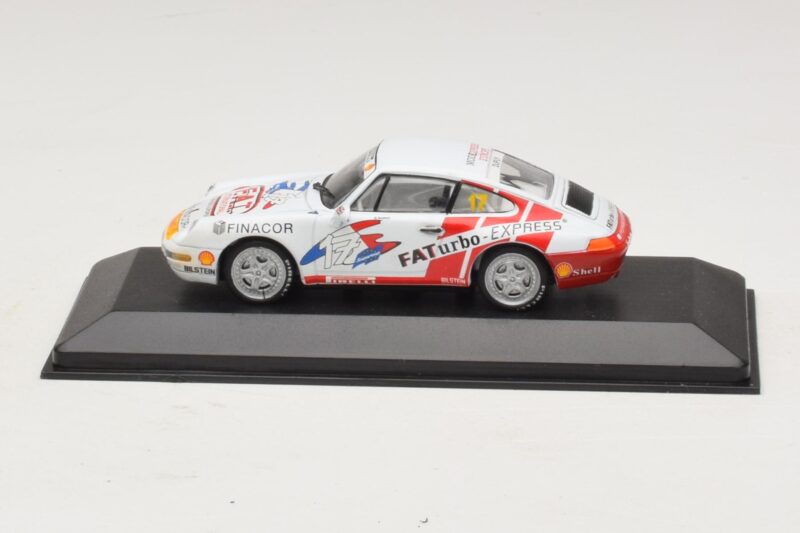
TL;DR: Minichamps' 1:43 Porsche 911 993 Cup 3.8 reproduces car #17, Dupuy's FATurbo Express entry from the 1994 one-make cup racing season. The sealed diecast body carries the 993 Cup's flared arches and fixed rear wing in tight, tampo-printed sponsor livery.
Porsche's one-make Cup series has run continuously since the mid-1980s, turning the 911 into a genuine spec racer decade after decade. Minichamps captures this 993-generation Cup 3.8 as it raced in 1994, sponsor decals and racing number rendered on a sealed body built for grid-lineup display rather than handling.
This 993 Cup 3.8 is cast as a single fixed shell in zinc alloy, and the construction suits a one-make racer well, since every car on a Carrera Cup grid shares the same body regardless of team, which puts the entire burden of differentiation on livery execution. The FATurbo Express sponsor decals and car #17's number graphics are tampo-printed directly onto the shell, holding flat, sharp edges that a raised sticker application would not achieve at this scale. The 993 Cup's flared arches, widened to clear the racing tires the class required, and the fixed rear wing, mounted higher and more aggressively than a road-going 993's factory wing, are captured as distinct cast features that separate this car's silhouette from a standard street 911 of the same generation. Because Cup cars are built for stripped-down racing rather than road use, the sealed body actually mirrors reality more closely than an opening-panel casting would, since a genuine Cup car's doors were often welded or heavily reinforced rather than fully functional the way a road car's are. Wheel and brake detail is simplified at 1:43 relative to what a 1:18 casting could show, an honest trade for the smaller footprint, but the ride height and wheel arch relationship read correctly, giving the car the low, purposeful stance a genuine racing 911 should have. For a one-make Cup subject, that combination of accurate livery and correct stance is exactly what separates a serious casting from a generic 911 wearing race numbers.
The 993 was the last air-cooled Porsche 911 generation, produced through the mid-to-late 1990s before Porsche moved to water-cooled engines with the following 996 generation, which gives any 993-based racing car a particular significance among Porsche enthusiasts as a representative of the final chapter of a defining engineering approach. Porsche's Carrera Cup, the one-make series this car raced in, exists specifically to let drivers compete in identically prepared 911s, removing most mechanical variables so that racecraft and driver skill decide results rather than budget differences between teams. That format has made the Cup series a genuine proving ground for drivers moving toward higher levels of motorsport, and it has run in various national and international forms continuously since the mid-1980s. Car #17's FATurbo Express livery represents a single team and sponsor combination from the 1994 season, one entry among a competitive field rather than a standout championship result, and that honesty matters: this is a genuine competitor's livery, not a manufactured highlight. For American collectors, Porsche Cup racing carries less mainstream recognition than IMSA sports car racing or NASCAR, but it represents an important, continuously running part of Porsche's global motorsport identity, built on strict mechanical parity rather than open development.
At 1:43, this 993 Cup 3.8 works well as a supporting piece in a broader Porsche 911 racing collection, sitting naturally beside other Cup liveries or alongside road-going 993s to show the contrast between street and race preparation. Its sealed body keeps the price accessible relative to opening-panel models, a sensible trade for a subject whose entire identity is livery and stance rather than mechanical detail hidden from view. Collectors tracing the air-cooled 911's final generation, or the Carrera Cup's long competitive history, will find this a genuine, honestly represented entry rather than a manufactured highlight reel piece. The FATurbo Express branding also gives it a distinctive identity among the many similarly liveried Cup cars from the same era.