On sale:
-5%
New arrival
Pre-order
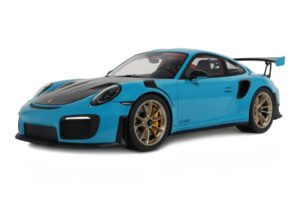
Porsche 911 991.2 GT2 RS Miami Blue GT Spirit 1:12
Expected 04-14.11.2026
Limited slots
Price:
was
210.00 €
200.00 €
You save 10.00 €
This model is currently sold out. Enter your email and we'll let you know when it's back in stock.
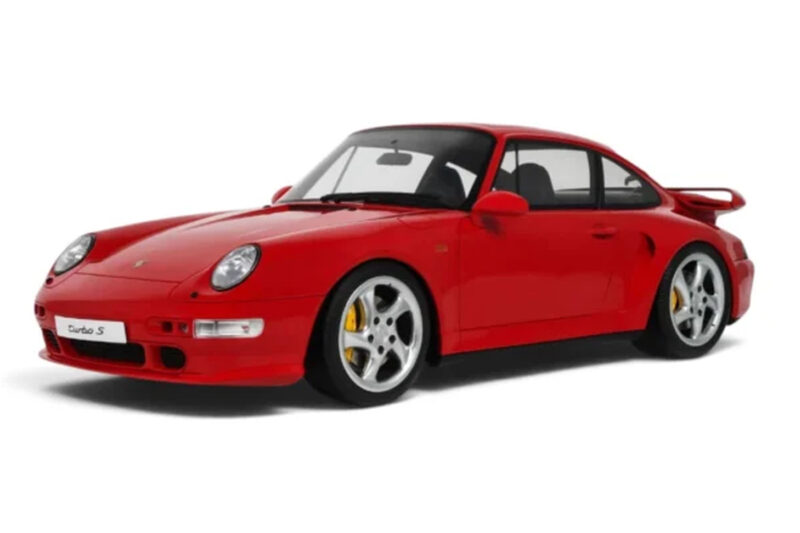
TL;DR: GT Spirit's 1:12 resin Porsche 911 993 Turbo S reproduces the 1997 coupe in Indian Red, built as a sealed one-piece body. The larger 1:12 scale gives the last air-cooled Turbo's flared arches and twin-turbo aero genuine physical presence, with no panels articulating on this casting.
The 993 was the final Porsche 911 generation built with an air-cooled engine before the water-cooled 996 arrived, and the Turbo S sat at the very top of that lineup. GT Spirit's 1:12 resin coupe in Indian Red renders that last-of-its-kind status at a scale large enough to actually study.
Porsche introduced the 993 generation in 1994 with a completely new multi-link rear suspension that finally tamed the trailing-arm 911's reputation for snap oversteer, and it remained air-cooled throughout its run before Porsche switched to water cooling for good with the 996. The Turbo S variant, arriving toward the end of that production run, paired a twin-turbocharged 3.6-liter flat-six with widened rear arches and Porsche's fixed rear wing, marking the final and most powerful expression of an air-cooled Turbo before the format disappeared from the lineup entirely.
Porsche offered Indian Red through its special-order color program during this era, a shade that stood apart from the more common Guards Red and Grand Prix White that dominated 911 sales sheets. Choosing that color on a real 993 was a deliberate way to stand out, and the same logic applies to picking it for a scale reproduction.
At 1:12, the 993's compact coupe dimensions come out to roughly 40 centimeters long, nearly twice the footprint of the same car at 1:18, and that extra size lets GT Spirit render the Turbo S's widened rear arches, the fixed rear wing's mounting points and the smooth, rounded surfacing that defined the 993's body language with far more clarity than a smaller scale allows. Resin handles that kind of rounded, low-drama bodywork cleanly, holding smooth surface transitions without the mold lines a die can sometimes leave on curved panels.
No panel opens on this casting. Doors, hood and the rear decklid are sealed as part of a single-piece body, which puts the entire weight of the model's quality on its exterior: how consistently the panel gaps run, how the wing sits relative to the deck, and how the paint carries across those smooth transitions. Removing hinge tolerances is exactly what allows a resin body at this scale to hold tighter, more continuous lines than an equivalent casting built to open would manage.
Indian Red reads as a warm, slightly muted red rather than the brighter fire-engine tone of Guards Red, and on a resin body that distinction shows clearly under a directed lamp, where the metallic-free finish holds an even, deep gloss across the 993's rounded fenders. The widened arches sit noticeably proud of the standard body at this scale, and the fixed wing's angle relative to the rear glass is one of the first details a Porsche-literate collector checks for accuracy on any Turbo S reproduction. GT Spirit's resin pricing at 1:12 sits in the mid-tier range for the hobby, a reflection of the larger casting and hand-applied paintwork rather than tooled mass production. For a collector comparing scales, the trade is straightforward: 1:18 offers a broader Porsche lineup at a lower unit cost, while 1:12 sacrifices breadth for the kind of physical presence that makes the 993's widebody arches genuinely readable from across a room.
Placed beside a water-cooled 996 Turbo, this 993 marks the exact point where Porsche's engineering philosophy changed for good, and doing that comparison at 1:12 rather than a smaller scale makes the visual differences between the two eras far easier to see. For an air-cooled 911 collection, an Indian Red Turbo S is a distinctive way to close out that chapter.
You save 10.00 €

You save 10.00 €