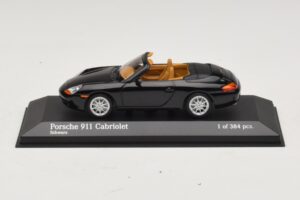
Used
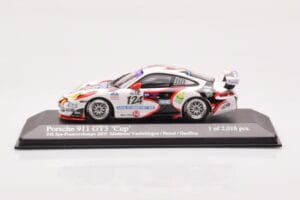
Porsche 911 997 GT3 Cup #124 Mattheus / Geoffroy / Vanbellingen / Fumal 24 Hours of Spa 2005 Minichamps 1:43
Only 3 left
Price:
33.00 €
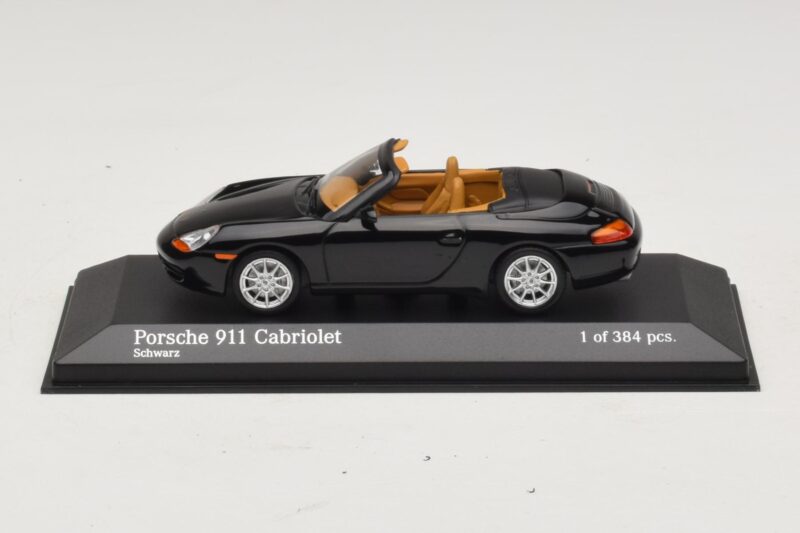
TL;DR: Minichamps' 1:43 diecast reproduces the 1998 Porsche 911 996 Cabriolet in Black Metallic, the first water-cooled 911 convertible. The body is a sealed one-piece casting with a molded glass rear window and deep gloss paint over a metal shell. A compact anchor piece for a shelf tracing 911 generations across decades.
The 996 marked Porsche's most contentious 911 transition: out went four decades of air-cooled engineering, in came water cooling, a shared headlight design with the Boxster, and a new debate among purists that still surfaces at car shows today. This Cabriolet variant, finished in Black Metallic, sits at the center of that argument in miniature.
Porsche introduced the 996 in 1997 as the first 911 built around a water-cooled engine, ending an air-cooled lineage that stretched back to the original 1963 car. The shift freed engineers to meet tightening emissions and noise regulations while improving cooling consistency, but it also meant the 996 shared its headlight units with the contemporary Boxster, a cost-saving decision that drew criticism from longtime owners who wanted their flagship model visually distinct from Porsche's entry-level roadster. The Cabriolet variant added a folding soft top and, for the first time on an open 911, a glass rear window rather than the flexible plastic panel earlier convertibles used, a detail that improved rear visibility and resisted yellowing with age.
Building a 911 without a fixed roof demands additional chassis bracing to recover the rigidity a coupe's roofline provides for free, and the 996 Cabriolet carried that reinforcement beneath its folding top. Black Metallic was one of the more restrained color choices Porsche offered on the 996, favored by buyers who wanted the car's shape to do the talking rather than a bright hue. On a diecast replica, a dark metallic finish is also the hardest to get right: flat black hides panel lines that lighter colors would reveal, so achieving a slight metallic sparkle without losing that depth takes careful pigment work in the paint booth.
This model has no opening parts. Doors, trunk lid, and the folding-top compartment are all cast into a single metal shell, a construction choice increasingly common on 1:43 diecast, where mechanisms for moving panels would eat into the tight tolerances the scale can hold. A sealed body lets Minichamps focus every bit of casting precision on the exterior instead of on hinges a collector would rarely open anyway. Run a fingernail along the door line and it tracks as one continuous groove, with no seam gap wide enough to catch a nail edge, the kind of tight, consistent shutline a fixed body can hold that an articulated one has to compromise on.
Zinc alloy diecast brings real heft for a model this size, and that density is the first thing a buyer notices lifting it from its packaging. The Black Metallic paint sits on a hard metal shell, so under a display lamp the gloss reads deep and even rather than flat, with just enough metallic flake visible up close to distinguish it from a plain black. The molded rear glass sits flush against its surround, the taillamp lenses carry the correct 996-era lens shape, and the wheel design matches the factory alloy pattern offered on Cabriolet models that year. At 1:43, that level of correct detail matters more than raw size.
At roughly 10cm long, this Cabriolet occupies a fraction of the shelf space a 1:18 model would need, which is exactly why 1:43 remains the scale of choice for collectors trying to cover the 911's full generational span, from earliest air-cooled cars through the 996, 997, and beyond, without running out of cabinet room. Displayed next to a 996 Coupe or an earlier 993, the differences in headlight shape and roofline become obvious side by side in a way spec sheets never quite convey. Black Metallic works particularly well as an anchor color in a mixed lineup, since it won't clash with brighter cars placed nearby. For collectors building that kind of generational run, this piece earns its place less through drama than through completeness.