Used
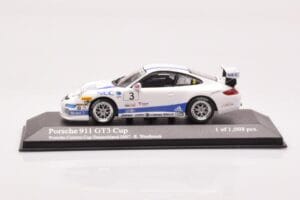
Porsche 911 997 GT3 Cup #124 Mattheus / Geoffroy / Vanbellingen / Fumal 24 Hours of Spa 2005 Minichamps 1:43
Only 3 left
Price:
33.00 €
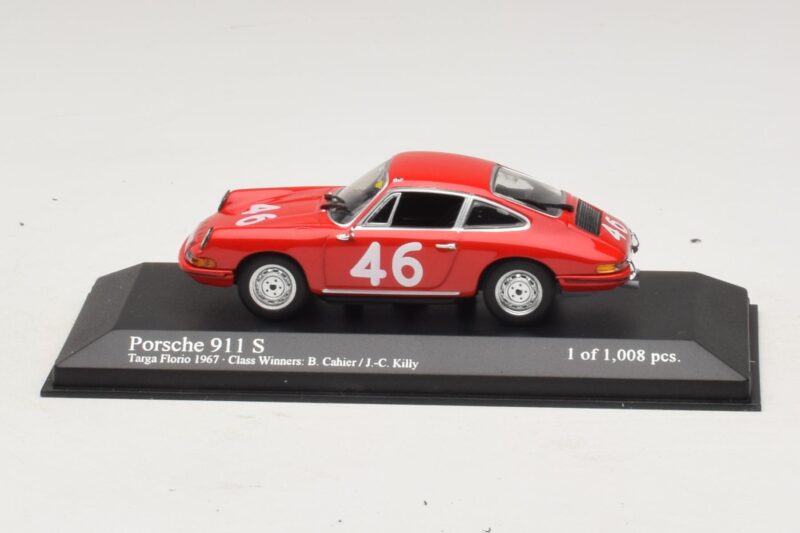
TL;DR: Minichamps' 1:43 diecast Porsche 911 S reproduces the #46 car that won its class at the 1967 Targa Florio, driven by Bernard Cahier and Jean-Claude Killy. The sealed one-piece body carries the race livery's number panels and period-correct wheels, documenting an early 911 competing on Sicily's brutal public-road circuit.
The Targa Florio ran on ordinary Sicilian mountain roads, closed to traffic but never tamed into a proper circuit, and it punished cars that couldn't handle a full lap of blind crests and unmarked drops. A production-based 911 S taking a class win there says as much about the car's fundamental toughness as any closed-circuit result could. Minichamps captures that entry at 1:43.
With the body cast as one sealed piece, the #46 livery's number panels sit on a continuous surface with no door seam interrupting the graphics, a small but real advantage for a racing casting built around bold, simple markings rather than complex sponsor artwork. The white number circles hold sharp edges against the body color, and the door and hood shutlines run in even, consistent grooves that a hinged assembly at this scale would struggle to match. For a road-race livery whose whole visual identity is a number and a stripe, that clean, uninterrupted surface is exactly what the design needs.
The 911 S wears the narrower steel wheels period 911s actually raced on, rather than the wider alloy look sometimes substituted on generic vintage racing castings, and the tire sidewalls carry a proportion that keeps the stance low and correct for a 1960s road car. Headlight covers, a common addition for endurance-style events run partly at night or in dust, are picked out where the real car carried them. The number panel placement follows period photographs rather than a generic rally-number template, positioned on the door and roof in the spots period scrutineers actually required. Those specifics matter to anyone building a serious early-911 racing display.
The Targa Florio's Piccolo Madonie circuit ran for over forty miles through Sicilian mountain villages, using public roads that stayed rough, narrow, and largely unmarked between corners. Cars needed real suspension travel and genuine mechanical reliability to survive a full lap, let alone the multiple laps a full race demanded, which made it a fundamentally different test than a smooth, purpose-built racetrack. Porsche's 911 S, essentially a well-sorted production sports car with modest tuning, was suited to exactly that kind of punishment in a way many purpose-built racing cars of the era were not, favoring durability over outright peak speed.
Bernard Cahier, better known within motorsport circles as a journalist and photographer with close access to the era's top teams, shared this 911 S with Jean-Claude Killy, whose fame came from an entirely different sport before he turned to competitive driving. Their class win at the 1967 Targa Florio is a reminder that this event drew a genuinely mixed field, from committed factory efforts to well-connected amateurs running competitive machinery. That kind of result, a class victory rather than an outright win, is exactly the sort of documented, checkable history that gives a small-scale racing casting real substance beyond its paint scheme.
Early 911 racing history gets overshadowed by the 917s and 956s that followed it, but cars like this #46 entry are where Porsche's competition reputation actually started building. At 1:43, a Targa Florio entry pairs naturally with other 1960s road-race castings, from Le Mans GT entries to rally-liveried coupes, letting a collector build a decade-specific shelf without the larger footprint 1:18 prototypes demand. This is a subject for someone interested in Porsche's competition roots rather than its most famous racing machinery. That honesty is part of what makes it worth including.