Used
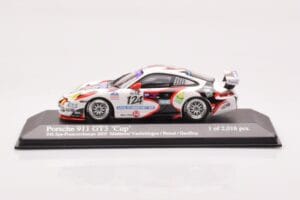
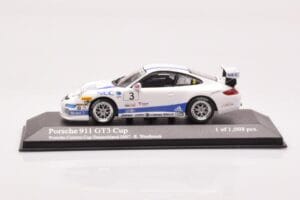
Porsche 911 997 GT3 Cup #124 Mattheus / Geoffroy / Vanbellingen / Fumal 24 Hours of Spa 2005 Minichamps 1:43
Only 2 left
Price:
33.00 €
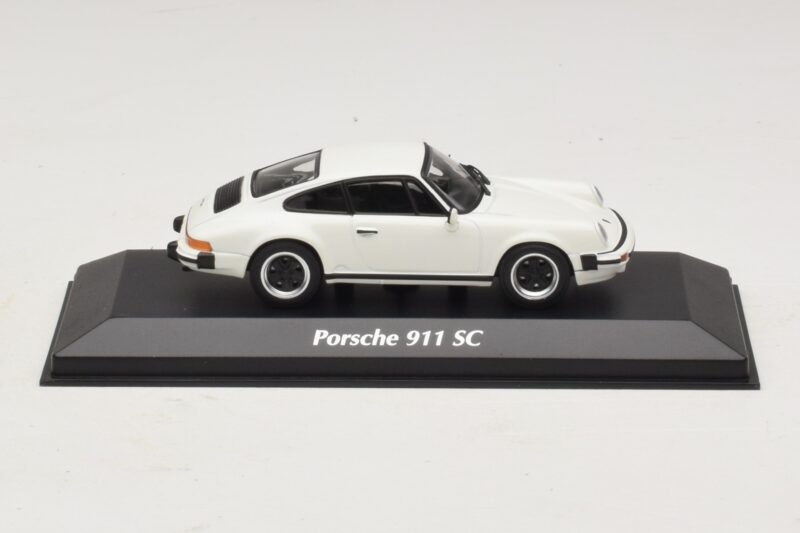
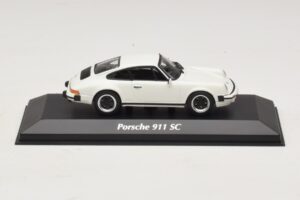
TL;DR: The Maxichamps Porsche 911 SC White 1:43 is a diecast coupe of the 1979 model year with a fixed one-piece body. White paint exposes every panel line and the casting's stance, so the exterior detail carries the model. It suits air-cooled 911 collectors building a 1970s Porsche shelf at a compact scale.
White is the unforgiving color in 1:43. Nothing hides: a wavy shoulder, a thick window frame, a soft badge all show. Porsche's 911 SC arrived in the late 1970s as the rear-engined coupe's refined evolution, and Maxichamps casts it in diecast. Here is what to look at before it goes on the shelf.
White diecast is a test the manufacturer cannot hide from. Paint on a hard metal shell goes down smooth and even, and the pale finish throws light across every curve, so the fender crowns, the roof's slope toward the tail and the shape of the bumpers read plainly. Under a shelf lamp a dip or ripple shows as a shadow. On a well-cast body the highlights run clean from fender to door to quarter panel. Black trim and chrome stand out sharply against white, which makes window surrounds, door handles and bumper edges easy to judge. Check the glass-to-body edges first. Crisp, even borders there usually mean careful assembly everywhere else.
The body is a single casting with nothing that opens, a normal construction at 1:43 and the reason the panel lines stay so uniform. Slide a fingertip along a door line and it glides without catching. With no hinge clearance to allow for, the cuts can hold the same width from one end to the other, and the paint can flow across the whole shell as one surface. Weight is the other giveaway. Lifted from its case, the model has the cool, dense heft of metal, steady enough to sit planted on a glass shelf. Buyers who prize interior access should look elsewhere; those who value surface precision at this size get exactly that.
Porsche introduced the 911 SC in 1978 and built it through 1983, when the Carrera 3.2 took over. Under the rear deck sat a 3.0-liter air-cooled flat-six behind the rear axle, and by then the shell was galvanized steel, a durability decision that helped these cars survive decades of use. The impact bumpers with folding bellows, introduced for American safety rules and carried across the range, give the SC a heavier nose and tail than the earlier long-hood cars. That is the first detail to check on the model: bumper height, the depth of the bellows and how low the nose sits set the 1970s character more than any badge does.
Collectors tracing the 1970s 911 usually park the SC beside the 930 Turbo, which shares the silhouette but adds wide rear hips. At 1:43 the SC is the narrower, quieter shape, and that contrast is exactly why the pair works on one shelf. The SC was the volume car of the range, the one most owners really drove, so a white example speaks for the everyday end of the family while the Turbo marks its extreme. Neither needs the other to make sense, though together they explain how far the same basic body was stretched in a single decade.
At 1:43 a 911 coupe is small enough that a cabinet shelf holds a full run of them with room to spare, so spacing and backdrop do the work. A dark background makes white read cleanly; a pale one washes the body lines out. Keep the lighting indirect and slightly angled, which shows the paint's surface without hot glare, and dust the casting with a soft brush rather than a cloth. Pair it with the red SC in this series to compare how color changes the way a body shape reads, or with a Turbo for the family contrast. For hobbyists who want a compact, honest 1970s 911 at an accessible price tier, the white SC is an easy order to justify.