Used

Porsche 911 997 GT3 Cup #124 Mattheus / Geoffroy / Vanbellingen / Fumal 24 Hours of Spa 2005 Minichamps 1:43
Only 3 left
Price:
33.00 €
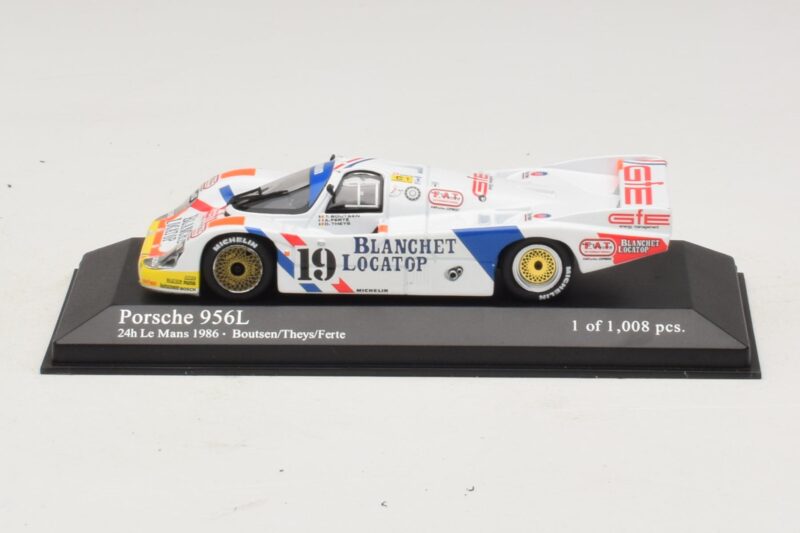
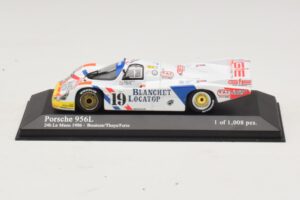
TL;DR: Minichamps' 1:43 diecast Porsche 956L reproduces the #19 long-tail Group C prototype Thierry Boutsen and Didier Theys campaigned at the 1986 24 Hours of Le Mans. The sealed one-piece body captures the Langheck aero package's stretched tail, wing detail, and livery registration from Porsche's dominant Group C era.
Porsche's 956 spent much of the mid-1980s as the car everyone else in Group C was racing against, and the long-tail Langheck version built specifically for Le Mans's long Mulsanne straight represents the model at its most purpose-built. Minichamps renders the #19 entry Boutsen and Theys drove in 1986 at 1:43, a compact way to hold a genuinely dominant era of sports car racing.
The 956L's stretched tail section is the single most identifiable feature separating it from the standard-wheelbase 956, and Minichamps captures that elongated rear deck and lower drag profile as a single sealed casting with no opening panels to interrupt its lines. The extended bodywork tapers smoothly into the rear wing mounts, and the shutlines along the cockpit surround and engine cover run as clean, continuous grooves rather than the slightly stepped look a hinged casting can introduce on curved surfaces like this. For a shape defined almost entirely by aerodynamic proportion, that unbroken surface is exactly the right construction choice.
The #19 livery's sponsor decals and number panels sit in sharp registration across the body's curves, holding their edges even where the surface changes angle sharply around the sidepods. The rear wing carries the correct period profile for the Langheck package, mounted lower and angled differently than the standard 956's wing to manage the trade-off between drag and downforce a long-tail car demanded. Wheels carry the correct period tire proportion and center-lock detail Group C prototypes actually used, sitting low in the arches to match the real car's ground-hugging stance. It is a small casting representing a genuinely specialized piece of racing engineering.
Porsche built the Langheck version of the 956 specifically to cut drag on Le Mans's Mulsanne straight, then several miles long and largely uninterrupted, where top speed mattered more than the cornering grip a shorter tail provided at other circuits. That specialization is a good example of how seriously Porsche approached Group C: rather than running one generic aerodynamic package everywhere, the team built dedicated bodywork for Le Mans and reverted to the standard tail for tighter tracks. The 956 and its 962 successor went on to dominate sports car racing through most of the 1980s, and the long-tail Le Mans cars were the most specialized expression of that program.
Thierry Boutsen brought Formula 1-level experience to sports car racing during the mid-1980s, a period when several grand prix drivers supplemented their championship campaigns with high-profile endurance outings. Didier Theys built a long career specifically within sports car racing rather than treating it as a side project, giving the pairing a useful mix of raw single-seater pace and dedicated endurance racecraft. Their #19 entry in the 1986 race represents one of many strong privateer and factory-supported efforts fielding 956s and 962s that season, part of the depth of competition that made Group C's mid-1980s era so consistently competitive.
Group C defined sports car racing's aesthetic through most of the 1980s, and a 956L is close to the era's defining shape: low, wide, and stretched for top speed in a way no modern LMP or hypercar racer quite replicates. At 1:43, several Group C prototypes fit along one shelf run without the space demands larger-scale castings require, letting a collector assemble an entire era's grid. This particular livery pairs naturally with other mid-1980s Porsche prototype entries, building toward a display that traces the 956 and 962's run of dominance year by year.