Used
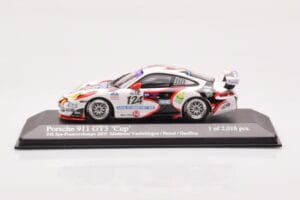
Porsche 911 997 GT3 Cup #124 Mattheus / Geoffroy / Vanbellingen / Fumal 24 Hours of Spa 2005 Minichamps 1:43
Only 3 left
Price:
33.00 €
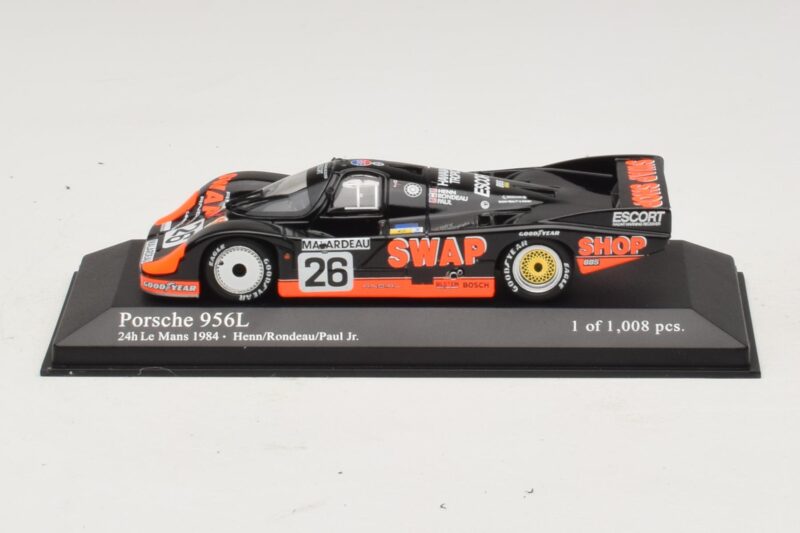
TL;DR: Minichamps' 1:43 diecast Porsche 956L reproduces the #26 T-Bird Swap Shop entry Preston Henn and Jean Rondeau ran at the 1984 24 Hours of Le Mans. The sealed one-piece body carries the American privateer team's distinctive livery across the long-tail bodywork, an alternative to the factory liveries that usually dominate Group C shelves.
Not every strong Le Mans entry came from a factory works team, and Preston Henn's Swap Shop operation is one of the era's better-known American exceptions. Henn, who built his fortune running a flea market business in Florida, funded a genuinely competitive Porsche prototype effort through much of the early 1980s. Minichamps captures the #26 car he shared with Jean Rondeau at 1:43.
The Swap Shop livery's bold color scheme sits on a single sealed casting with no doors or hood that open, and that continuous surface serves the design well: the paint transitions and sponsor lettering wrap around the body without a shutline breaking up the graphics mid-panel. Minichamps holds the color separation sharp where one paint block meets another, a genuine test for any livery built around broad, saturated color fields rather than thin pinstripes. The number 26 sits correctly sized on the door and nose, legible at a glance rather than shrunk down to the point of needing a magnifier to read.
Like its factory-liveried siblings, this 956 wears the stretched Langheck tail section built for Le Mans's long straight, and the casting keeps that extended rear deck's proportions consistent with standard-wheelbase 956 models elsewhere in a collection. The rear wing and underbody detail follow the same period-correct profile Porsche's works cars carried that season, since Group C's private teams generally ran factory-supplied or factory-derived chassis rather than independently engineered ones. Wheels sit low in the arches with the correct center-lock hubs, and the tire sidewall proportion keeps the stance grounded rather than looking inflated for visibility.
Preston Henn ran his Swap Shop flea market business in Fort Lauderdale, Florida, and used its profile to fund a genuinely serious sports car racing effort rather than a hobby-level entry. His team fielded Porsche prototypes at Le Mans across several seasons during Group C's peak years, competing directly against factory-backed Rothmans and works efforts with a fraction of their resources. That kind of American privateer program, funded by a domestic business rather than a motorsport sponsor or manufacturer budget, was relatively rare at Le Mans's top level, and it gives this particular 956 a story distinct from the factory cars it lined up against on the grid.
Jean Rondeau remains the only driver to win the 24 Hours of Le Mans in a car bearing his own name, having built and raced his own Rondeau chassis to victory in 1980 before later seasons found him behind the wheel of cars like this Swap Shop-liveried 956. That background gave him a rare depth of understanding of the Circuit de la Sarthe's demands, both as a constructor and as a racer, and pairing that experience with Henn's well-funded privateer effort made the #26 car a genuinely competitive entry rather than a backmarker with a colorful paint scheme.
Group C shelves tend to fill up quickly with Rothmans-liveried works Porsches, and a Swap Shop entry offers a genuinely different visual and historical angle within the same era. It represents the privateer side of endurance racing, where a business owner's ambition and a champion driver's experience combined to run seriously against factory-funded competition. At 1:43, it sits comfortably alongside other 956 and 962 liveries from the period, adding contrast rather than repetition to a Group C display worth building around variety, not just factory winners.